The useful thing about a bad calculator is that it leaves a precise bruise. It does not ruin your week. It merely asks for your income, your down payment and perhaps a slice of your patience, then returns a number as if arithmetic were the same as advice. Matthew Covi met that particular species of disappointment while he and his wife were shopping for their first home. The tools on their bank's website looked, in his later description, like Windows 98. They could compute. They could not help.
Covi had spent his career learning to notice what sits behind a click. He worked through digital analytics, search strategy and marketing roles at Syndicate Media, Converseon, Reprise Media and NewsCred, then became Head of Growth at Stash. The résumé has a tidy upward slope, but the more interesting continuity is behavioral. Search data is full of disguised questions. A person typing “mortgage calculator” is not studying multiplication. They are standing near a decision and trying to make the uncertainty smaller.
That distinction became the seed of Chimney. Covi co-founded the company with Chase Neinken and Ryan Salerno, first operating under the name Signal Intent. The early product was proudly practical: financial calculators that banks and credit unions could embed on their own sites. They were designed to answer a question, capture intent and lead naturally toward the relevant account or loan. The website, Covi would say, “has become the new branch.” His wager was that the branch ought to be useful after closing time.
A calculator is a confession with numbers
Fintech often arrives wearing revolutionary trousers. Chimney began with a widget. This was commercially shrewd. Banks already had customers, trust, websites and compliance departments. What many lacked was a modern answer at the exact moment someone asked, Can I afford this? Covi did not need to persuade consumers to adopt another finance app. Chimney could improve the room behind a door millions of people already used.
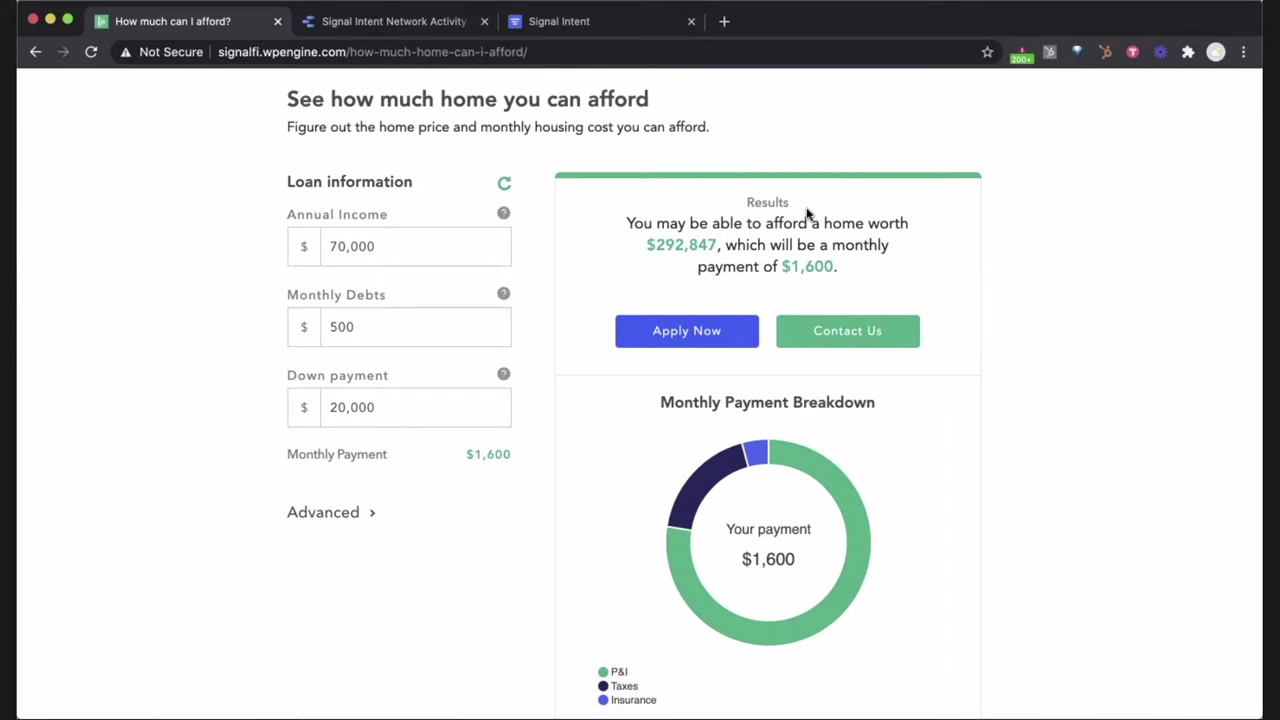
The approach won Best of Show at FinovateSpring in 2021. That year Covi was also named a Lending Luminary by PROGRESS in Lending Association. Neither recognition changed the nature of the product. The calculator remained a small, almost comically ordinary object. Its power came from timing. Covi said users who visited one were seven times more likely to continue to an application than other visitors. The number on the screen mattered, but the revealed intention mattered too.
A payment, savings goal, borrowing estimate or affordability range.
A customer close enough to a decision to ask a specific question.
This was Covi's marketing background becoming product architecture. SEO had taught him how questions travel. Stash had shown him what an entirely digital financial relationship could feel like. Chimney joined the lessons: meet the question inside a trusted channel, give a lucid answer, then make the next step obvious. The software was business-to-business; the test of it remained stubbornly human.
“We really see financial guidance as education within the context of making a decision.”
Matthew Covi, Banking Transformed
Debt in one app, possibility in another
Then Covi became the customer again. He and his wife spent a year searching for their first home, followed by a six-month renovation. The costs required a home-equity line of credit. The application took eight weeks. Nothing in that sentence sounds like software until you consider how many screens, forms, estimates and silences can fit inside eight weeks.
He noticed an even cleaner contrast. In his banking app, the house appeared as mortgage debt and an autopay date. On Zillow, the same property appeared as something that had appreciated, an asset with growing equity. One screen recorded the obligation. The other rewarded curiosity. The house had not moved an inch, yet the interface changed its meaning.
Chimney Home grew out of that mismatch. Embedded in a banking app, it could show an estimated home value, equity, borrowing power and offers shaped by the financial institution's own lending rules. It gave the bank something useful to say between transactions. For the homeowner, it replaced a static balance with a live financial picture. For the institution, it created a chance to arrive before the customer had already wandered elsewhere for the next loan.
At an early client, Covi said 20 percent of eligible homeowners enrolled during the first 90 days, while related emails reached 75 percent open rates. Those figures are less a referendum on email than on appetite. People will return for information about the largest asset many of them own. A monthly home-value update has rather more narrative tension than a checking balance that changed because somebody bought lunch.
The company kept widening the machinery beneath that experience. Property records, valuation models, mortgage information and other data could help a financial institution understand when refinancing or equity might be relevant. Chimney later launched Property Intelligence to surface lending opportunities before an application arrived. The calculator had become a listening device, and the home dashboard had become a relationship layer.
Useful before dazzling
Covi's public language returns repeatedly to implementation. A calculator could technically go live in minutes; a normal client launch took around two weeks. Chimney Home could be configured in roughly six. He spoke about institutions with competing priorities and made room for the obvious truth that a missing CRM might outrank his own product. There is an operator's discipline in admitting that your software lives on somebody else's list.
That restraint also clarifies Chimney's distribution strategy. The company partnered with digital-banking platforms and sold through channels that could place the tools in many institutions. Community banks and credit unions did not need to assemble property feeds, design an interface and orchestrate campaigns from scratch. Chimney packaged the difficult middle. Smaller institutions could launch the experience; larger ones could use APIs and data endpoints to extend it.
The model earned a second Finovate Best of Show award in 2023. By the end of 2024, Chimney said it served more than 150 financial institutions and that more than 31 million people had used its calculators during the year. Its own figures had begun to look like the sort of result screen it once set out to improve: comprehensible, useful and pointing toward what came next.
“Building this company has been unlike anything I've experienced.”
Matthew Covi, after the Array acquisition
Five years, then the next screen
In February 2026, Array acquired Chimney. The terms were not disclosed. The fit was legible without them. Array supplies embedded consumer-finance products; Chimney brought calculators, home-value tracking and property intelligence. One company had a broad platform. The other had spent years studying the instant when a vague financial worry becomes a specific question.
Covi wrote that Chimney was profitable and served nearly 200 clients. He thanked the team, customers, partners and investors, and described the deal as a new chapter rather than a curtain call. In the formal announcement, he connected the acquisition to the original mission: helping traditional financial institutions give millions of Americans better, data-driven financial experiences.
There is a pleasing loop to the outcome. Chimney began because an institution's digital tools could not carry a person gracefully through a decision. It grew by embedding better tools inside those institutions. Then it joined a larger embedded-finance platform to distribute them further. The strategy stayed put even as the company around it expanded.
The continuity also explains why the acquisition reads as a fit instead of a detour. Array can place Chimney beside tools for credit, money management, identity and privacy. Covi's team brings the property layer and the decision interface. A homeowner does not experience those categories as an org chart. They experience one evening at a kitchen table, wondering what they can afford and which number to trust. The combined product has to meet that evening.
Covi's story offers no need for founder mythology. It has something more reproducible: attention paid at the correct resolution. Notice the calculator that answers too little. Notice the app that presents an asset only as a debt. Notice the eight weeks where the customer hears almost nothing. Then build close to the irritation, with the people and channels already present.
A chimney, after all, is infrastructure disguised as part of the house. It works best when nobody has to think very hard about it. The name proved apt. Covi and his co-founders built a path for information to move through the financial home. The most important thing was never the pipe. It was what could finally pass through.