The first useful image in Mark Schacknies's career is a line of people standing in the rain. It is late 2005 in Clarendon, Virginia, and the development company where he directs acquisitions is previewing 420 condominiums. Schacknies sees the weather and assumes the party will be a washout. Instead, roughly 4,000 people arrive. The queue overwhelms the entrance. Two-thirds never make it inside. Ten weeks later, every unit is sold.
Then comes the second image: long corridors, few residents and a lockbox on nearly every door. Many buyers had not purchased a home so much as a position. The market looked busy, but the building was quiet. Schacknies would later recall that this was when he knew something was amiss.
Between those two pictures sits an education no business school can package neatly. Demand can be noisy and still be brittle. A transaction is not the same thing as a relationship. And in real estate, where a small army touches every deal, the distance between apparent momentum and useful progress can be measured in paperwork, handoffs and steak dinners.
The connector habit
Schacknies studied finance at George Mason University, then real estate and urban development at George Washington University. By 2008, an industry profile described him as having worked in technology and finance before developing more than $300 million in mixed-use projects. He had learned the physical business - dirt, buildings, capital, buyers - and kept noticing the invisible one: all the people who needed one another but could not easily see one another.
His answer was MyDealBook.com, co-founded with Ryan Slack and Nima Negahban. It tried to combine a professional network with a record of who had done what on a property. Click a deal, Schacknies explained, and find the financier, architect and development sponsor. The irritation underneath the pitch was gloriously mundane: gathering those names through phone calls and scattered searches was “not a productive use of anyone's time.”
The recurring Schacknies loop
The site launched with the inherited reach of PropertyShark, roughly 330,000 to 350,000 accounts. At a New York gathering that autumn, the founders of this digital network manned the name-tag table. There is something apt about that scene. For all the software's ambition, the real work was still helping actual people find one another in a room.
Schacknies kept one foot in physical development. In 2016, as founder of Banyan Development Co., he described a five-home project in Seven Corners, Virginia. The arrangement with the longtime landowner was a joint venture: land went in, a share of future profits came back. Even a small subdivision was a network of aligned incentives.
A platform with a constituency
That same year, Schacknies, Jonathan Spinetto and Leo Pareja founded the company that became Remine. They came from real estate and shared a frustration with the number of applications needed to piece together a transaction. Remine launched in 2017 and placed the multiple listing service, or MLS, at the center of its strategy.
This was an important choice. A platform is an abstract noun until it has a constituency. Remine's constituency was the network that real estate professionals already used to cooperate and compete. In 2019, when Schacknies moved from CFO to CEO, he wrote about an ambitious marketplace where people could buy, sell, rent and get loans. His argument was that the MLS could be the connective tissue.
By 2020, the company said more than one million professionals subscribed through their MLS or Realtor association. Growth did not spare it from hard arithmetic. Remine doubled revenue from 2018 to 2019 but had not become profitable. In 2021, facing a shrinking runway after a sale process drew no durable bidder, its largest customers formed a joint venture to buy the company. The aggregate price was $53.5 million.
The ending was neither a fairy tale nor a funeral. Customers protected a tool they depended on. Common shareholders received some value only after preferred investors reduced their contractual preference. The deal kept the technology running. For an operator, it was a severe lesson in the difference between a product people use and a company whose balance sheet can carry it.
The door inside the house
Schacknies and Spinetto began NFTYDoor in late 2021 and launched its first platform in 2022. The new target was a familiar piece of financial plumbing: the home-equity line of credit. Millions of owners held mortgages below 4 percent while new prevailing rates sat far higher. Replacing the entire first mortgage to extract cash could be painfully expensive. A HELOC offered another door into the house.
Traditional processing made that door heavy. Credit, property value, income, title and closing lived across separate steps and systems. NFTYDoor pulled them into a digital sequence with a one-minute application, instant pre-qualification for some borrowers and automated decisioning. Yet the company did not present people as a bug to remove. Schacknies said every loan retained a human touchpoint.
That distinction is more than bedside manner for a balance sheet. Automation can turn repetitive verification from hours into minutes. A person can explain an exception, notice confusion and preserve trust. In a 2025 interview, Schacknies said the company processed more than 7,500 applications each month, closed in under six days on average and could complete selected qualified loans the same day. He also reported that automated credit decisioning had lifted conversion by nearly 40 percent.
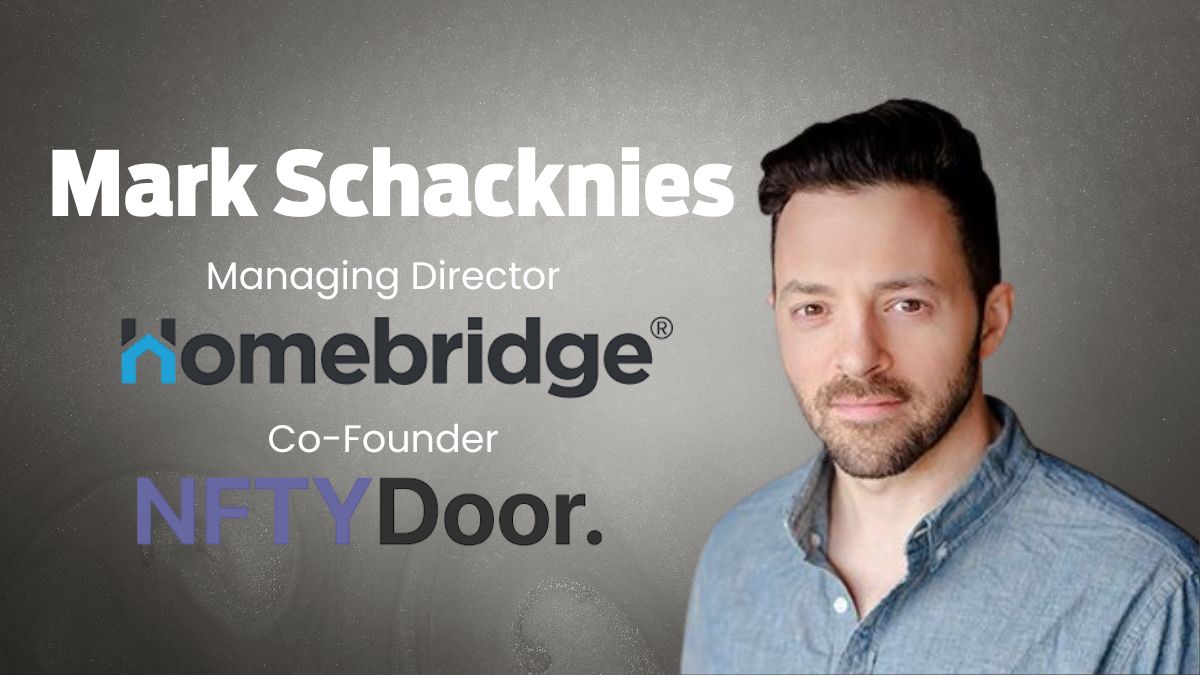
Homebridge acquired NFTYDoor in mid-2023, giving the platform a national licensing base and a large operating partner. By 2025, Schacknies was both NFTYDoor's co-founder and a managing director at Homebridge. In April 2026, NFTYDoor announced another turn: it was operating independently again, with broader borrower eligibility, revised rates and new economics for brokers and private-label partners.
Four months later, K Street Capital described the business as serving more than 500 lenders and 36,000 mortgage loan officers, approaching $7 billion in annual run-rate volume. Schacknies spoke of a sequence of corporate transactions and a new long-term capital home. The legal wrappers had changed. The product's route to market had become the durable object.
When the phone rings first
Schacknies's clearest founder advice is almost anti-pitch. Ask precisely who the audience is. If the answer is “everyone,” ask again. Then set aside the founder's enthusiasm and study the customer's self-interest. Why should this person care? What gets faster, cheaper or easier for them? How much work must they do before the improvement appears?
He knows the opposite version: multi-year enterprise sales, bespoke implementation and ten or twelve steak dinners. NFTYDoor aimed for something closer to plug-and-play. The company hired its first marketing employee four years into the journey and, Schacknies said, had one salesperson from inception. “It was our phone ringing, not us calling.” Some of that was timing, he conceded. Some was a product that arrived when high rates made old home-equity machinery newly intolerable.
The useful lesson is not that salespeople are unnecessary. It is that distribution begins before the sales department. It begins in product scope, integration effort and the motivations of whoever already owns the customer relationship. A lender wants a product it can offer without rebuilding. A loan officer wants clarity and compensation without weeks of chasing paper. A borrower wants terms that arrive before the life event has passed.
This explains the continuity across Schacknies's career better than the labels proptech or fintech. MyDealBook exposed the participants in a deal. Remine organized the MLS ecosystem. NFTYDoor connects the borrower, loan officer, lender and machinery behind a line of credit. Each company begins where one person hands work to another and asks whether the gap can be made visible, legible and short.
The boyish phrase in his 2019 platform manifesto was “with joy.” Real estate rarely earns that noun. It offers rain-soaked queues, empty corridors, documents with small print and steak dinners that outlast the buyer's patience. Schacknies has nevertheless kept the phrase's underlying hope: a serious transaction need not feel like punishment.
The machine he keeps building is not really a mortgage machine. It is a handoff machine. Its ambition is to let each participant do less searching, less waiting and less retyping, then spend more time on the judgment only that participant can supply. Software provides the speed. Distribution provides the reach. The human at the end of the line provides the reason anyone trusts either one.