A mortgage can be digital and still spend most of its life waiting. The borrower taps through a tidy form, then the file wanders into a thicket of pay stubs, insurance calls, title checks, underwriter queues, wet signatures and banking windows. NFTYDoor’s founding observation was almost comic in its simplicity: a 45-day process is not one large delay. It is a collection of small delays with nobody responsible for the space between them.
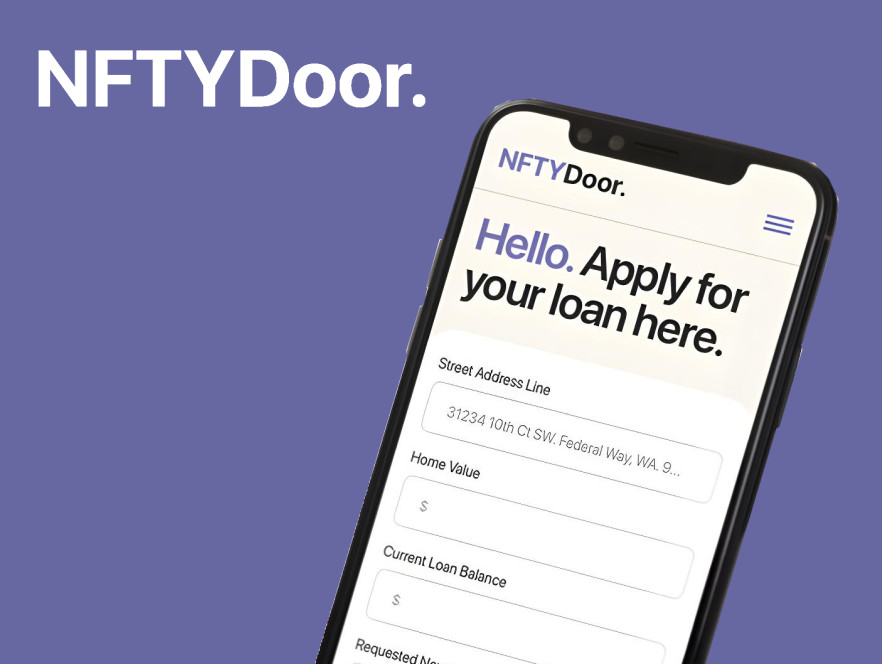
Mark Schacknies and Jonathan Spinetto launched the McLean, Virginia company in 2022 with a one-minute application and a promise to fund eligible home-equity loans in as little as three days. The original offer was consumer-facing: homeowners could borrow $25,000 to $250,000 without refinancing a low-rate first mortgage. But the more consequential product was behind the screen - a decision and fulfillment engine that connected credit, valuation, income, title, closing, funding and servicing.
Today, NFTYDoor sells that machinery to mortgage brokers, independent mortgage banks, banks, credit unions and fintechs. A partner can send a loan through NFTYDoor’s wholesale channel, keep its name on a correspondent or private-label experience, or use a fully managed software model. In the neatest version of the pitch, the partner brings the borrower and NFTYDoor handles the rest. That means less software assembly, less operational hiring and, for some arrangements, no separate warehouse line.
01 / The boring parts are the product
What NFTYDoor actually built
Calling NFTYDoor an “AI mortgage company” is technically useful and strategically vague. Its engine evaluates credit, income, property and risk in real time. More than half of applicants receive the company’s Fast Pass instant approval, and Schacknies has said automation cut manual underwriting by more than 90 percent. Yet the differentiator is not a chatbot in a loan officer’s browser. It is the decision to treat origination and fulfillment as one continuous product.
Income verification is a good example. The team initially relied on traditional documents. Those checks were slow, invited errors and caused applicants to disappear. By connecting permissioned bank data through Plaid, NFTYDoor made the check instantaneous for supported applicants. Plaid reports that verification turnaround improved by 50 percent and applicant conversion exceeded 85 percent. The lesson is not “buy Plaid.” It is to identify the first point where good customers quit and remove the repeated request.
Insurance created another paper chase. NFTYDoor had already worked with consumer-permissioned verification providers, but wanted lower costs, stronger product performance and a more collaborative vendor relationship. It began with Truv’s homeowners-insurance verification, heard positive borrower feedback, then added income and employment. That sequence matters: solve one measurable failure, verify that it works, and only then widen the integration.
02 / Make Monday optional
Speed became a service design
The most amusing expression of NFTYDoor’s thesis arrives on Saturday morning. A borrower closes, waits through the federal right-of-rescission period, then receives funds through a real-time payment rail rather than watching the file sit until the banking week resumes. Modern Treasury supplies payment orchestration and ledgers, letting NFTYDoor route ACH, wires and real-time payments while showing where each dollar went. For debt consolidation, the system can pay creditors directly and expose check and transaction status to the borrower.
This is where “human in the loop” earns its keep. Clean files move automatically; strange files still need judgment. NFTYDoor says its global team operates 24/7/365, with a named processor and digital underwriter on every file. The internal framing is deliberately hospitable: AI handles repetitive review and coordination so people can answer the phone. The company even calls partner support “Concierge,” a hotel word dropped into the mortgage-industrial complex.
That approach solves a genuine conversion problem. A fully automated journey can be quick right up to the moment a borrower inherits a half-renovated house, earns income through a complicated business, or owns the subject property through an entity the program does not accept. Software makes the median file fast. Humans decide whether the outlier can be saved. NFTYDoor’s wager is that speed and service are complements, not opposing ideologies.
03 / The business behind the button
Distribution, not a consumer brand, is the sharper moat
NFTYDoor started by helping homeowners tap equity. It discovered a larger customer hiding one layer up: the institutions that already had borrower relationships but lacked a modern HELOC stack. Its public materials now emphasize more than 400 lenders and 36,000 mortgage loan officers. The company serves three partner modes. Wholesale lets brokers submit to an NFTYDoor lending partner. Correspondent and private label let a lender own origination and branding while NFTYDoor fulfills the work. Fully managed SaaS lets an institution control pricing and capital markets while renting the operating engine.
That positioning separates NFTYDoor from a pure direct lender. Figure, Better, Spring EQ, SoFi and traditional banks all compete for home-equity borrowers, many with increasingly fast digital products. Blend and ICE Mortgage Technology sell broad mortgage infrastructure. NFTYDoor sits between those camps: narrower than a general loan-origination system, more operationally complete than a front-end widget, and more channel-friendly than a company trying to own every consumer.
The commercial model follows the workflow. NFTYDoor can bundle technology, processing, underwriting, title, closing, funding and capital-markets support. Partners may earn base premiums and volume upside, depending on the arrangement. What does it cost? Public partner pricing is not posted. Homebridge’s 2023 acquisition price was also undisclosed. Buyers therefore have to model avoided expense - engineering, compliance integrations, warehouse capacity and fulfillment headcount - against whatever contract NFTYDoor offers. “No operational lift” is an invitation to diligence, not a line item.
The ownership story is unusually compressed. NFTYDoor launched in 2022, received early backing associated with 757 Accelerate, K Street Capital and the Virginia Innovation Partnership Corporation, and was acquired by Homebridge in mid-2023. Homebridge later described the purchase as an alternative to patching legacy systems. In April 2026, NFTYDoor announced that it was operating as a fully independent company. The terms of that transition were not disclosed, but the strategic change was visible: direct partner contracts, better partner economics and a wider credit box.
The new parameters moved the minimum FICO from 640 to 600, maximum combined loan-to-value from 80 to 90 percent, and maximum loan amount from $500,000 to $750,000. NFTYDoor also said borrower rates fell by more than 100 basis points for the new direct structure and private-label partners gained a no-cost embedded warehouse line. Faster software became available to more files, which is a far more practical growth lever than shaving another few seconds from the application.
04 / The copyable playbook
Steal the queue, not the slogan
The reader does not need to run a mortgage company to borrow NFTYDoor’s method. Any regulated, document-heavy service can start with a wait map. List every moment when a customer is waiting for a person, a document, a vendor or a banking window. Measure abandonment at each handoff. Automate the clean path. Give one human ownership of exceptions. Expose status so customers do not create more work by asking where the work went.
Measure queue time separately from work time. The idle hours usually hide the opportunity.
NFTYDoor started Truv with insurance, watched the result, then expanded the relationship.
Automation feels safer when customers know who owns the odd case and can reach them.
Package software with the operations, capital and support required to produce the promised outcome.
There is another idea worth copying: change vendors when the collaboration becomes part of the bottleneck. NFTYDoor’s move toward Truv was not presented as a failure of automation itself. The company wanted better cost, performance, transparency and problem-solving. A vendor can hit its service-level agreement and still slow product learning. In a chain this interdependent, responsiveness is a feature.
Where the model breaks
This approach will not work as advertised when bank-data connections fail, property or income is unusually complex, title defects need curing, the borrower falls outside a lender’s credit box, local rules constrain digital closing, or a partner lacks enough volume to justify the integration. Speed also cannot rescue weak underwriting. It only makes the quality of the rules visible sooner.
NFTYDoor is now stretching the engine beyond HELOCs, with bridge, debt-service-coverage-ratio and Non-QM products announced for 2026. That expansion is a test of the company’s central claim: that the same core of digital origination, compliance, closing and support can serve multiple forms of home-based credit. Reuse can produce leverage. It can also reveal that each loan type carries its own exceptions, capital partners and operational weather.
The company’s market fit is easiest to understand without the “one-minute mortgage” phrase. NFTYDoor is a specialist operating layer for organizations that already know how to find borrowers. It gives those organizations a way to add home equity faster than building a new lending line from scratch. The homeowner sees an application. The loan officer sees a communications hub. The institution sees infrastructure, fulfillment and liquidity stitched together.
And the operator should see a disciplined product thesis. The first thing that failed was not the website; it was the document chase behind it. What changed the company’s mind was evidence - drop-off, slow verification, uneven vendor collaboration and a larger B2B distribution opportunity. What others can copy is the habit of treating every wait as owned product surface. The magic is not that a mortgage can happen on a phone. It is that, after the tap, the file keeps moving.