Prudential had found a way to make more marketing. Generative AI increased the supply of content, but each new piece still needed checking. Insurance promises do not become less consequential because a machine writes them quickly. In a conversation published by Norm Ai, marketing executive Lilly Raymond described the result: “Our compliance team was at capacity.” The creative department had acquired a faster engine. The inspection queue had acquired more traffic.
- Norm Ai turns regulations and company policies into agents that check work and explain their findings.
- Its customers include financial institutions with large volumes of regulated content.
- Its technology also powers an independent affiliated law firm, Norm Law, which prices work around outcomes.
The queue that AI made longer
Prudential’s response was to work with Norm’s legal engineers on policies and product language. Marketers could check materials before submitting them; compliance staff could conduct final reviews in the same platform. The attraction was practical: spot a troublesome claim while its author can still fix it. In Norm’s published account, reviewers gradually trusted the calibrated system. That is a more useful adoption story than a prediction about lawyers becoming obsolete.
Norm sells into the point where a business wants to move faster and someone must answer for the consequences. Its agents assess material against particular standards, flag problems and explain proposed changes. The buyer is often a legal or compliance leader. The beneficiary may be the marketer waiting to send a campaign, or the risk team trying to keep decisions consistent.
A lawyer learns to build
Founder John Nay arrived at this problem through research. Stanford describes his AI work at Vanderbilt, postdoctoral research at NYU and teaching at NYU School of Law. His academic background helps explain the company’s unusual premise: legal reasoning can become a component of software, rather than advice consulted after software has acted.

The mechanism is more specific than asking a chatbot whether an advertisement looks legal. Nay describes breaking regulations into requirements and nuances, then arranging them into decision trees. An agent works through those questions and produces a determination with reasons. Norm’s explanation of regulatory agents makes the ambition clear: preserve the structure of the rule as well as the ability to interpret language.
The people doing this are legal engineers. Norm’s proprietary Legal Engineering Automation Platform, or LEAP, gives them no-code tools to construct agents. Attorneys learn the capabilities and limits of language models, encode standards, and calibrate systems for a client’s interpretations and risk preferences. In October 2025, Norm said more than 30 attorneys worked at the company.
One detail deserves attention: a change to a public-policy representation must be reviewed by another certified legal engineer. Software teams will recognize the habit. Lawyers will recognize the second pair of eyes. Norm’s published process joins the two. Its careers page offers bar-fee reimbursement, a small reminder that legal credentials remain part of the machinery.
- 01Interpret
the rule - 02Encode
firm standards - 03Check
the material - 04Explain
and review
The customer helped write the specification
New York Life offers a particularly revealing example. Its venture team connected with Nay before Norm’s official launch, introduced the compliance department, and supported work tailored to existing processes. The insurer subsequently became an investor as well as a customer.
In New York Life’s own account, legal engineers tuned agents to review selected sales and marketing content against external regulations and internal guidelines. Professionals retained final judgment. Bring the people who interpret policy into development early. A procurement checklist cannot supply the institution’s unwritten judgment.
“New York Life’s guidance helped shape a product built for large enterprises.”
John Nay / New York Life customer account
A memory for the next questionnaire
Norm’s diligence-questionnaire and request-for-proposal product tackles a related irritation. A firm may have answered the same investor question last quarter, yet the next response still requires chasing documents and colleagues. The information exists; the dependable route to it does not.
The DDQ and RFP system uses a versioned repository of approved answers, policies, fund documents and previous questionnaires. Exact matches can reuse approved language. Partial matches receive drafts with citations; gaps are flagged for attention. Reviewers can inspect supporting excerpts, pass responses through multiple approvals and export them. Each firm is paired with a legal engineer to maintain the rules around that knowledge.
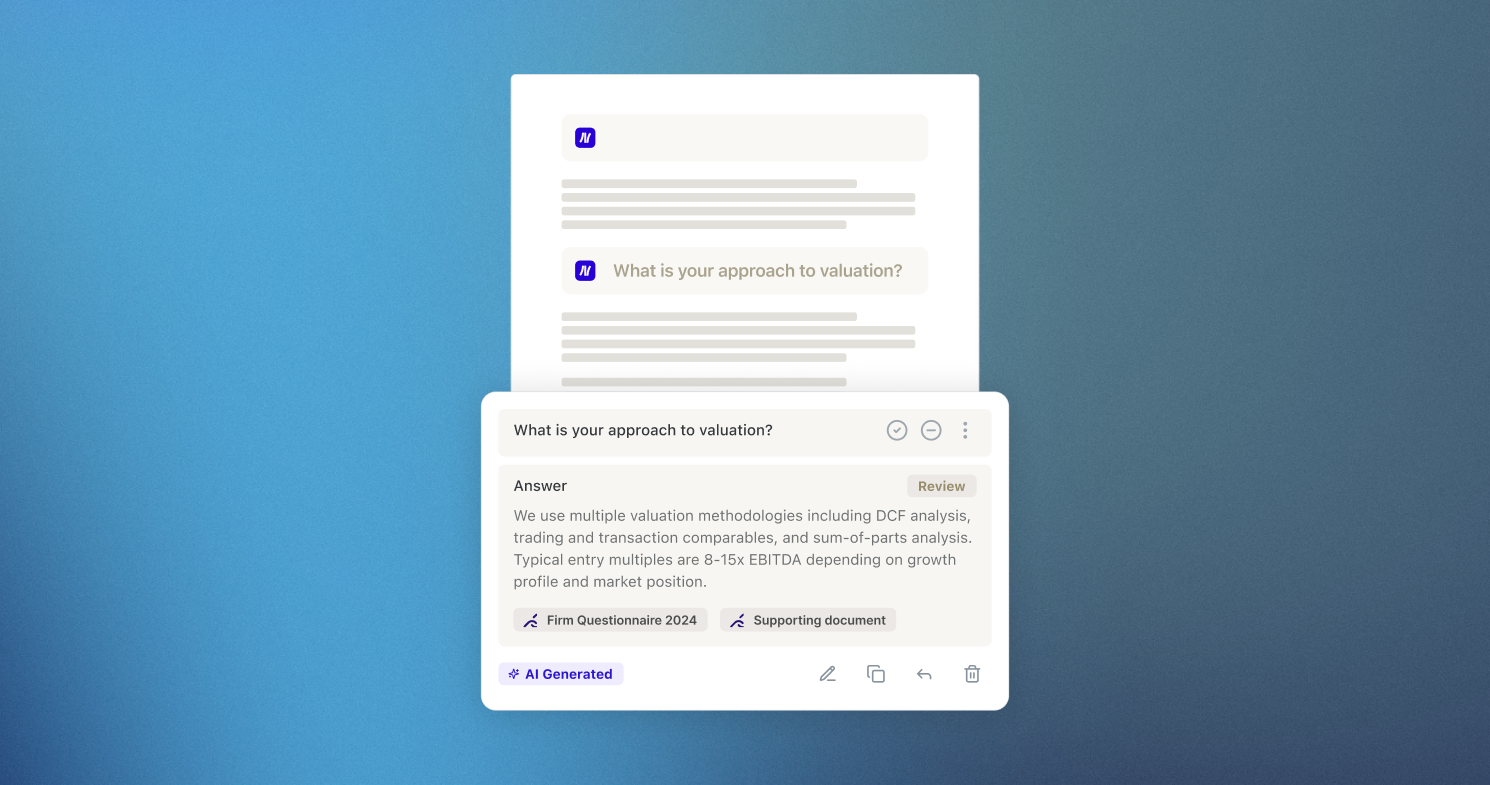
The reusable lesson is to save approved reasoning alongside approved text. Otherwise, automation can merely accelerate the circulation of an answer nobody quite remembers approving.
The billable hour meets a different bargain
Stanford’s company directory identifies a subscription revenue model for Norm Ai. The wider business now connects enterprise technology with Norm Law, an independent affiliated law firm. Norm Ai supplies technology and services; licensed Norm Law attorneys supply legal advice. That division matters when understanding what a customer is buying.
Norm Law’s stated pricing is tied to outcomes rather than hours. If repeatable work becomes cheaper to perform, the client can share the benefit without rewarding a longer timesheet. Harvey and Legora are adjacent legal AI alternatives. Norm’s particular proposition combines encoded institutional standards, agent deployment and affiliated legal practice.
The disclosed capital tells us what investors have committed. Norm announced a $120 million Series C led by Khosla Ventures in July 2026, at a $1.2 billion valuation, taking reported funding above $260 million. That money supports hiring, wider practice coverage and supervisory agents. It does not establish a customer’s savings. Those depend on the workflow, the calibration effort and the decisions still requiring a person.
When the agent needs a supervisor
In May 2026, Norm announced a compliance agent for Microsoft 365 Copilot, bringing review, disclosures and policy questions into everyday work. Supervising other enterprise agents extends the same idea: as software takes action, the checks must travel with it.
There are conditions attached. As an operational inference, incomplete policies, stale approved documents or absent expert review would weaken this approach. Encoding a standard does not settle every ambiguous case. At its September 2026 forum, Norm described accountable professionals and clear escalation points as requirements for enterprise agents.
Its work with Delaware on a proposed sandbox for AI-managed companies moves the question beyond document review. The proposal remains an experiment in legal accountability. For a business adopting AI today, the immediate lesson is smaller and eminently copyable: speed up the check when you speed up the work.