The first thing to fail was the document. In banks, a diagram of how data moves through a system can be accurate on Monday and archaeological evidence by Friday. A field gets renamed. A risk calculation acquires a new source. A migration leaves half the old machinery humming in a basement. Then a regulator asks where one number came from, and a roomful of expensive people begins comparing spreadsheets.
Philip Dutton and Philip Miller had watched this movie through roughly 35 combined years of consulting. Their projects ran long, the systems were tangled, and confidence in the resulting data was low. They did not begin with a grand plan to replace the enterprise data stack. They built a practitioner’s tool to speed up the work in front of them. Threadneedle Software was incorporated in 2011; the product called Solidatus was engineered and launched in February 2017.

That distinction matters. Solidatus was born from a workflow, not a category slide. It models the relationships among data, systems, transformations, reports, policies, owners and obligations, then renders them as an explorable graph. A user can begin with a risk report, trace one field backward to its authoritative source, inspect every transformation, and ask which downstream assets would be affected by a change.
It sells a graph, but the product is confidence
The company’s customers are organizations for which “we think this is the source” is not an acceptable answer. HSBC, BNY, Deutsche Bank, LSEG, ABN AMRO, M&T Bank, Investec and Royal London Asset Management appear among its named users. The daily operators are data-governance leads, architects, engineers, risk teams, compliance officers and transformation managers. The economic buyer is often the executive who owns the consequences when those groups disagree.
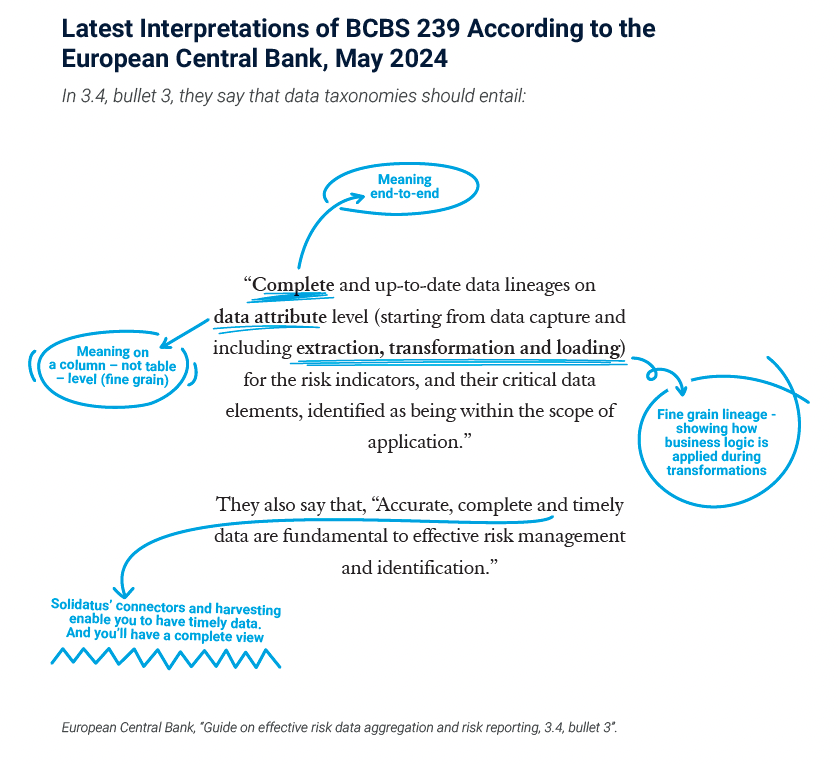
Solidatus combines technical lineage - tables, columns, pipelines and transformations - with business lineage: the owner, policy, regulatory rule, risk rating or purpose attached to the data. Its connectors ingest metadata from Snowflake, Databricks, Azure, AWS, Oracle, SQL Server, Informatica, dbt, mainframes and analytics tools. APIs cover the awkward internal systems that never appear in a tidy architecture diagram.
One map, three moves
The odd, useful feature is time travel. Solidatus calls its approach bi-temporal version control. In plain language, the system can distinguish when something was true in the business from when that truth was recorded. Teams can inspect a past state, compare it with today, or build a proposed future state before a migration goes live. A static catalog says what exists. A versioned lineage graph can show what changed and what the change is likely to disturb.
What they did, what it cost
At HSBC, the platform’s most legible result came from cross-border data-sharing approvals. A manual process that could take months was converted into an automated response based on predefined parameters, with the underlying relationships modeled in Solidatus. In another HSBC program, a team of two documented and modeled the bank’s global credit and lending book in under six months. The point was not prettier diagrams. It was turning a recurring investigation into an answerable query.
The sticker price is enterprise-sized. Most Solidatus deals are quoted privately, but AWS Marketplace lists a 36-month single-production-instance bundle at $247,500. That includes users, standard importers, an API and standard support; AWS infrastructure may cost extra. The useful comparison is not a lightweight diagramming tool. It is the people-hours spent rebuilding lineage for audits, migrations and risk reports, plus the cost of discovering a dependency after production changes.
36 months, one production instance, users, standard importers, API and standard support. Contract terms vary; infrastructure can be additional.
The company reports a 60 percent reduction in manual data-management costs at a global asset manager and 65 percent less workload-automation effort at a Tier 1 investment bank. These are vendor-published customer outcomes, not universal promises. A graph cannot rescue an organization that refuses to name owners, settle definitions or maintain the model.
The change of mind was the market
The founders expected a tool that made their own projects faster. After the 2017 launch, customers showed them a wider use: the same relationship model could support regulatory reporting, cloud migration, operational resilience, privacy, lending, ESG and eventually AI governance. The product did not need a separate map for every problem. It needed a durable map with different overlays.
That insight shaped the go-to-market. Citi became both an enterprise customer and the company’s first major strategic investor in 2020. In 2021, AlbionVC led a £14 million Series A joined by HSBC Ventures and Citi. Customer-investors are not automatically good news, but here they were unusually direct evidence that the pain existed at scale. Solidatus later secured £5 million in growth debt from Salica Investments in October 2025 for research, development and expansion.
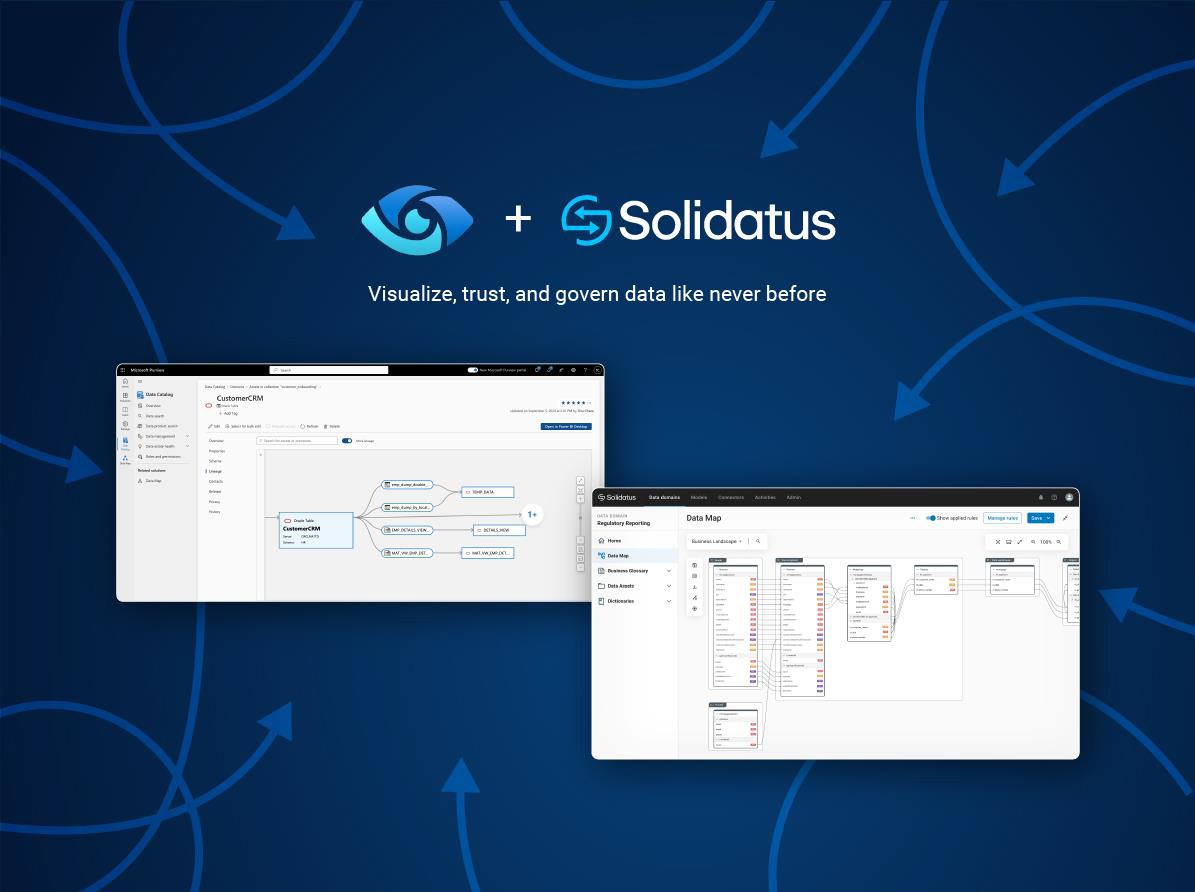
Microsoft supplied the next distribution turn. In 2024 it named Solidatus its preferred data-lineage integration partner for the redesigned Purview governance experience. The positioning is clever: do not insist that a bank throw away its catalog. Extend it across non-Microsoft clouds, legacy systems and deeper column-level relationships. Solidatus is also sold through Azure and AWS marketplaces, where procurement can move through channels the customer already trusts.
AI enters, on a short leash
In March 2026, Solidatus launched an AI Lineage Assistant that does more than search metadata. It drafts mappings, proposes connections, adds business terms and converts PDFs, images and spreadsheets into structured models. Every proposed change is staged for human review with diffs, undo, redo and an audit trail. Customers can bring an approved model from Azure OpenAI, Gemini, AWS Bedrock or another provider, or use hosted infrastructure.
Release 2026.3 added Model Context Protocol support, letting external AI agents query governed lineage, plus persistent assistant sessions and reusable prompts. The company’s argument is neatly circular: AI can help build the map, and the map can help govern AI. For regulated buyers, the human approval step is the product, not friction accidentally left in it.
Solidatus competes with Collibra, Alation, Atlan, Informatica, Microsoft Purview and lineage built into cloud platforms. Its claim is depth: cross-system lineage, transformations at column level, business overlays, time-aware versions and scenario modeling. Its restraint is equally important. It often sits beside catalogs rather than demanding a rip-and-replace project. That makes the company easier to buy, although it also means another platform, integration and governance habit to maintain.
What a reader can steal
The Solidatus playbook begins with one ugly, expensive workflow. Do not start by mapping the entire company. Pick the approval that takes months, the report nobody can reconstruct, or the migration everyone is afraid to touch. Capture the relationships needed to answer that question. Add ownership and policy context. Version the model. Once the first workflow produces a measurable answer, reuse the graph for the next one.
The copyable playbook
- Choose a recurring decision with a visible cost, deadline or regulatory owner.
- Map dependencies, not merely assets: source, transformation, report, rule and accountable human.
- Keep past and proposed states so every change can be explained before and after release.
- Automate collection, but make people approve meaning and exceptions.
- Expand only after the first map shortens a real workflow.
There are conditions under which this will not work. A small company with a clean warehouse, a handful of pipelines and obvious ownership may get enough lineage from its cloud platform or dbt. A business without regulatory pressure or costly change programs may struggle to justify a six-figure contract. And an enterprise that treats governance as software someone else will maintain will simply create a handsome new layer of stale documentation.
Solidatus fits where complexity is compulsory: many systems, old and new; several teams; regulated outputs; frequent change; and a buyer who can price one bad dependency. The company’s bet is that data estates will not become simpler as AI arrives. Every model adds another hungry consumer, another chain of inputs and another executive who may have to explain the result. In that world, the humble map stops looking like documentation. It starts looking like infrastructure.
Go deeper
See the platform, customer work, product updates and interviews directly from Solidatus and its public channels.