A regulator asks where a number came from. The question is short. Inside a bank, the answer may cross decades of software, a procession of owners, thousands of fields and enough spreadsheets to make archaeology look brisk. Philip Dutton built his career in that awkward distance between the simple question and the complicated truth. His company, Solidatus, draws the route. It turns systems, transformations, policies and people into a connected map, then preserves how that map changes over time. In an industry fond of selling the future, Dutton's subject has always been the trail of receipts.
That subject has become newly fashionable because artificial intelligence has acquired a governance problem. An AI output can sound perfectly assured while the data beneath it remains biased, incomplete, stale or impossible to trace. Dutton has worked in data lineage for nearly two decades. He watches today's scramble and hears an old tune: institutions want to automate before they understand the machinery. His compact warning, delivered at a 2026 data conference, could fit above every ambitious technology roadmap: “You can't automate what you don't understand.”
What entered?
What happened?
Can we defend it?
A childhood without one fixed horizon
Dutton describes himself as a global citizen, a phrase that can sound like airport-lounge copy until he supplies the itinerary. He was born and raised in Papua New Guinea until the age of 12. He remembers running free, exploring, and watching entrepreneurial parents work together to support both their family and an underserved community. Brisbane came next. There he studied information technology at Griffith University, including information systems and software engineering, and played elite-level rugby.
The rugby detail is more than founder-biography decoration. Dutton has connected it to dedication, leadership, teamwork and the camaraderie that produced lasting friendships. Software at institutional scale is also a team sport in which the ball is usually invisible and everyone has a different diagram. The instinct to create a shared field of play would follow him.
Four homes / one working map
Just after university in 1998, he started an e-commerce software business with two friends. Then came the travel bug and London, his intended first stop and eventual home for more than 20 years. The city gave him financial technology, a family and the professional problem that would consume his attention. In 2001 he was working on web and content-management software. He moved into trading systems, working with large global financial institutions where technical elegance meets rules, deadlines and the expensive consequences of ambiguity.
The apprenticeship inside complexity
At Formicary, a global IT consultancy, Dutton helped the business grow from seven people to more than 120. Accenture acquired it in 2012. Scale taught him what diagrams conceal: large enterprises do not possess one tidy system. They accumulate systems. Each merger, regulation, workaround and urgent delivery adds another layer. The system still runs, reports still arrive and confidence can survive long after comprehension has left the room.
In 2011, Dutton and an ex-Formicary colleague started Threadneedle Technology. It was a consultancy and, crucially, a funding vehicle for Threadneedle Software. The consulting work paid for the development of a product Dutton believed could change how organisations executed data and regulatory transformation. This was patient company-building: solve the problem in the field, earn revenue, put that money into software, repeat. Solidatus did not reach general release until 2017.
The product's idea was visual and temporal. Map connections across an organisation, from data and systems to processes, policies and business uses. Keep versions so a team can see what existed, what changed and what may be affected next. In banking, where a number must sometimes be evidenced across scores of jurisdictions, the appeal was practical. Solidatus gained traction with systemically important banks by helping them evidence regulatory reporting.
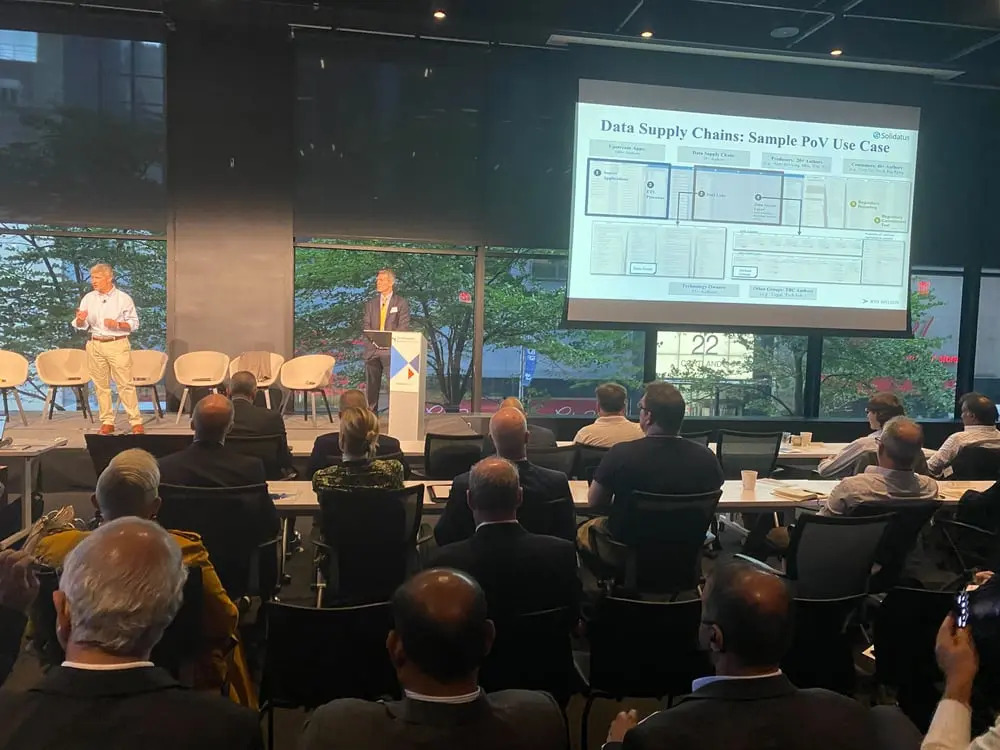
One HSBC project gives the abstraction some edges. A small team used the platform to model the bank's wholesale lending book across 45 source systems and 63 jurisdictions. The work labelled more than 20,000 data linkages across 2,000 source tables and created a common vocabulary spanning more than 80,000 fields. Those are not numbers designed for a tidy pitch deck. They describe the reason a map is needed. No individual can hold the whole landscape in memory, and no static picture can keep pace with every change. The value sits in making a sprawling institutional object searchable, shared and alive.
“The demon of complexity is the thing we're all struggling with.”Philip Dutton, on the enterprise data problem
Dutton is fond of analogies, especially when metadata threatens to empty a room. His library version goes like this: the Library of Congress contains a vast number of items, but an index helps a person find the right one. The index describes where something is and what it is. On the internet, a search engine plays a related role by indexing descriptive information. Metadata makes data findable and understandable; lineage supplies the connections. He calls it the hyperlink between documents.
A London product grows a Houston address
Solidatus raised a £14 million Series A in 2021, led by AlbionVC with participation from HSBC and Citi. Dutton and co-founder Philip Miller spoke publicly then about growing through three lockdowns, building a team from scratch and accelerating international plans. The funding was not presented as an escape from the company's technical roots. Dutton said the ambition included both engineering necessary software and building a collaborative, inclusive, forward-thinking company.
In 2022, the founders divided their responsibilities. Dutton became sole CEO, Miller moved into the chief innovation role, and Solidatus established its North American headquarters in Houston. Dutton moved there with his family. He saw physical commitment as important to a market packed with the complex, regulated organisations Solidatus served. London remained the engineering and cultural root; Houston became the next operating base.
The move also completed a personal set of four homes: Papua New Guinea, Brisbane, London and Houston. When ITV asked him in 2023 to discuss the UK's technology ambitions, Dutton wrote warmly about London's role in Solidatus and in his own life. Then he allowed himself a mischievous postscript: viewers who stayed to the end of the clip could also see how a CEO wins at table football. Data lineage has few natural comedians. A little foosball helps.
The receipts underneath AI
By 2024, Microsoft had chosen Solidatus as its preferred data-lineage integration partner for a reworked Microsoft Purview governance experience. In 2025, Solidatus appeared in Gartner's inaugural Magic Quadrant for Data and Analytics Governance Platforms. That October, it secured a £5 million loan from Salica Investments, taking total funding reported by the company to £25 million. The money was directed toward AI-enabled lineage and continued growth.
The strategic turn is easy to understand. AI systems draw from data, generate new data and increasingly take actions. Boards and regulators will ask which sources informed an outcome, how those sources changed and who approved the result. The answer requires more than a catalogue. It requires movement, context and an audit trail. In March 2026, Solidatus launched an AI Lineage Assistant designed to build and enrich maps, propose changes inside a controlled environment and leave human beings in charge of approval.
Dutton's argument carries a useful piece of restraint. Businesses do not need to discard their existing governance operating model merely because the acronym changed to AI. Financial institutions have spent years learning how to evidence regulated data. They can extend those habits, close the lineage gaps and use natural-language tools to work with the resulting map. The new interface may converse; the institutional duty remains to show the working.
Trust is not a tone of voice. In enterprise AI, it is a route back to the evidence.The principle behind a lineage-first approach
His own stated leadership traits match that architecture. Openness comes first. Curiosity follows: ask why, accept new information and challenge the status quo. Then comes what he once called resilience “to the point of lunacy,” paired with the ability to persuade a team that the destination merits the journey. A living map assumes the world will change. An open leader does too.
The map is still widening. In June 2026, Dutton joined a London fintech and cybersecurity trade mission to Singapore. The itinerary put Solidatus in conversations with banks, market-infrastructure businesses and regional organisations across a gateway to Southeast Asia. It was an appropriately international scene for a founder who still calls London home away from home while running the company from Texas. It also showed the continuity beneath the new AI language: regulated institutions in every market face the same uncomfortable need to understand how information moves before they trust what it produces.
This is the neat symmetry in Dutton's story. A child who explored one landscape, an engineer who crossed four countries and a founder who spent years observing complex institutions all arrived at a company about orientation. Solidatus does not promise to make a bank's history simple. It tries to make that history visible enough to navigate. As AI makes decisions faster, that modest distinction becomes more valuable. Speed without a map is merely a quicker way to get lost.