A public library is an awkward place to announce that you intend to build an international software business. There are other people trying to read. Yet the library in Somerset, New Jersey, supplied Tianyi Jiang and Kai Gong with something more useful than an impressive address: somewhere to work. AvePoint’s early ambitions had to fit around a desk.
Jiang, usually called TJ, had already worked in places whose addresses needed little explanation. He wrote financial software for Wall Street institutions. He had engineering degrees from Cornell. The distance between that world and a library startup was considerable, although the practical question remained familiar: could he make something work?
Twenty-five years after AvePoint’s founding in 2001, Jiang runs a company traded on Nasdaq and the Singapore Exchange. Its products deal with the less photogenic side of digital life: moving data, protecting it, controlling access and keeping systems recoverable. These jobs rarely get the applause at a technology demonstration. They tend to attract attention when somebody discovers they have been neglected.
A borrowed desk, a problem worth solving
Jiang and Gong met at Lucent, where Jiang worked after Cornell. Their friendship became the basis of a business partnership. The first AvePoint product backed up Microsoft Exchange email. It was a sensible task in a crowded market, which is a polite way of saying that a sensible task does not automatically produce customers.
The founders’ opening came through SharePoint, Microsoft’s collaboration software. In 2003, organizations moving between versions faced a migration problem. AvePoint offered a way through. A tool that might once have been another item on a crowded software shelf became an answer to a particular customer’s difficulty.
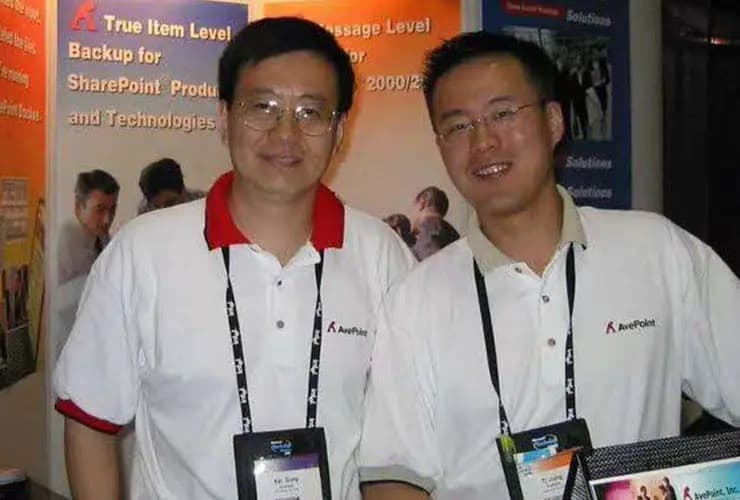
The distinction matters to Jiang’s account of entrepreneurship. Technical competence was the starting equipment. Sales, marketing, distribution and raising money were subjects he still had to learn. Software written for a trading desk had a defined setting and demanding users. A company had to find its users, earn their confidence and persuade them to keep paying.
The business grew around those practical obligations. SharePoint’s expansion supported DocAve, AvePoint’s platform for migration, management and protection. Summit Partners invested in 2006. In 2013, DocAve 6 won the SharePoint category at Best of TechEd. An idea tested in a library had acquired customers, investors and a considerable amount of maintenance work.
A good salary, a smaller world
Jiang’s parents were academics who came to the United States from China. As a teenager, he worked alongside his studies and attended Walt Whitman High School in Bethesda, Maryland. Education offered a route forward, but the household’s academic background did not make the bills disappear.
He went to Cornell for electrical and computer engineering, earning his bachelor’s degree in 1996 and his master’s in 1997. He later studied data mining at NYU’s Stern School of Business, completing his doctorate in 2008. Long before generative AI became a regular item in corporate presentations, he was working in the territory beneath it: extracting useful information from data.
His financial software career included Deutsche Bank, Lehman Brothers and Citadel. The work required speed, reliability and discipline. Those requirements would prove portable. A bank’s trading platform is an unforgiving place to discover that a programmer has mistaken enthusiasm for testing.
There was also a limit to the attraction. Jiang has recalled becoming increasingly accomplished at high-frequency trading while feeling that his working life was becoming narrower. He wanted more breadth. Starting a software company certainly supplied that, including several subjects for which engineering school had offered little preparation.
September 11, 2001, had already changed his sense of what a secure career meant. His Lehman Brothers office was on the North Tower’s 40th floor. That morning he was on the Jersey City waterfront, on his way to work, when he witnessed the attacks across the river. Everyone on his floor escaped. He has described the day as a reason to reconsider his direction and pursue work he cared about.
“Life is too short to not take risks.”Tianyi Jiang
His subsequent choices combined study with business building. They resist the tidy version of a founder story in which one revelation immediately sorts out the next twenty years. Jiang still tried different work. He still needed to discover what held his attention. AvePoint became the place where technical problems and a wider working life could meet.
The cloud arrives. The cash comes later.
One of Jiang’s consequential decisions concerned a change that customers could find convenient and suppliers could find financially uncomfortable: moving software toward the cloud and subscriptions. AvePoint’s history dates its transition to a subscription licensing model, supporting self-hosted, hybrid and SaaS deployments, to 2014.
The arithmetic is straightforward. A traditional license brings in a substantial payment near the beginning. A subscription spreads payments across time. Meanwhile, the company still pays the people building, selling and supporting the product. A promising contract can coexist with an immediate need for cash.
Same $300. Different calendar.
Payroll does not wait for year three. Illustrative amounts only; not AvePoint pricing or reported results.
Jiang’s financial language is often less romantic than the circumstances of his founding. He talks about cash flow, dilution and control. He advises founders to delay raising capital until they have a business that can justify it. Investment has a purpose; accumulating impressive funding announcements is a different activity.
That discipline also appears in his approach to acquisitions. Acquired software, he argues, needs to be recoded, refactored and integrated into the platform. Otherwise the deal risks leaving customers with a collection of products whose strongest connection is the announcement that put them together.
The partnership’s division of responsibility evolved, too. Jiang served as chief operating officer until 2009, then shared the chief executive role with Gong until 2020. Jiang became sole CEO as Gong became executive chairman. The arrangement gave their long collaboration another form, with Jiang responsible for overall strategy, product innovation, investor relations and business development.
AvePoint began Nasdaq trading in 2021 following its combination with Apex Technology Acquisition Corporation. Jiang has spoken about the accountability of a public company, where results become visible beyond the boardroom. The library founders now had a much larger audience for their arithmetic.
Singapore becomes a working address
The expansion overseas has a personal geography. Singapore became a base for Jiang’s family and a center of AvePoint’s research. He has described living there with his Singaporean wife and five children. The city’s place in his story extends well beyond an occasional business trip.
AvePoint established a S$100 million international research and development hub in Singapore in 2022, followed by an AI Lab in 2024. In September 2025, it added a Singapore Exchange listing under the symbol AVP. The Nasdaq symbol remained AVPT. Two exchanges now put prices on a business that had once needed somewhere to sit.
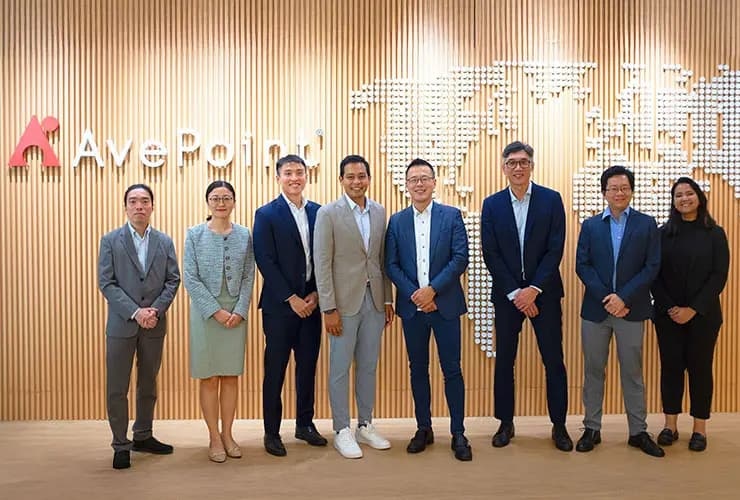
Jiang has also pointed to specialized ventures such as education software business MaivenPoint, led by Zoe Shang, as a way to address distinct markets and give other leaders room to build. His account of expansion includes the development of people who can make decisions themselves.
The harder managerial questions have been present for years. Back in 2013, Jiang identified managing, empowering and scaling people as the toughest part of growing AvePoint. Writing a product and building an organization require different forms of patience. The second task does not disappear when the first one succeeds.
at June 30, 2026
By the second quarter of 2026, AvePoint reported total revenue of $124.5 million, up 22% from a year earlier, and annual recurring revenue of $465.1 million, up 27%. ARR is a recurring revenue measure, distinct from the revenue recognized in a single quarter. The figures describe the company’s scale; they also establish how much has to keep working.
Jiang’s current emphasis is AI governance and security. As organizations give intelligent systems more work, the underlying questions about data and access become harder to postpone. Which information should a system see? Who can authorize an action? What happens when something needs to be recovered? Those are recognizable descendants of the practical problems AvePoint began by solving.
Buying someone else a summer
For a more personal view of Jiang’s priorities, consider the summer job. In 2024, he announced that he would donate some of his AvePoint shares to Cornell Engineering to support student fellowships. The idea was to let students try startup work without having to finance the experiment themselves.
The inaugural Jiang Fellows cohort welcomed 20 students in 2025. Participants prepared through entrepreneurship study, then worked at startups with a weekly stipend and travel costs covered. Host companies offered access to executive leadership and mentorship. Students could see how decisions were made as well as complete the assignments those decisions created.
Jiang’s explanation emphasized breadth. A small company lets a student encounter development, marketing, customers and strategy in close quarters. He wanted students to experience the connections among those activities. That preference makes sense coming from an engineer whose own education in business continued well after his formal degrees.
There is a modest reversal here. Early in his career, Jiang needed room to try a different working life. Now he can help pay for someone else to do the same. The fellowship converts ownership in a public company into time inside a young one.
The library desk remains an apt place to leave him. It held no promise of stock listings or research laboratories. It offered a place to put the work. Jiang’s career has accumulated the credentials and addresses that usually decorate a business profile, while returning to a fairly ordinary question: what useful thing can you build from where you are sitting?