The revealing number in CoreStack’s story is 100,000. That is how many cloud resources appear in its published case study of Synopsys, the chip-design software company. Spread across AWS, Microsoft Azure and Google Cloud, they presented a problem that sounds almost comically small: the labels needed to be right.
A resource tag is metadata. It can tell you which project uses a machine, which department should pay for it, or who ought to answer when something goes wrong. Multiply an unreliable label by a hundred thousand and you acquire a rather sophisticated way of losing track of your own business.
- The job: connect cloud spending, security and operations to a common inventory and set of rules.
- The buyers: enterprise teams and service providers managing cloud environments for other companies.
- The new bet: BetterCloud brings SaaS management into CoreStack’s wider governance strategy.
- The lesson: establish ownership before asking automation to take charge.
A hundred thousand tiny labels
Synopsys turned to CoreStack’s tagging capabilities to improve cost visibility, allocation and optimization. The case reports 100% compliance across mapped tags on more than 100,000 resources. The qualification matters: this is a tagging outcome, not a claim that every security problem disappeared.
What failed here was the ability to connect technical consumption to a useful financial explanation. A cloud invoice can be correct while remaining maddeningly unhelpful. Knowing the total is one thing; knowing which product, project or business unit produced it is another. A label supplies the missing connection.
“It saved us from writing custom scripts”Ranjitha Thota, Enterprise Solutions, Synopsys
That short customer remark, published by CoreStack, is more informative than a page of grand adjectives. Someone had a job to do. The alternative involved writing and maintaining scripts. CoreStack supplied the capability in a product. Enterprise software often earns its keep in precisely this unglamorous exchange.
There is a lesson here for anyone confronting a sprawling cloud estate: clean up the accounting of responsibility. A dashboard cannot resolve a dispute over ownership if the underlying resources have never been assigned an owner.
Three departments, one expensive problem
CoreStack occupies the layer above the cloud providers. AWS, Azure, Google Cloud and Oracle Cloud provide the infrastructure. CoreStack helps organizations govern their use of it. Its software brings together financial operations, security operations and cloud operations, usually shortened to FinOps, SecOps and CloudOps.
FinOps+ handles the financial questions: where spending goes, how it changes, what looks wasteful and how to allocate the bill. Its dashboards use FOCUS, a specification intended to make billing data more consistent. Forecasting, anomaly detection and chargeback or showback help finance and engineering discuss the same spending without spending the meeting translating it.
Who pays?
Which rule applies?
What needs fixing?
SecOps applies security and compliance policies, identifies violations and supports remediation workflows. CloudOps adds monitoring, rule-based automation, access controls and operational reporting. These are adjacent tasks because the same resource can simultaneously be expensive, poorly configured and somebody’s production system. Optimizing any one dimension without considering the others can produce a wonderfully tidy mistake.
The point of the shared platform is coordination. A cost recommendation becomes more useful when the team can identify the resource, understand its purpose and send the work into an existing ticketing process. CoreStack’s product pages describe integrations with tools including Jira and ServiceNow. The person responsible still needs a place to receive the task.
The people who sell the housekeeping
CoreStack’s audience extends beyond companies tending their own infrastructure. Managed service providers and systems integrators use it to govern customer environments. Its multi-tenant features let a partner organize multiple customers rather than repeatedly assemble the same reporting machinery.
This explains the prominence of partners such as Logicalis and Virtusa in its customer stories. For a provider, governance can become a service to sell: assessments, cost management, compliance monitoring and ongoing operational support. CoreStack supplies software; the partner brings customer relationships and delivery expertise. Neurealm’s June 2026 GovernOps announcement makes that arrangement explicit, combining managed services with CoreStack’s capabilities.
Assessments is another doorway into that business. It evaluates cloud workloads against cloud-native and custom frameworks. CoreStack released an agentic AI update in December 2025. In a published customer example, Cloudelligent reported a 30% reduction in AWS architecture assessment time. The appeal is straightforward: a provider can spend less time collecting and reconciling evidence.
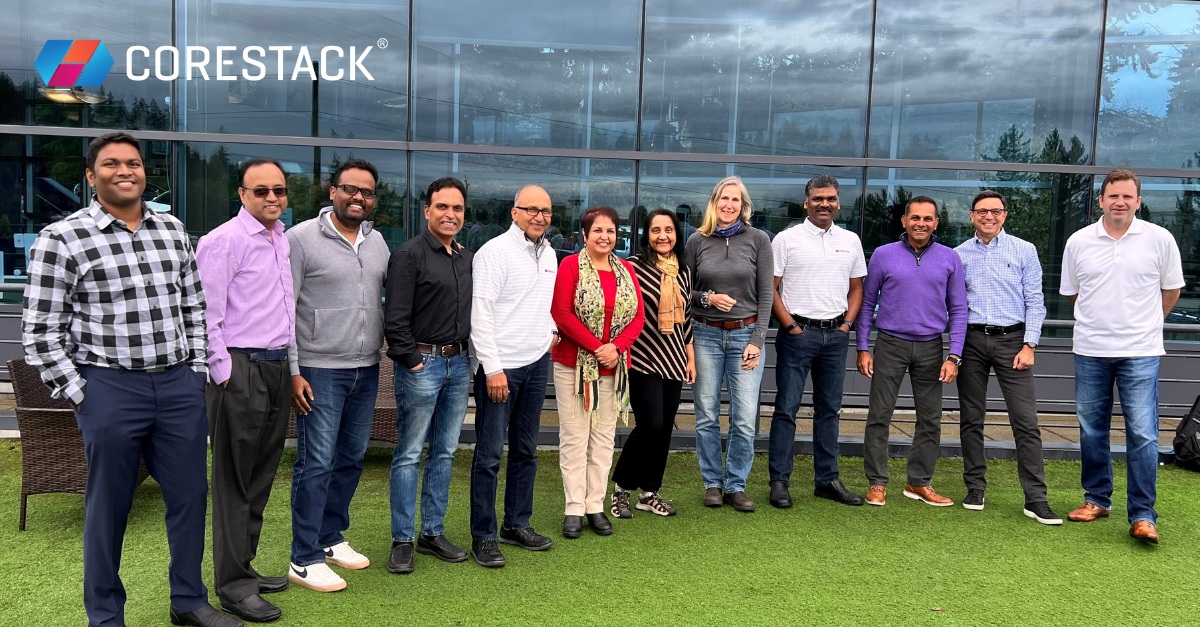
The company began in 2016. Its co-founders include CEO Ezhilarasan Natarajan, COO Krishnakumar Narayanan, CTO Sabapathy Arumugam and Thiruvalluvar NB. Natarajan’s earlier career included Capgemini, Mindtree and Texas Instruments. The business also has a Chennai office, connecting its US headquarters with an Indian operating presence.
Borrowing room to grow
CoreStack sells subscription software. Enterprise buyers and partners are purchasing capabilities that have to justify their own cost. A useful assessment compares the subscription and implementation effort with recoverable waste, avoided manual work and the value of better controls. A savings percentage alone cannot do that arithmetic.
Examity offers a more tangible illustration. CoreStack’s published account describes escalating cloud costs and limited visibility, followed by granular cost monitoring and automation. It reports $1.5 million in savings and a 40% reduction in cloud costs within two months. Those are results from one implementation, not a reasonable number to paste into every prospective buyer’s budget.
CoreStack’s own financing deserves equally careful labels. It announced a $30 million Series B in November 2021, led by Avatar Growth Capital, with Dallas Venture Capital and Iron Pillar participating. In October 2025 it announced $50 million from Post Road Group. That later transaction was funded debt, with potential additional capacity. It should not be described as another $50 million equity round.
The company said the financing would support innovation, market expansion and acquisitions. Debt offers capital while preserving ownership, but it also carries obligations. The announcement establishes the funding structure; it does not establish the economics of every deal that followed.
When the software starts acting
CoreStack’s product expansion also reaches deeper into security. Graphion, publicly released in December 2025, constructs a graph linking code, containers, Kubernetes, APIs, identities and configurations. It connects software and infrastructure bills of materials, attempting to show how a weakness in one component relates to what actually runs.
The underlying proposition is sensible: a list of vulnerabilities is less useful than an account of which connections make them dangerous. Graphion’s stated goal is to give security teams context for prioritization and explainable remediation. Buyers should assess that goal against their own environment and incident workflow.
Then came BetterCloud. CoreStack announced the acquisition on March 31, 2026, extending its reach into SaaS application management, user automation and software spending. It calls the broader ambition an “Agentic Governance OS”: policies defined by people and enforced across systems that increasingly act on their behalf.
Customers and partners worldwide, according to the acquisition announcement. Combined scale includes BetterCloud.
The strategic logic is that infrastructure, application access and AI workflows are becoming harder to govern separately. Owning businesses in those areas creates an opportunity to connect them. The acquisition itself is not proof that every connection is already seamless. In September 2026, BetterCloud introduced an IT leadership council to work on AI governance, another indication of where the group is putting its attention.
Start with the labels
CoreStack competes across several buying decisions. IBM Cloudability and CloudHealth overlap in financial governance; Wiz overlaps in cloud security. Native cloud tools are also an alternative. CoreStack’s proposition is the combination of functions, multi-cloud coverage and partner delivery, rather than the mere existence of a cost dashboard.
A small, uncomplicated environment may be adequately served by native tooling. A complex enterprise or provider handling many customer accounts has more reason to value shared reporting and policy automation. That is a question of fit, not a contest in how many features can be named.
The practical sequence is worth copying: inventory the resources, agree on tags, assign owners, connect the findings to work, then automate actions with appropriate permissions and review. Without reliable data or people willing to act, another governance tool can become another place to admire a problem.
In a 2025 interview, Natarajan put his argument simply: “Governance is an enabler.” CoreStack’s most persuasive evidence comes from the modest tasks beneath that claim. Give the resource a label. Give the bill an owner. Give the person responsible enough context to do something useful.
Follow the work
Explore the CoreStack website, product documentation, company blog and newsroom.
Watch the company overview on YouTube, browse product demonstrations, or visit the Driven by DCKAP interview.