There are industries that announce themselves with velvet ropes, ringing bells and the smell of freshly printed money. Governance, risk and compliance is not among them. Its natural habitat is the spreadsheet with seventeen tabs, three owners and a cell colored red by someone who left the company last spring. Dan Campbell saw this world as a consultant and reached an unfashionable conclusion: the problem was interesting.
The available software often behaved like poured concrete. A company could have its own processes, language and appetite for risk, provided all three happened to resemble the vendor's template. Changes required developers. Connections between risks, controls, vendors and policies were difficult to see. The technology intended to make order had acquired the social graces of a filing cabinet.
Campbell and fellow consultants Matt Kunkel and Jon Siegler kept encountering the same irritation. In 2015, in Chicago, they acted on it. They spent a year on research, design and the labor that Campbell later summarized with the traditional founder's ingredients: blood, sweat and tears. The first version of LogicGate emerged as a software-as-a-service application. The premise was easy to say and hard to engineer. Customers should shape risk software around their business processes, rather than shoehorn their business into somebody else's product.
“From day one, we set out to build a GRC solution that is intuitive, flexible, and scalable.”Dan Campbell
A business student with a compiler nearby
Campbell arrived at the founding table with an unusually tidy bridge between commerce and code. At the University of Michigan, where he studied from 2009 to 2013, he earned a business degree and minored in computer science. He also worked on web applications for the university's information technology services. Later, at Navigant, he moved into consulting. The route put him on both sides of enterprise software: among the people expected to understand the business problem and among those capable of building a technical answer.
His public biography is almost comically economical: “Passionate builder and technology enthusiast.” Five words, no ceremonial adjectives. Accounts of his early LogicGate work place him in product design and full-stack development. His interests away from the office are more colorful: outer space, mysteries, Halloween, video games and guitar. He is also a Michigan football supporter. One imagines the mysteries are relaxing because, unlike enterprise data models, they usually have only one murderer.
Business training for the process. Computer science for the machinery. Consulting for the irritation. Curiosity for the decision to do something about it.
The product argument beneath the product
LogicGate was not merely a cleaner interface placed over compliance chores. Its founders made flexibility the product argument. Users could configure workflows through no-code controls. The platform would expose connections across an organization instead of scattering them among separate files. Visibility and flexibility became the two pillars Campbell used to describe the early system.
Then the founders encountered an awkward truth about flexibility: promising it is easier than storing it. A relational database is excellent when the world can be arranged into stable tables. Risk work is full of relationships that multiply and change. A vendor may touch several systems. Those systems support processes. The processes answer to controls, regulations and owners. Alter one relationship and a static model may demand surgery in several places.
and assets
and risks
and evidence
LogicGate's engineering team moved the application from a relational database toward Neo4j, a graph database designed to treat relationships as first-class information. Campbell was admirably unsentimental about the technology. A graph database was not right for everything, he wrote. The right database should be used for the right job. In this job, the match mattered because the architecture could change as a customer's organization changed.
That is the quiet difference between configurable software and software wearing a configurable hat. A drag-and-drop screen can suggest freedom. The data model decides how much freedom actually survives.
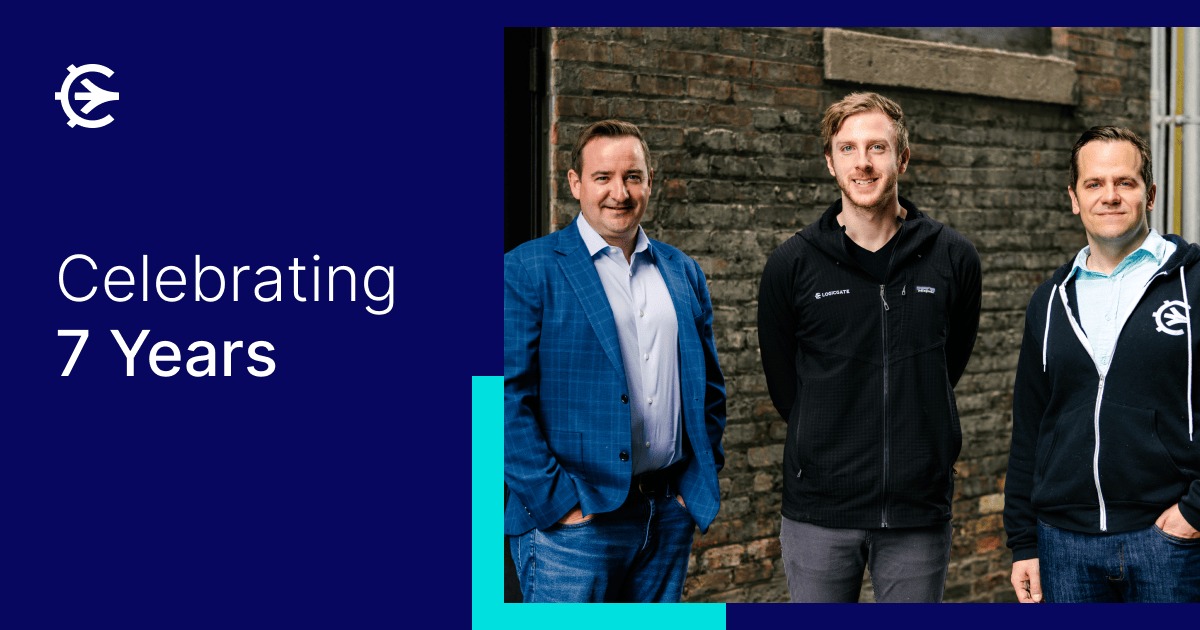
The trio's division of labor changed as LogicGate matured, but their shared vocabulary survived. Kunkel became the chief executive, Siegler led product, and Campbell stayed close to the technical foundations. In their anniversary conversations, they do not describe a single dazzling revelation. They describe years of client work, a first customer, a hundredth customer, office moves and course corrections. Company history arrives as a sequence of things made slightly less impossible.
That continuity matters in a category dense with abbreviations and absolutes. The founders were trying to give risk professionals control over systems normally handed down as finished doctrine. Their platform-first approach allowed applications to be linked while remaining configurable. It was an engineering decision, but also a view of expertise: the people running a risk program know details that no universal template can anticipate. Good software should preserve room for that knowledge.
When the room finally looked real
Startups acquire legitimacy in peculiar increments. A customer says yes. A second customer says yes without being related to the first. Somebody prints a sign. For Campbell, one memory stands above the spreadsheets of conventional milestones. In 2019, LogicGate moved into what felt like its first real office. The company held a kickoff party with investors, customers and friends. There was live music. The evening ran late. For once, the evidence of the company was standing in the same room.
By then the private build had become a public organization. LogicGate raised a $7.5 million Series A in 2018. It crossed the 100-customer line, moved offices more than once and expanded internationally. In July 2021, it announced a $113 million Series C led by PSG, taking company-reported funding to $156 million. The round was intended for product development, partnerships, international reach and security. These are large numbers, though their most useful meaning is simple: the little argument about flexible software had found a market.
Founders are legally obliged, it sometimes seems, to varnish hardship into myth. Campbell and his colleagues have offered something more edible. During LogicGate's tenth-anniversary podcast, he compared the startup journey to a vodka sugar-free Red Bull. The early company, the founders joked, ran on Red Bull and Hot Pockets. Supply the programmers with both, wait 24 hours, inspect the result. It is not a nutrition plan. It is, however, an honest period detail.
“Write some code.”Campbell's compact answer during LogicGate's ten-year retrospective
The architect after the groundbreaking
Campbell's title shifted with the scale of the company. Early profiles called him co-founder and chief technology officer. Today he is Co-Founder and Chief Architect. The distinction suits his public body of work. He writes less like a corporate herald and more like someone worrying a system until its joints become visible.
His articles have considered how graph databases expose connections, how organizations can coordinate vulnerability management against ransomware, and how risk quantification can create a common measure for very different business dangers. Each subject returns to the same design problem: information lives in different places, while decisions need a connected view. Centralize without making the system rigid. Automate without pretending the organization will stop changing.
Even his examples favor practical consequences over architectural theater. A connected model can reveal how a vulnerability reaches across departments. A common risk measure can help leaders compare investments that otherwise speak different numerical dialects. The machinery earns its keep only when somebody can make a better decision with it.
The next system must explain itself
Governance software is now meeting a technology far less predictable than a spreadsheet. LogicGate has placed AI governance and software agents inside its current product story. In 2026, Diego Panama succeeded Kunkel as CEO, while Kunkel moved to Executive Chairman and Siegler expanded his remit as Chief Product and Technology Officer. Campbell stayed as Chief Architect. On announcing the transition, he wrote that there was still much to accomplish in the “Agentic GRC era.”
The language has changed, but his old architectural concern has not. AI introduces more relationships, faster decisions and a fresh catalog of things that can surprise a company. A useful risk system must connect evidence, preserve human oversight and adapt without dissolving into improvisation. The architecture has to permit motion and provide handrails. Useful friction, in other words.
Campbell's career offers a modest corrective to the familiar founder portrait. The important act is not always the lightning strike of an idea. Sometimes it is the decade spent keeping the original idea technically honest. Software should fit the organization. Relationships matter. Flexibility must extend below the screen. Use the right database for the right job.
After the funding rounds, customer milestones and office parties, he remains the fellow who can answer a grand question with a small instruction: write some code. Architecture begins with a philosophy. Eventually, somebody has to make it run.