Mini Peiris arrived at Cornerstone OnDemand in December 2025 with a peculiar advantage: she had already watched several versions of the future become ordinary. The cloud had gone from a suspicious place to put company accounts to the default address for business software. Mobile screens had shrunk the distance between a sales pitch and a thumb. Artificial intelligence had moved from a technical capability to a phrase pasted on nearly every corporate plan. Each transition produced its own vocabulary. Peiris made a career out of translating it.
Her latest assignment is broad even by C-suite standards. As chief marketing officer, she leads Cornerstone's brand strategy, marketing operations, field marketing, demand generation, and its product, partner, and customer marketing teams. The company sells software for learning, skills, and workforce readiness. In other words, Peiris is marketing technology about people at the moment when technology is making companies reconsider what their people should do.
She does not approach that knot as a lifelong human-resources specialist. Her route has crossed enterprise resource planning, customer relationship management, medical-imaging software, supply chains, home closings, process automation, AI data, and now workforce technology. If a conventional executive biography resembles a staircase, hers looks more like a subway map drawn by someone who enjoys changing trains.
“I've long believed that it's best to let your customers tell your story.”Mini Peiris, on customer marketing
The biology graduate who chose product
Peiris graduated from the University of Michigan in 1995 with a Bachelor of Science in cellular molecular biology. Her first work was scientific research at Janssen Pharmaceutical, studying drug stability. It is tempting to turn that beginning into a neat metaphor about controlled experiments. Careers rarely cooperate so politely. What is clear is that she left the laboratory for software and learned the business from the product outward.
At Interact Commerce she held senior product-management roles for ACT! and SalesLogix. She worked on SalesLogix for Web, an early browser-based customer-relationship application. This was a period when putting business software in a browser was still sufficiently novel to require explanation. Product managers had to understand the code, the commercial promise, and the hesitation sitting between the two.
That functional apprenticeship matters more than the chronological tidiness of her job history. Product management taught her what engineers can build and what customers actually request. Product marketing taught her that these are not always the same thing. Global marketing added the larger machinery: demand, events, partners, analysts, pricing, packaging, and a message that hundreds of colleagues must be able to repeat without turning it into soup.
Learning to sell the cloud before it sold itself
In 2002, Peiris joined NetSuite as vice president of product management. NetSuite was an early software-as-a-service company, though the phrase had not yet acquired its later inevitability. She oversaw products spanning enterprise resource planning, customer relationships, ecommerce, and the company's platform. By 2006 she was explaining why an interface filled with AJAX mattered. Later she moved through product marketing to worldwide marketing.
NetSuite became the long apprenticeship at the center of her career. She stayed more than 12 years, from the company's early stage through its 2007 initial public offering and beyond. As the worldwide marketing leader, she helped support go-to-market growth from $100 million to $750 million. The figure is striking, but its real subject is repetition. Enterprise software is not scaled by inventing a fresh identity every Tuesday. It is scaled by finding the few ideas a company can keep saying as its products, buyers, and ambitions expand.
Peiris later described NetSuite's message as three light bulbs: the cloud, the suite, and a third idea that evolved from small businesses to industries as the company moved upmarket. The image is almost comically simple. That is the point. She has said engineering-minded leaders must be comfortable saying the same thing for ten years. A brand is not a creative writing competition conducted each quarter.
The customer gathering grew with the company. SuiteWorld reached 5,000 attendees from 30 countries in 2013, moving into the San Jose Convention Center. A user conference of that size is a business system disguised as lanyards and coffee. It creates product feedback, customer identity, partner energy, and demand whose origin cannot always be assigned to one tidy cell.
A career built by changing the question
Five CMO seats, no favorite industry
After NetSuite, Peiris stopped choosing familiar categories. She became chief marketing officer of DICOM Grid, which rebranded as Ambra Health, then moved to supply-chain software company Elementum. In 2020 she joined real-estate technology company Doma. Each move demanded a new map of the customer: different language, different stakes, different buying committees. The repeated job title concealed a fresh learning curve.
The changes also widened her view beyond the marketing department. In 2022 she joined Appen as an independent non-executive director and sat on its People and Culture Committee. That role lasted until May 2025. She also became an executive in residence and go-to-market advisor with Scale Venture Partners, helping emerging software companies with such unglamorous and necessary matters as ideal-customer profiles, pipeline models, product marketing, and budgets.
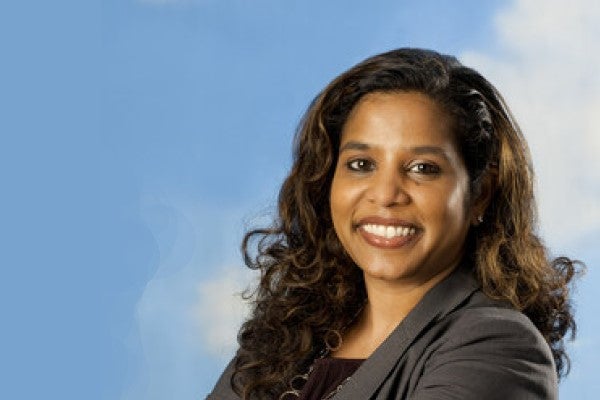
She joined Nintex as CMO in October 2023 after taking the first sustained break of her 20-plus-year career. The intermission was not especially monastic. Peiris traveled with family to Belize, Roatán, Botswana, New York, and London, including separate trips with each of her children. Between journeys she worked with Scale's advisor group. Rest, in this telling, included five trips and advising startups. Some people recharge their batteries; Peiris appears to have installed a second one.
At Nintex, she oversaw global go-to-market strategy and helped shift the company's positioning from process automation toward agentic business orchestration. The phrase is technical, but her brand premise remained stubbornly human. Nintex asked customers about their most significant business challenge. The leading answers concerned people: retaining them, leading them, keeping them happy. The resulting brand anchored automation in the possibilities it could unlock for the people doing the work.
The buyer behind the buying committee
Peiris's most useful marketing doctrine sounds almost too plain to print: buyers are people. In business-to-business software, the language of accounts, segments, personas, and pipeline can make the purchaser disappear. Her argument is that a brand should help buyers recognize themselves, their problem, and the better version of themselves they hope the product makes possible. The customer, not the vendor, gets the leading role.
This belief makes room for activities that produce value before they produce a measurable lead. She has spoken about customer advocacy as a pipeline that attribution software cannot perfectly track. At one company, community formed around donuts. At Dreamforce in 2024, the Nintex team was running two full days of meetings in a space outside the conference crush when a customer wanted ice cream. They improvised an ice-cream social. There is no grand theory of frozen dessert here. There is simply an alertness to the moment when a transaction becomes a relationship.
A company needs positioning sturdy enough to survive repetition. At NetSuite, three simple “light bulbs” carried the message across products and years: cloud delivery, an integrated suite, and a clear customer focus that evolved as the business grew.
That warmth sits beside a distinctly operational streak. In product-marketing workshops, Peiris has pushed for alignment among marketing, product management, and engineering; pricing tied to customer value; seller enablement built around actual sales calls; and launch teams accountable to revenue outcomes. The soft and hard parts are not rivals. A customer story without operating discipline becomes decoration. A dashboard without empathy becomes bureaucracy in a nice chart.
“The future won't belong to organizations with the most AI. It will belong to the ones who know how to use AI to make people better.”Mini Peiris, reflecting on her first months at Cornerstone
The next translation is already here
Five months into the Cornerstone role, Peiris described a sprint of customer and partner listening, two sales kickoffs, product-strategy sessions, quarterly business reviews, and positioning work with industry analysts. She called the period a roller coaster, which may be the most economical description available for becoming a CMO while every meeting contains the letters A and I.
Her emerging frame is “constant reinvention.” The Information Age gave way to the Cloud Age, which gave way to the AI Age. Peiris wonders whether the next one might be a Wisdom Age, defined not by possessing the most artificial intelligence but by applying it in service of human judgment. It is a useful distinction for a workforce-software company. Employees do not experience technological change as a market category. They experience it as a new task, a vanished routine, a skill they need, or a manager asking them to try again.
The idea also connects her professional past to her present. Early in her career, she translated browser software and cloud delivery for skeptical business buyers. At Nintex, she translated automation and AI agents into a story about removing friction from people's work. At Cornerstone, the task is to explain how AI can expand human capability without making the human sound like an inconvenient legacy system.
In August 2026, that remit acquired a nonprofit dimension when Peiris joined the board of the Cornerstone OnDemand Foundation. The foundation provides free learning to nonprofit, development, and humanitarian professionals through programs including DisasterReady and NonprofitReady. It is an apt extension of her day job: the same craft of building awareness, directed toward people who need useful training wherever they can access it.
Peiris has also spent time mentoring and judging girls' teams in the Technovation Challenge, where participants build mobile applications around social problems and learn to write a business plan and pitch. The pattern is consistent. Product is not separate from story. Skill is not separate from confidence. Technology matters when a person can understand it, use it, and persuade someone else that it belongs in the world.
After more than 25 years, the vocabulary around Peiris keeps changing. The job underneath it has not. Learn a complicated system. Find the few truths worth repeating. Invite the customer into the sentence. Then repeat it long enough for an unfamiliar future to feel usable.