Before a SailPoint sales engineer could demonstrate the product, there was another job to do: check the demonstration itself. Shared third-party environments might have changed. Integrations needed testing. Afterwards came cleanup. Across a team of 150 sales engineers and a product with more than 200 integrations, the sales pitch carried a considerable backstage operation.
- Walnut captures software interfaces and turns them into editable, interactive demos.
- Sales teams can personalize and reuse those demos; buyers can explore them independently.
- The payoff depends on the preparation work saved and the relevance of the story told.
The hour nobody buys
SailPoint’s December 2023 customer account describes engineers spending more than an hour preparing an environment for a single demo. Walnut reduced that burden by making demonstrations easier to maintain and share. SailPoint reported a 75% rise in demo views within one quarter. More views are useful; they are also a different measure from more sales.
“The cost of maintaining and delivering demos made it impossible for us to scale”
Ian Gritter · SailPoint · customer account
Here is an awkward possibility for anyone selling software: the presentation can become harder to operate than the argument is to make. The buyer wants to understand a result. The seller is worrying about an environment. Walnut built a company around the space between those two concerns.
A product with its stage fright removed
Founded in 2020 by Yoav Vilner and Danni Friedland, Walnut makes codeless interactive product demos for B2B teams. Its current platform captures a product’s HTML interface, then lets teams edit content, arrange a guided journey and personalize what the prospect sees. The experience can travel through a website, email or sales conversation.
The mechanism matters. A captured interface gives the seller control over the presentation without requiring the live application to behave perfectly on cue. Names, data and messaging can fit the account. A prospect can click through a relevant workflow rather than watch a representative tour every available button. Software occasionally deserves an editor as much as a developer.
- 01CaptureProduct screens
- 02TailorBuyer context
- 03ShareA clickable story
- 04ReviewEngagement signals
Walnut’s customers include Adobe and NetApp, and it reports more than 500 customers on its About page. Its expertise sits between product storytelling, sales enablement and buyer analytics. Marketing can offer an early tour; presales can reuse an approved scenario; customer success can explain an expansion. One captured experience acquires several jobs.
The idea attracted a $15 million Series A in 2021, followed by a $35 million Series B led by Felicis in January 2022. Walnut reported $56 million raised in total. That is financing, rather than evidence of customer returns. Its commercial argument still comes down to a smaller question: how much useful selling time can a repeatable demo recover?
Make the template do the work
Forma, which sells flexible employee benefits software, had a particular problem. Employers differ, so a fixed demonstration could make a flexible product look oddly inflexible. Product marketing lead Danielle Ross needed to help a growing sales team without appearing in every deal.
Her approach was to build customizable templates, then let account executives adapt them with variables and find-and-replace. Forma’s April 2025 account describes a seller preparing a custom demo with ten minutes’ notice. The practical lesson is pleasantly unglamorous: standardize the parts that repeat, and reserve the work for the parts that make the buyer feel understood.
This is also a useful way to read Walnut’s positioning. Reprise, Demostack, Navattic and Storylane inhabit the same broad demo market. Walnut combines editable captured experiences with distribution, buyer engagement and support. Its distinction is that combination, rather than a claim that nobody else can make a clickable tour.

The demo follows the buyer home
In July 2025, Walnut announced its Interactive Deal Room: a shared place for demos, documents, collaboration and mutual action plans. The announcement named Eric Anderson as CEO, following the company’s earlier notice that Vilner had moved to a board role. The product widened the original proposition from showing software to helping a buying group navigate a deal.
That makes sense when the person on the call must explain the product to someone who missed it. A shareable demo preserves more of the experience than a recollection of a screen-share. Engagement records can help a seller choose the next conversation. They remain clues: curiosity and purchase intent are not interchangeable.
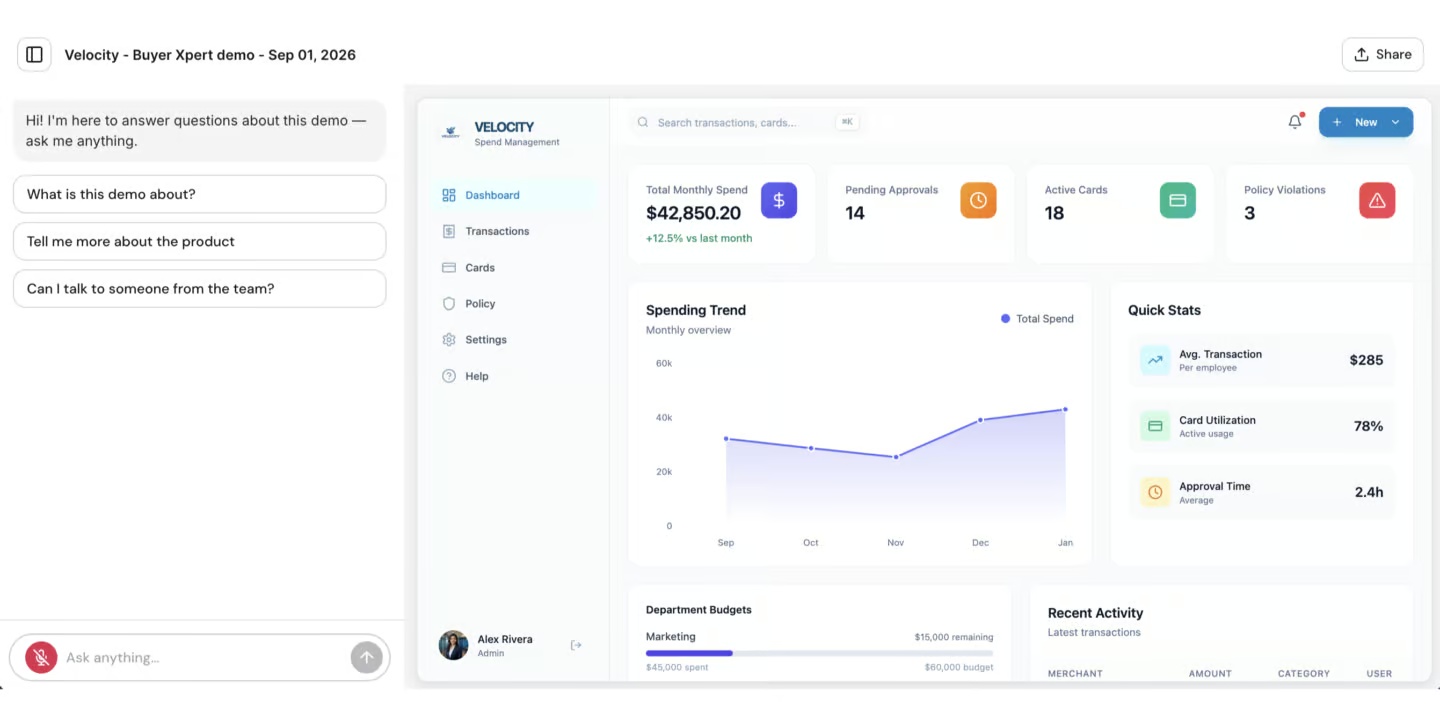
Walnut’s 2025 recap describes AI Mode, Story Capture and video overlays. The current site also promotes Buyer Xpert, an assistant inside the demo that answers from approved content and can hand a question to a person. AI helps assemble and explain the experience; the team still needs to choose the argument and review what reaches the buyer.
The bill behind the click
As checked on October 3, 2026, Ignite costs $575 a month, billed annually; Accelerate costs $1,550. Scale has a custom price. Plans combine seats with pooled AI credits, with top-ups available. The entry plan’s annual commitment is therefore $6,900 before extras. Unlimited demos do not mean unlimited AI generation.
Monthly list price × 12. Scale: custom quote. Extras excluded.
The sensible comparison is with the labour already consumed by preparation, personalization and upkeep. For a team repeating complex demonstrations, that bill may justify a subscription. For someone with a simple product and a perfectly adequate video, the arithmetic is less persuasive. A new sales tool should earn its place on the invoice.
Give the library an owner
Riverbed’s customer account supplies another operating detail: it assigned responsibility for creating and maintaining its scenario library to a sales manager. The library supported a roadshow across five cities. Repeatability came with ownership. Someone still had to keep the story consistent.
Readers can copy that discipline without copying the procurement decision. Start with one recurring buyer question. Build the shortest credible workflow that answers it. Let sellers change the relevant details. Review where people stop, and appoint someone to update the underlying material.
A captured demo cannot establish production performance, validate a real integration or replace a trial with customer data. Those questions need separate evidence. Walnut is most useful when a team knows the difference between explaining a product and proving it under working conditions. Removing the presentation’s stage fright is valuable. The product must still deserve the applause.