The meeting has gone beautifully. Everyone nods. The buyer says, with cheerful precision, “Send me the proposal and I’ll speak to my manager.” Then the proposal departs as an email attachment and enters the administrative afterlife. Was it opened? Forwarded? Read by the manager? Loved, loathed or merely lost beneath a lunch receipt? The seller knows only that Tuesday has become Friday.
- GetAccept gives a B2B deal one shared link for content, conversation, action plans, proposals, contracts and signatures.
- Its best fit is a considered sale with several people, several steps and a CRM the team actually uses.
- The full Professional product is listed at $49 per user per month, with a five-user minimum; Enterprise pricing is negotiated.
- The useful idea to copy is simple: make the buyer’s next step visible before asking for the signature.
The first thing to fail was the follow-up
Mathias Thulin knew the disappearing act. He and Samir Smajic had watched good sales meetings become unanswered documents, so they went looking for evidence. In 2015, with Carl Carell and Jonas Blanck, they founded GetAccept in Malmö. The first version was an e-signature and document-tracking service: a way to see what happened after “send.” It did not abolish indecision. It made indecision observable.
The company’s first office was Carell’s bedroom. Seventeen customers signed up in December 2015. The four founders had just been accepted to Y Combinator and moved to Silicon Valley for the Winter 2016 batch. Carell later wrote that the company reached roughly $300,000 in annual recurring revenue during those 90 days. The origin has the appealing compression of a fable: four Swedes, one bedroom, 17 customers and an inbox full of unanswered questions.

By 2017, GetAccept had raised a $1.6 million seed round. DN Capital led a $7 million Series A in 2019. In December 2020, while remote selling had changed from forecast to compulsory habit, Bessemer Venture Partners led a $20 million Series B. Public round announcements put total financing above $30 million. The money paid for a larger ambition: not simply to sign the document, but to own the untidy stretch of work before it.
A proposal grows walls
The product today is a Digital Sales Room, a phrase that sounds grander than its architecture. Think of one buyer-facing workspace. The seller places the meeting notes, videos, case studies, pricing and proposal inside it. Buyer and seller chat there. A mutual action plan names the next steps. Engagement analytics show which material was viewed and whether new stakeholders appeared. A Contract Room carries the process through redlining, approval and electronic signature.
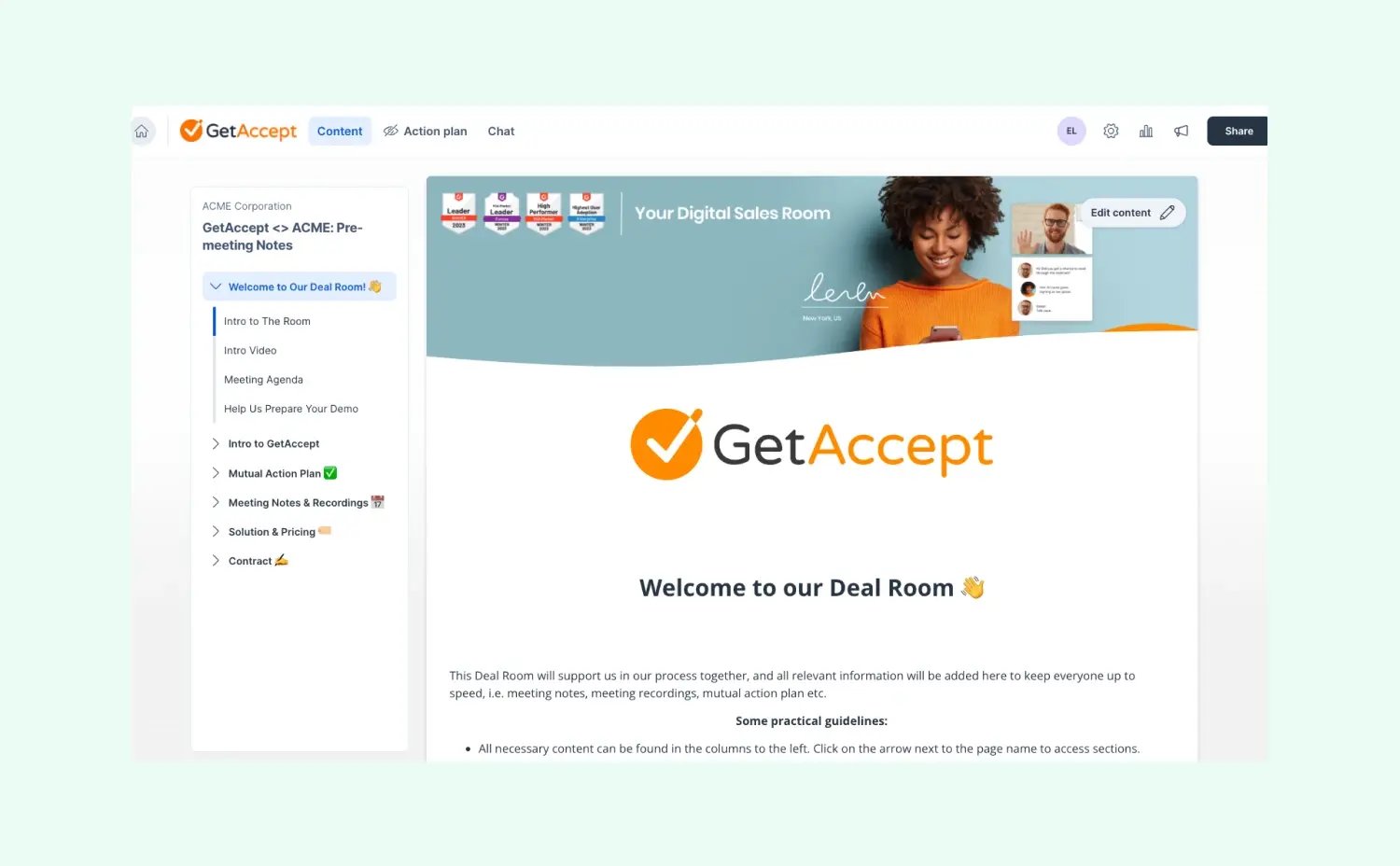
The distinction matters. DocuSign and Adobe Acrobat Sign are natural alternatives at the signature end. PandaDoc lives nearer proposals. Highspot, Showpad and Seismic organize sales content. Aligned, Dock, trumpet and Flowla offer their own versions of the shared buyer space. GetAccept’s wager is that native signatures, proposal editing, CPQ, buyer collaboration and CRM data belong to one continuous object. The buyer experiences a deal, after all, not a software stack.
The software works by making a habit visible
SalesScreen’s published case study is the neatest demonstration. Its enterprise win rate moved from 13 percent to 26 percent after it changed provider and introduced GetAccept. Revenue growth doubled from one quarter to the next. Those numbers belong to one customer, and SalesScreen explicitly says the software was not the only change. The more revealing detail is procedural: reps followed eight quality principles and began each room with a template that forced them to state the buyer’s problem, desired outcome, expected impact and next step.
One customer’s reported result
This is the sly part of the Digital Sales Room. It appears to organize the buyer’s material, but it also compels the seller to organize the seller’s thinking. The analytics can answer whether a deal is “ice cold or warm,” as SalesScreen’s Remi Morken put it. The template asks a less comfortable question first: did the rep build a case worth reading?
The price of one more room
GetAccept is subscription software. Its public 2026 pricing lists eSign at $25 per user per month. Professional, the fuller sales-room experience, is $49 per user per month with a five-user minimum - $245 a month before optional extras. Enterprise is custom-priced and adds capabilities such as CPQ, SSO, API access and premium CRM integrations.
That arithmetic clarifies the customer. A five-person team selling complex software, services, property or logistics contracts can plausibly recover the cost by shortening one deal or reducing proposal work. A solo seller closing simple transactions may find the room more elaborate than the conversation. It also loses force when reps refuse to maintain the CRM, when buyers are locked inside a formal procurement portal, or when every deal is too different to benefit from templates. An empty shared workspace is merely an attachment with better lighting.
AI enters with the minutes
In October 2025, GetAccept put AI-powered Smart Content into early access. Instead of prompting a general chatbot and pasting the answer into a proposal, a rep can ask for a business case or executive summary using the material already attached to the deal: meeting transcripts, buyer data, seller data and room content. Managers can save approved prompts. GetAccept says the feature can cut the time spent producing some sales material by as much as 83 percent; that is a company claim, not a law of office physics.
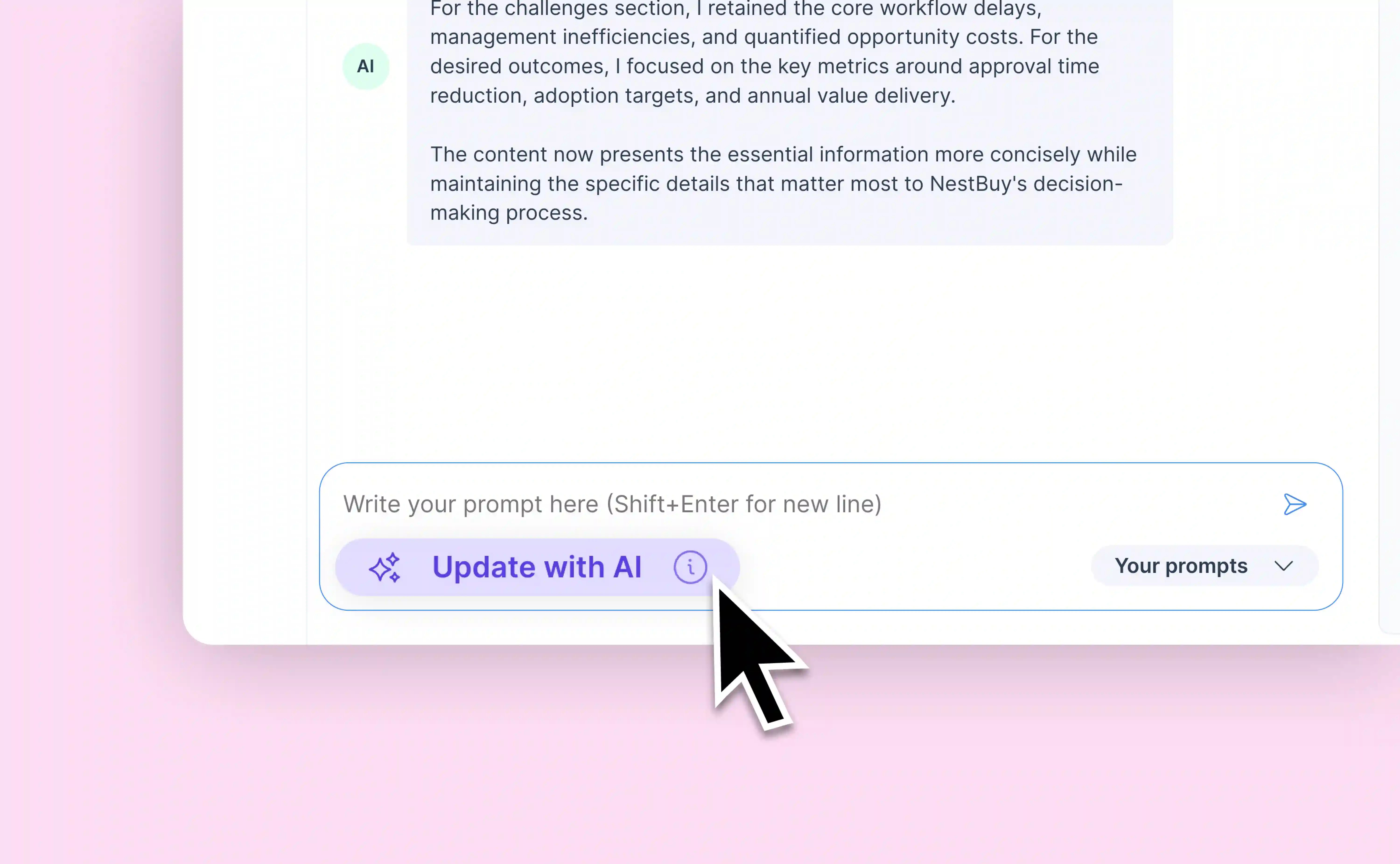
The development is less a pivot than a return to the original question. In 2015, the founders wanted to know what happened to the proposal. In 2025, they wanted the proposal to remember what happened in the meeting. The company says more than 5,000 businesses now use the platform. Its customer list crosses SaaS, hotels, professional services, finance and property. Its integrations with Salesforce, HubSpot, Microsoft Dynamics, Pipedrive and SuperOffice are not decorative: the room is most useful when it sits beside the system where the revenue team already works.
What another team can steal
The reusable lesson does not require buying GetAccept. It requires treating the sale as a joint project rather than a sequence of seller broadcasts.
- Give the deal one canonical link. Stop making a buying committee reconstruct your argument from six threads and three filenames.
- Write the buyer’s problem and desired outcome before presenting features. If the template cannot force clarity, it will only standardize vagueness.
- Put names and dates beside next steps. A mutual action plan is useful precisely because politeness is not a project manager.
- Measure engagement as a clue, not a verdict. Time on the pricing page invites a conversation; it does not reveal a person’s soul.
- Keep the workspace where reps already work. Adoption collapses when the team must perform the same administrative ritual twice.
GetAccept’s real product is continuity. The meeting should remember the discovery. The proposal should remember the meeting. The contract should remember the proposal. The CRM should remember all of them. There is nothing mystical in this. But in enterprise sales, where memory is distributed among inboxes, calendars and people who missed the call, continuity can look rather like intelligence.