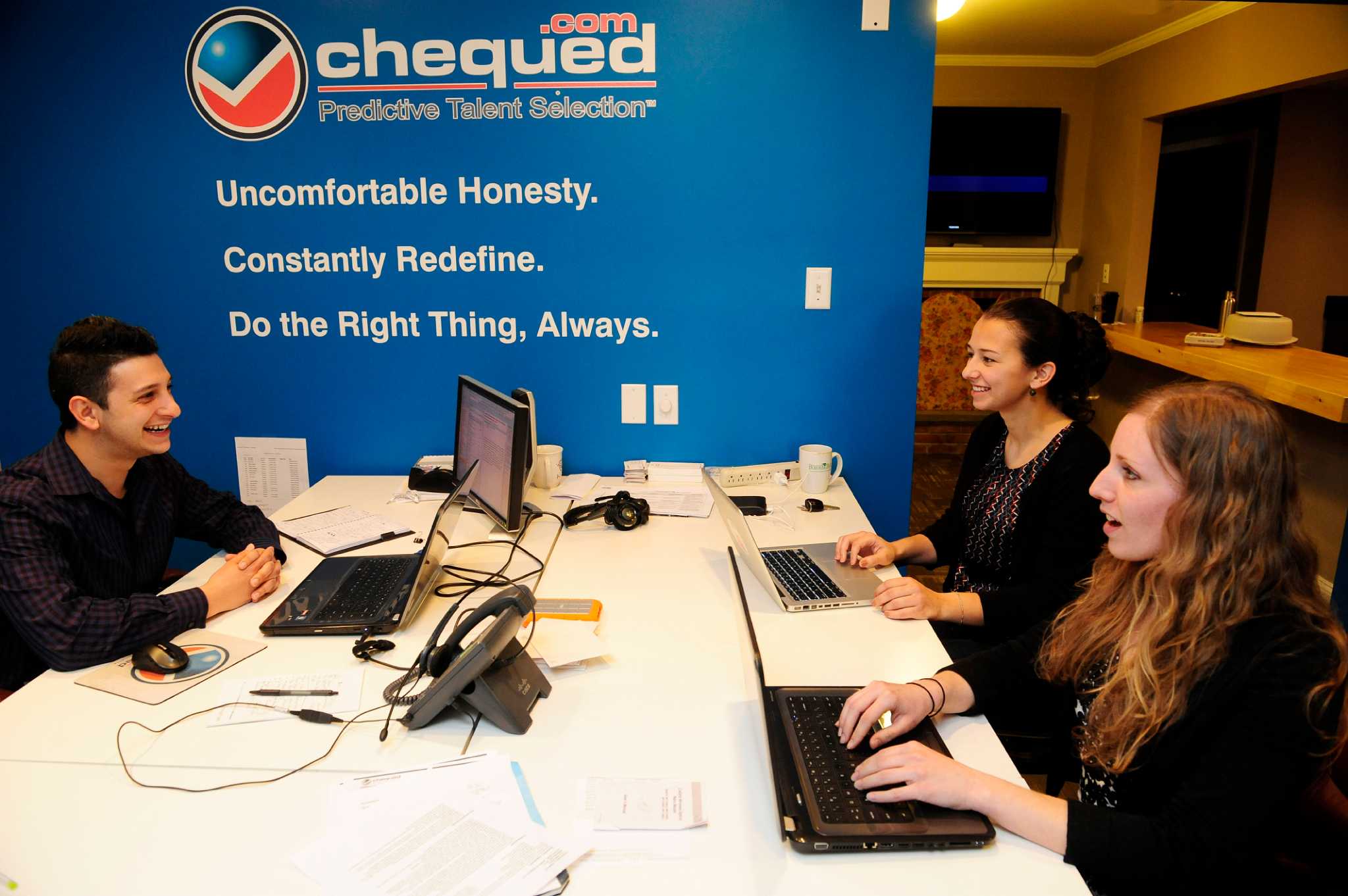
On a spring day in 2014, Andrew D'Agostino sat at the left edge of a white table in Saratoga Springs. Two laptops were open. A desk phone occupied valuable acreage. Papers had achieved the natural habitat of papers: everywhere. Across from him sat University at Albany doctoral students and interns. Behind the group, painted on a blue wall in letters too large to ignore, were three company vows: “Uncomfortable Honesty. Constantly Redefine. Do the Right Thing, Always.”
D'Agostino was the product manager at Chequed.com, a 25-person software company that combined automated hiring tools with industrial and organizational psychology. He also served as senior consultant to the university science team. The photograph feels like an accidental diagram of his career. Put the operator at the crowded table. Place the researchers, the software, the customer problem and the awkward telephone within arm's reach. Then ask him to translate.
Twelve years later, D'Agostino became Chief Marketing Officer of Conquer, a Salesforce-native sales communications and engagement company. The job title changed several times between those two scenes. The basic assignment did not. He kept turning up where one part of a business needed to understand another.
First, learn how the signal is made
Chequed.com sold a promise executives could appreciate and candidates might reasonably fear: use data to make a better hiring decision. Its software drew on psychology research, and its relationship with UAlbany helped turn graduate work into commercial tools. D'Agostino's place between the product and the science required more than feature management. He had to understand how an idea became evidence, how evidence became software and how software became an intelligible choice for a customer.
By 2019, Chequed.com had become part of OutMatch, and D'Agostino was Senior Product Management Director. When the company released tools called Compare and Succeed, he described the human problem plainly: “Candidates fear being overlooked.” The products were designed to surface transferable abilities and show employers plausible matches they might otherwise miss.
Candidates fear being overlooked.Andrew D'Agostino, on OutMatch's Compare and Succeed launch
That sentence is short, humane and commercially useful. It starts with the person experiencing the system, not the system itself. The marketer D'Agostino would later become was already visible inside the product manager: identify the anxiety, give it ordinary language, then connect it to what the product can actually do.
The OutMatch chapter expanded. His work crossed product management and sales enablement, then continued into Harver after the companies joined. A former colleague later praised his research, product strategy and ability to bring teams through the complexity of four acquisitions they experienced together. Conquer's own introduction to D'Agostino describes an even wider career tally: more than 10 acquisitions navigated and a journey that scaled revenue to $50 million.
The point guard does not hoard the ball
Acquisitions are corporate grammar lessons conducted during an earthquake. Teams inherit unfamiliar nouns, overlapping verbs and at least three definitions of “qualified.” Product calls something a capability. Marketing calls it a story. Sales calls it Tuesday's objection. Customer success calls it the reason an account renews. If nobody reconciles the language, the company can possess more talent and less coordination.
This is where D'Agostino's favorite metaphor earns its keep. In a 2025 conversation on Conquer's The Future of Selling, he argued that sales enablement had grown beyond training representatives. It had become the connective tissue of the go-to-market motion. The enablement leader, in his telling, plays point guard: aligning product, marketing, sales and account management, then helping strategy survive contact with daily work.
The revenue court
knows the capability
frames the demand
runs the conversation
hears the outcome
Enablement moves the information. The play works when every role recognizes the same customer, the same problem and the same next step.
The basketball image is revealing because the point guard is judged by the possession, not merely the shot. The glamour is distributed. The useful work happens in timing, field of vision and the pass made one beat before everyone else sees it. It is an unusually modest metaphor for an executive discipline, which may be why it sounds credible.
D'Agostino's prescriptions are similarly unromantic. Create a common language. Qualify opportunities ruthlessly. Remove friction from the selling process. Use frameworks such as MEDDIC and Force Management where they clarify decisions. Apply AI to coaching and insight, but give it a coherent process to improve. A machine can summarize the game film. It cannot make four departments agree which game they are playing.
A marketing department built from the seams
When D'Agostino moved to Conquer, he carried product instincts into a company devoted to the mechanics of revenue work: voice, email, text, workflow automation, coaching and attribution inside Salesforce. In 2025, as Head of Marketing, he hired and assembled a team that, in his account, exceeded its goals. He became CMO effective January 1, 2026.
His announcement was warm rather than imperial. He called the promotion the culmination of 15 years of work, learning and growth. He praised the team for how its members collaborated and supported one another. Then he named two mentors, Jim Trimarco and Greg Moran, and said he would not be where he was without them. Moran had also been the chief executive of Chequed.com in that 2014 office. The new title did not sever the old thread; it made the thread visible.
- Product manager at Chequed.com, working alongside UAlbany's psychology researchers.
- Senior Product Management Director at OutMatch, explaining talent products in human terms.
- Service alongside the day job: co-chair of the OutMatch Foundation, then an executive-board member of Harver's PRIDE employee group.
- Conquer's Head of Marketing and a public teacher of cross-functional sales enablement.
- Chief Marketing Officer at Conquer.
There is another line in the record, away from revenue targets. From July 2020 through October 2021, D'Agostino co-chaired the OutMatch Foundation. Its stated mission imagined a world in which every person could have a path, a purpose and a dream, with the chance to succeed treated as a right. From February 2023 through October 2024, he served on the executive board of Harver's PRIDE employee affinity group, helping set direction for a workplace space organized around belonging.
Those roles rhyme with his product work more than they first appear to. The 2019 tools sought to prevent a candidate's capabilities from disappearing inside a narrow job description. The employee group sought to prevent colleagues from disappearing inside an organization. The foundation placed access to opportunity at the center. In each case, the work challenged a system to recognize more of the person standing in front of it. One should be careful about turning a résumé into a grand theory, but repetition deserves notice.
It also gives the word “alignment” some moral weight. Alignment can sound like a tasteful diagram with arrows pointed in agreeable directions. In practice, it means deciding whose information enters the room, whose language gets adopted and whether the system can register talent that arrived in an unfamiliar package. The point guard must see the whole floor, including the players who have not been passed the ball.
The team itself offers a practical test of his alignment doctrine. Conquer embedded content, design and demand-generation colleagues in Kosovo through Outsorcy. In roughly a year, the group established a steady inbound flow, doubled organic traffic and helped launch a product. D'Agostino went to Kosovo to meet them.
A transatlantic visit is not a management framework, thank goodness. It is evidence of one. Distributed work can reduce people to rectangles in a meeting grid, while executive language turns them into “resources” with alarming efficiency. Getting on a plane restores proportion. The colleague is a person; the team has a place; trust is built at human scale.
Stepping into the CMO role is a personal milestone for me, representing the culmination of 15 years of hard work, learning, and growth.Andrew D'Agostino, announcing his promotion
The work after the title
Conquer's portfolio widened as D'Agostino's responsibilities did. The company acquired Buyerstage in October 2025, adding digital sales rooms and buyer collaboration to its voice, email and SMS foundation. D'Agostino appeared as a media contact on the announcement. By 2026, the company was also promoting a mobile field-sales product and a larger suite spanning communications, AI insights, outsourced talent and marketing attribution.
A CMO confronting that assortment has two possible luxuries, and only one is real. The false luxury is a tidy product story. The real luxury is experience with untidy product stories: years of discovering which distinctions matter to customers, which words survive a sales call and which handoffs leak meaning.
D'Agostino's route has made him fluent in those leaks. He has watched researchers explain models to product teams, product teams equip sellers, acquired companies combine vocabularies and distant colleagues build one marketing engine. Former coworkers describe him as a listener, mentor and cultural anchor. These are soft-sounding skills assigned hard labor. Listening prevents a strategy from being built on an imaginary customer. Mentoring turns individual knowledge into institutional capacity. Culture determines whether anyone admits the handoff is broken.
The old Chequed.com wall had it right about uncomfortable honesty. Every revenue system eventually meets a number it would prefer not to see. The interesting question is whether its people can look together, name the problem in the same language and pass the ball before the clock expires.
D'Agostino ended his promotion note with five brisk words: “Now let's get to work!” It is the natural slogan of an operator promoted into a storytelling job. The exclamation point supplies the celebration. The verb returns everyone to the court.