At about $1 million in annual recurring revenue, a software founder can discover that early success has built a rather elegant cage. Customers bought because the founder knew the product, remembered every objection and could change the pitch between calls. Then the calendar filled. Every promising deal still wanted the founder in the room, the pipeline depended on memory, and hiring a salesperson seemed like the obvious escape. Uncapped has built a business around the suspicion that this escape hatch is often painted on the wall.
The San Francisco consultancy argues that the person is usually hired before the sales motion is ready to be inherited. Its website puts a blunt price beside that mistake: a vice president of sales can command a base salary above $200,000, before equity, recruiting fees and onboarding. Uncapped’s alternative is an embedded go-to-market team that develops the playbook, connects the systems and works inside the client’s tools. The neatest line in its sales copy is only five words: “We build it. You own it.”
Founder instinct does not come with an export button
Uncapped was founded in 2023 by Zoya Segelbacher, a sales-development and enablement operator whose career crossed Medallia, Braze, Gong and Vanta. Those names matter less as badges than as operating environments. At Braze, she managed inbound, outbound, commercial and enterprise business development during the pre-IPO period. At Gong, she moved through SDR management, inside sales management and enablement. She says a later rebuild of a revenue system increased pipeline attainment by 145 percent in under a year.

Her stated reason for starting Uncapped is more pointed than the usual democratization slogan. Premium GTM advice, she observed, tends to reach founders backed by private equity or a large fund. Uncapped would give smaller founder-led companies access to the same kind of operating playbooks, without requiring enterprise overhead. Today LinkedIn lists the company at two to 10 employees; Uncapped calls itself a small, senior team.
“The hire wasn’t wrong. The sequence was.”Uncapped, on the first sales hire
That sentence contains its theory of failure. Founder-led sales is not merely a founder closing deals. It is live research into the ideal customer, buying committee, pricing, objections and language that makes the problem feel urgent. A senior account executive cannot reproduce knowledge that has never been written down. Six months later, Uncapped says, the rep is gone, the founder is back on every call, and a board is wondering why the expensive hire failed.
What the engagement actually buys
The flagship offer, the Embedded Engine, combines leadership and implementation. Outbound GTM Engineering identifies accounts, layers in buyer signals and automates research and routing. Revenue Operations cleans records, defines stages, scores leads and builds a weekly view of deals forming, stalling or leaking. Full-Funnel Marketing joins content, events and paid acquisition. Other work covers founder-led LinkedIn, company narrative, landing pages and sales talk tracks. This is not a fractional CRO who attends Monday’s leadership call and disappears into a calendar. The deliverable is a joined-up operating motion.
One motion, five jobs that usually live in separate rooms
The plus signs are the product. Uncapped competes on the handoffs between disciplines as much as on any single discipline.
Its preferred machinery is recognizably modern SaaS: Clay for enrichment and signal collection, Claude for research and message generation, HubSpot or Salesforce as the record, then sequencers and reporting. An “enrichment waterfall” sounds fancy but is practical: if one data provider lacks a useful field, the request falls to the next. Cleaner account data improves scoring; current signals decide who deserves outreach; the CRM records what happened.
This is where Uncapped’s AI pitch becomes more sensible than magical. The company does not say a language model has acquired sales judgment. It says automation can make a lean team operate with the throughput of a much larger SDR group. Segelbacher has publicly highlighted the danger of the opposite approach: a model can retrieve stale evidence, then make an articulate case for a bad account choice. AI is confident even when the reason to call expired months ago. Clean inputs and human review remain part of the product.
The menu is a staircase, not a buffet
A prospective customer can enter without buying the embedded team. Uncapped publishes a free weekly Revenue Intelligence newsletter, advertised to more than 1,000 founders. The Room costs $99 a month for peer roundtables, discussion threads and a monthly Q&A. A $500 Power Hour concentrates on one problem and promises a prioritized action plan. The Embedded Engine is priced by scope.
Public price markers - not equivalent products
Bars show the hierarchy of published prices, not a linear scale. Equity, recruiting, software and implementation can change total cost.
The company also says payment is based on revenue rather than meetings and presents a modeled case in which a $105,000 engagement produces more than $800,000 in net-new recurring revenue, or 6.6 times ROI. It is marketing arithmetic, not a disclosed client case study, so the useful part is the incentive design rather than the headline return. Conventional agencies can be paid for booked meetings or impressions. Uncapped wants its scorecard nearer closed revenue.
That does not eliminate attribution arguments. Revenue arrives after product work, founder involvement, market timing and the client’s own sales execution. A performance-linked fee can align attention, but only if both sides agree on which accounts, channels and time windows count. The model is strongest when the baseline is clear and the CRM is trustworthy - precisely the conditions an early sales operation may lack.
The first thing to fail is usually the dashboard
Uncapped’s public writing gives founders a useful autopsy kit. A familiar “3x pipeline coverage” ratio can conceal curious prospects, junior contacts without budget and wrong-fit accounts that never had a serious path to close. If coverage rises while win rate falls, the firm argues, qualification has failed. Likewise, scaling 100 generic emails into 10,000 AI-written emails does not repair a weak target list. It amplifies it.
The recommended correction is almost aggressively unromantic: agree on stage definitions; remove deals with no next step or buying authority; inspect conversion by source, segment and rep; review new pipeline creation every week, not merely total coverage; tie every stage and handoff to an owner. Use signals before composing the message. The campaign starts with evidence that somebody may care, not with a paragraph in search of a recipient.
Five moves a founder can copy on Monday
- Write down who buys, why now, the common objection and the real decision-maker.
- Make every pipeline stage mean one observable customer action.
- Delete opportunities with no owner, authority or dated next step.
- Review new qualified pipeline weekly, split by source and segment.
- Trigger outreach from current buyer evidence before asking AI to write it.
A consultancy that behaves like a media company
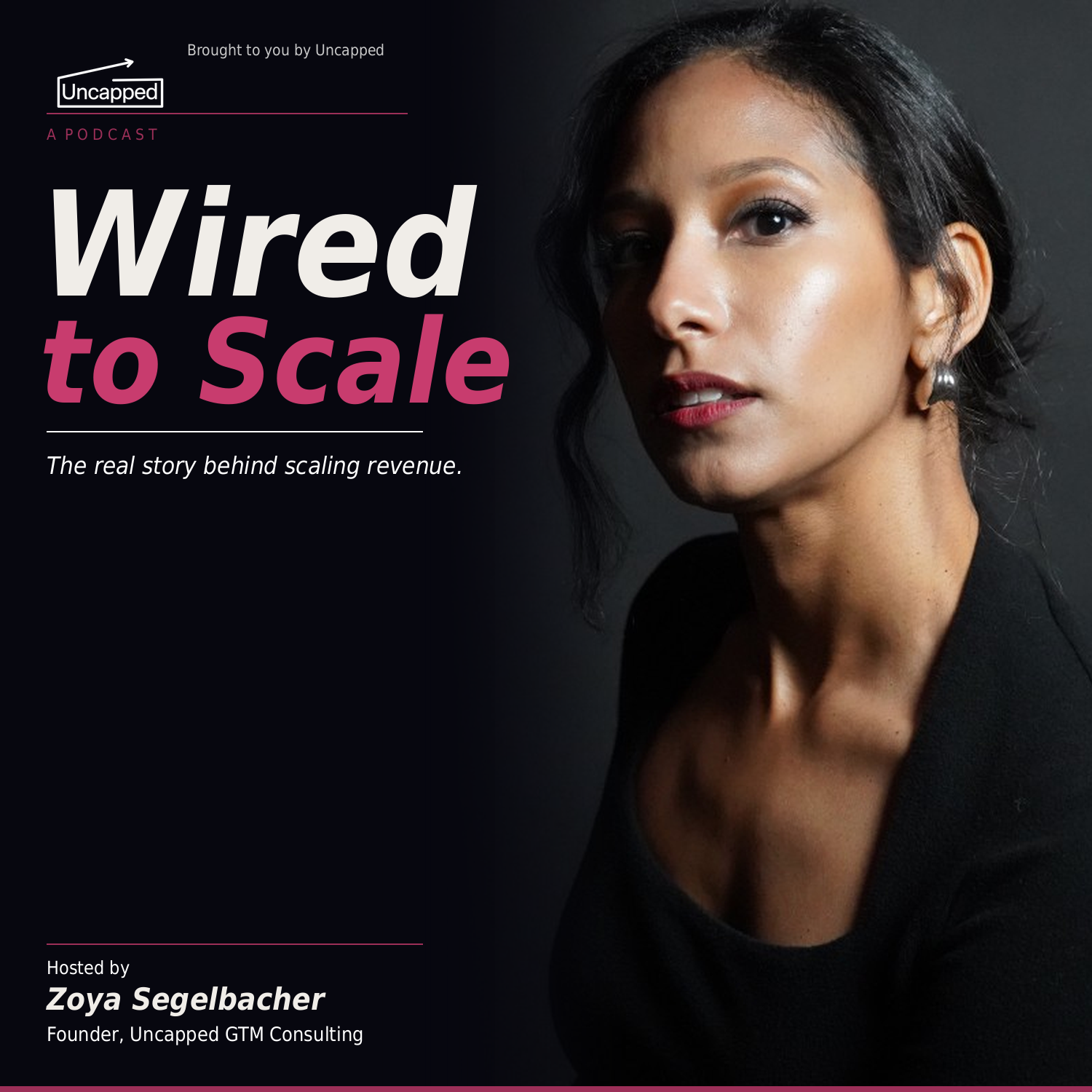
Uncapped’s reach exceeds its client roster because it publishes. The blog has challenged the first-sales-hire sequence, inflated pipeline, AI-era SDR work and the fashionable obsession with outbound volume. Wired to Scale interviews founders and revenue leaders. Recent episodes examined how Syft AI landed a million-dollar Workday deal and a $25 million deepfake fraud case. Monthly events and the founder community complete a small media loop: teach the operating point of view, convene the buyer and sell implementation when the buyer needs help.
Only one advisory customer is named prominently: Hyperbound, the Y Combinator S23 sales-training company, during its early outbound build. There are testimonials about Segelbacher from former colleagues and sales leaders, but Uncapped publishes less client-level evidence than a buyer might want for a six-figure engagement. The business is young. Its case will become more persuasive when revenue-share claims are paired with named baselines, time periods and results.
The fine print is the point
Uncapped’s own qualification narrows the market. The embedded offer is for B2B SaaS founders generally above $1 million ARR, with enough traction to reveal a repeatable pattern and enough ambition to invest in the next system. A pre-revenue startup still searching for a customer may not have a motion to scale. A company unwilling to maintain CRM discipline will contaminate the signals. A business whose buyers cannot be reached through the proposed channels needs a different design. And a founder who wants to outsource every commercial judgment has misunderstood “embedded.” The client team still has to operate what is built.
Good conditions
Clear early traction, founder knowledge worth documenting, reachable B2B buyers, usable data and a team willing to adopt a weekly operating cadence.
Poor conditions
No stable customer pattern, weak product-market fit, dirty records nobody will fix, unrealistic timing or a desire to buy meetings without changing the system.
Its competitive set is therefore broader than fractional CRO consultancies. It includes the founder continuing alone, the premature executive hire, the inexpensive SDR asked to invent a system, and agencies delivering one channel at a time. Uncapped’s position between them is coherent: senior enough to make cross-functional choices, temporary enough to avoid permanent leadership overhead, and involved enough to execute.
The bet is not that permanent leadership is unnecessary. It is that timing changes the value of the hire. A CRO arriving to undefined stages, disputed data and a founder’s private playbook spends expensive months excavating the business. The same leader arriving after the customer pattern, reporting rhythm and channel economics are visible can make decisions sooner. In that sense, Uncapped is selling preparation for an executive as much as substitution for one. Its success should eventually make the embedded team less necessary, not more entrenched.
There is a pleasing tension in the name. “Uncapped” implies growth without a ceiling, but the method is mostly about constraints: fewer accounts, clearer stages, cleaner data, explicit ownership and less indiscriminate volume. That is probably right. Early revenue often comes from hustle; repeatable revenue comes from deciding what no longer counts as a good opportunity. The founder does not need to vanish from sales. The founder needs to stop being the database.