BREAKING — Default announces Series A led by 8VC, reaching $20M total funding New platform ships: a real-time data layer for go-to-market Meet Dot — the revenue agent that speaks your CRM's language Customers include Perplexity, Cortex, Owner, Airbyte Default sets aside $1.5M to buy out legacy GTM contracts Headquarters: New York City BREAKING — Default announces Series A led by 8VC, reaching $20M total funding New platform ships: a real-time data layer for go-to-market Meet Dot — the revenue agent that speaks your CRM's language Customers include Perplexity, Cortex, Owner, Airbyte Default sets aside $1.5M to buy out legacy GTM contracts Headquarters: New York City
Company Profile Go-To-Market Software · New York

Default.com

The data layer and AI agent that revenue teams use to run go-to-market - from lead routing to a unified revenue warehouse.

$20M
Total Funding
~85
Employees
100s
Customers Served
NYC
Headquarters
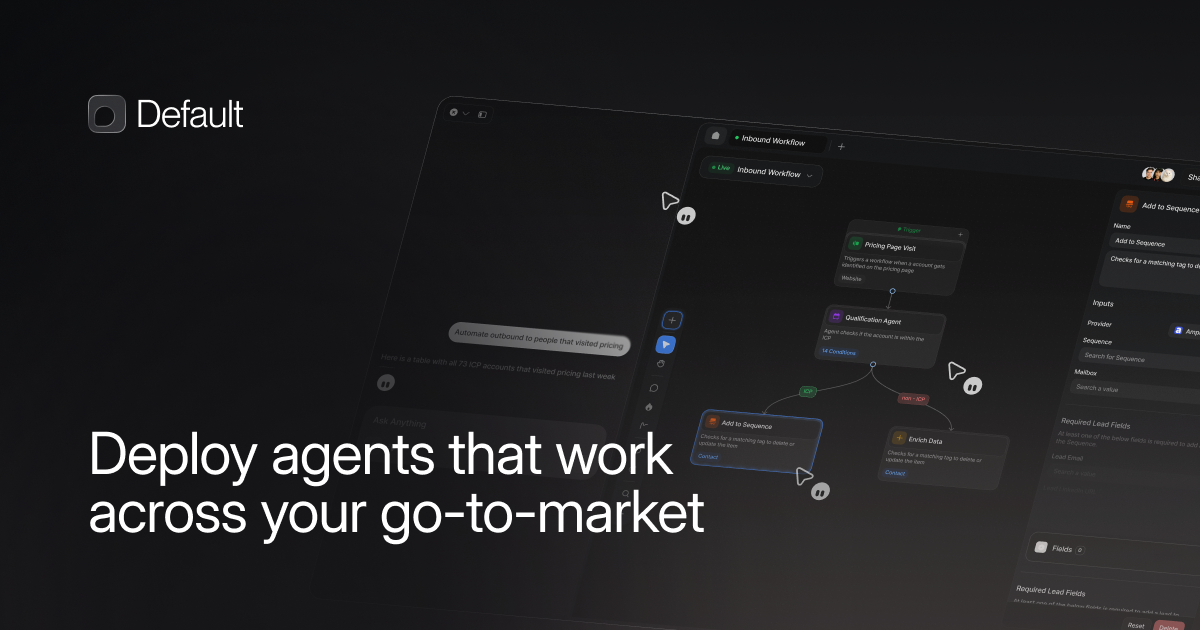
Default brand and product interface showing agents that work across go-to-market

DEFAULT — The New York company's product surface, where the Dot agent runs go-to-market work on a unified revenue data layer. Brand image: default.com

Share LinkedIn X / Twitter Facebook Instagram
The Story

Rebuilding the plumbing of the sales floor

In July 2026, Default did something few software companies do while a product is still selling well: it took the thing apart and rebuilt it. The New York startup, known for helping fast-growing companies route, schedule, and convert inbound leads, announced a Series A led by 8VC - bringing total funding to $20 million - and shipped a new platform built around a single idea. Revenue teams do not need another tool. They need a foundation their tools, their data, and their AI agents can all stand on.

Default was founded by Nico Ferreyra, a college dropout who moved the company from San Francisco to New York and describes it, with a straight face, as the "Costco of go-to-market SaaS" - everything a revenue team needs, bundled under one membership instead of stitched together from a dozen point tools. For about two and a half years, that meant an inbound orchestration platform: lead capture forms, routing rules, automated scheduling, and enrichment, deployed across hundreds of companies including Perplexity, Cortex, Owner, and Airbyte.

Then, by the company's own account, the ground shifted. "In the last 18 months, something changed," Ferreyra wrote. "Teams stopped looking to their tools to solve their growth and scaling challenges, and started looking to their data foundations, systems architecture, and - more recently - their agents." Default's response was to become that foundation.
"Go-to-market teams have never needed tools less than they do today. But the need - and demand - for more data, intelligence, and infrastructure for go-to-market has never been higher." Nico Ferreyra, CEO & Co-Founder
What Default Does

One data layer. A suite of tools. An agent named Dot.

// Foundation

The Data Layer

Connect a CRM, marketing automation, forms, enrichment vendors, and ad platforms, and Default syncs, enriches, and unifies records into a real-time revenue data warehouse with identity resolution - the shared context everything else runs on.

// Agent

Dot

A revenue agent that plans complex work, executes fast queries, and turns plain-language requests into workflows, reports, and operational changes. It speaks the same language as the team and the tools it sits on top of.

// Tools

Stateful GTM Tools

Waterfall enrichment, meeting scheduling, lead routing and assignment, and workflow orchestration - native to the data layer and usable by both people and agents.

Governance built in

Agents propose changes; humans approve before anything ships. Every action is logged and reversible - a design that keeps people in the loop rather than handing the keys to an autonomous system.

What you can actually do with it

Ask Dot to route a new enterprise lead to the right rep, enrich an account, book a meeting, or build a workflow - in plain English - and have it execute against unified, up-to-date data instead of stale, siloed records.

The Problem & The Difference

Why agents keep failing at go-to-market

Default's pitch starts with a diagnosis it says customers keep repeating: every team is trying to build or buy AI agents, and most are hitting the same wall. "Their systems and data are nowhere near ready for them," Ferreyra wrote. "Nobody wants to admit it." A model can be brilliant and still be useless if the records it reads are duplicated across a CRM, a forms tool, and three enrichment vendors that disagree with each other.

That framing is also how Default separates itself from the point tools it grew up alongside. LeanData and Chili Piper do routing and scheduling. Clay and Apollo do enrichment and data. HubSpot and Salesforce anchor the CRM. Default's argument is that bolting an agent onto any one of those does not solve the underlying fragmentation - so it bundles routing, scheduling, enrichment, and workflows on top of a single unified data layer, then lets an agent operate across all of it.

Where the friction lives // approximate, illustrative of Default's thesis

Data scattered across GTM toolsHigh
Teams trying to build/buy agentsRising
Agents production-ready on that dataLow
Appetite for more toolsFalling
"It's the control layer we're using to run GTM from the same brain." Matt McGonegle, Director of GTM Operations, Cortex
Customers & Business Model

Who runs on Default

Default sells subscription access to fast-growing B2B and SaaS revenue, sales, marketing, and operations teams. Its named customers read like a directory of the AI era's breakout companies - and the company says it has served hundreds over roughly two and a half years.

Perplexity Cortex Owner Airbyte WorkOS Hebbia Dust Decagon Air Listen Labs Profound Wispr Flow fal.ai

The bundle

Positioned as an all-in-one alternative to a fragmented stack of point tools - the "Costco of go-to-market SaaS." One platform covering data, routing, scheduling, enrichment, and workflows.

The $1.5M buyout

To ease switching, Default set aside $1.5 million to buy out customers' legacy go-to-market contracts - removing the cost of walking away from incumbent tools.

Funding & Timeline

From $6.6M seed to $20M and a new product

2020 · APPROX.

Default is founded

Nico Ferreyra co-founds Default to fix fragmented inbound go-to-market workflows.

2021

First product ships

An inbound orchestration platform for lead routing, scheduling, forms, and enrichment; a seed round is raised.

NOV 2023

$6.6M seed revealed

Led by Craft Ventures with 8VC, the Jack Altman Fund, BoxGroup, and GTM operators from Ramp, Airtable, Notion, and Figma, alongside an AI-powered inbound funnel.

2025

Market shifts to data & agents

Default closes a Series A and starts building for interoperability between teams, tools, data, and agents.

JUL 2026

New platform & $20M total

Launches the real-time data layer, the Dot agent, and native tools; Series A led by 8VC brings total funding to $20M.

Capital raised // cumulative

Seed (2023)$6.6M
Series A (2026)$20M total

Series A investors: 8VC (lead), Craft Ventures, and Jack Altman. The Series A brought Default to $20M in total funding.

"Building Default to help the next 10 million B2B companies grow from zero to IPO better, faster, and cheaper." Nico Ferreyra
In Their Words

Expertise, on the record

"Today, we're launching Default's new product and announcing our Series A led by 8VC, with participation from Craft and Jack Altman, bringing us to $20m in total funding."

Nico Ferreyra · Series A announcement

"Leads are getting more expensive to generate so they need to be handled intelligently. Fully integrating lead generation and conversion makes it possible for digital businesses to manage their entire customer lifecycle."

Nico Ferreyra · Seed round, 2023

"Every team is trying to build or buy agents with limited success and the same bottlenecks: their systems and data are nowhere near ready for them."

Default · New platform launch

"It's the control layer we're using to run GTM from the same brain."

Matt McGonegle · Cortex
Details That Stick

Five things about Default

1 · The dot in the logo

Default's AI agent is named Dot - echoing the rounded-square mark and its single white shape.

2 · Dropout to CEO

Founder Nico Ferreyra left college and later moved the company from San Francisco to New York.

3 · The Costco line

Ferreyra calls Default the "Costco of go-to-market SaaS" - everything bundled under one membership.

4 · Paying to switch you

The company earmarked $1.5M to buy out customers' existing contracts with competing tools.

5 · The 10-million goal

Its stated mission is to help "the next 10 million B2B companies" grow from zero to IPO.

// Where it fits

The market slot

Default sits between RevOps automation and the emerging category of GTM agents - selling the data foundation and tools that make revenue AI actually work.

Frequently Asked

Questions about Default

What does Default do?

Default provides a real-time data layer and an AI agent (Dot) for go-to-market teams. It connects and unifies CRM, marketing, forms, and enrichment data, then lets teams and Dot run routing, scheduling, enrichment, and workflow automation on top of it.

Who founded Default and where is it based?

Default was co-founded by CEO Nico Ferreyra and is headquartered in New York City, after relocating from San Francisco.

How much funding has Default raised?

Default has raised $20M in total funding, including a $6.6M seed led by Craft Ventures and a Series A led by 8VC with participation from Craft Ventures and Jack Altman.

Who uses Default?

Fast-growing B2B and SaaS revenue teams, including Perplexity, Cortex, Owner, Airbyte, WorkOS, Hebbia, Dust, and Decagon.

How is Default different from LeanData or Chili Piper?

Rather than being a single point tool for routing or scheduling, Default bundles those capabilities on a unified revenue data layer designed so AI agents can execute complex go-to-market work with human approval.

Profile compiled from public sources including default.com, the company's Series A and seed announcements, Sacra, Crunchbase, Demand Gen Report, and Pulse 2.0. Figures such as employee count and revenue are third-party estimates and marked approximate where noted. Founding year is approximate.