Saurav Bubber’s first serious career plan involved a golf club, not a software company. Between 12 and 16, he practiced before school, on weekends and whenever the calendar yielded an opening. He won tournaments and reached a scratch handicap within a few years. Then high school delivered an unsentimental performance review: he was good, but not likely to become a professional. Golf had already done its quieter work. It taught him to repeat a difficult motion, examine the miss and return for another swing.
The next lesson arrived beneath fluorescent lights. McDonald’s rejected his job application four times in succession. At university, he found work setting up campus events - moving tables, cleaning up and doing whatever made the room function before anyone entered it. At 19, he became a bank teller. He remembers the counter as his first real exposure to sales because he talked with people all day. The job was transactional on paper and conversational in practice.
A tidy biography might treat these as charming preliminaries before the respectable work began. That misses their utility. Sales asks for tolerance of rejection. Operations asks that someone notice the tables. Founding asks for repetition without certainty. Bubber collected all three before his résumé acquired the vocabulary to name them.
The adviser becomes an operator
After earning an Honors Business Administration degree from the Richard Ivey School of Business, Bubber went into consulting at Deloitte. He has described that chapter as a place where he learned to think critically and structure problems. It also clarified an appetite. He considered an MBA, then realized he wanted to spend more time building than advising.
At 24, he joined Deel’s go-to-market strategy and operations team. The company was growing quickly, and he supported the GTM organization as annual recurring revenue moved from roughly $50 million to more than $600 million. It was an education in speed, but also in the odd burdens that survive inside successful companies.
Revenue teams depended on a thicket of software. Bubber later described outbound work as a process that could require more than ten tools, with revenue-operations teams holding the pieces together. One system stored records. Another found prospects. Others enriched data, detected intent, sent messages or tracked replies. The stack functioned, but demanded a parallel job: managing the stack itself.
This is the useful distinction in Bubber’s story. He did not encounter sales software as a category slide. He met it as operating friction. The complaint had names, handoffs and browser tabs. When large language models made natural-language interfaces commercially plausible, the accumulated irritation began to look like a product brief.
“We started by talking to people.”Saurav Bubber on FuseAI’s early process
A deadline, several misses and a one-way flight
Bubber left Deel at 26 and gave himself one year to work out what came next. He shipped several things. Most, by his own account, did not work. There is no need to decorate this stretch. Failed experiments are ordinary startup material, useful mainly because each one removes a mistaken conviction.
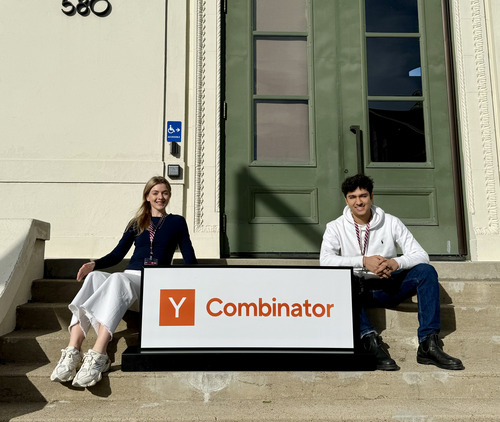
At 27, he booked a one-way flight to Silicon Valley. FuseAI entered Y Combinator’s Winter 2025 batch, with Bubber as co-founder and CEO and Imogen Low as co-founder and CTO. Bubber has also described teaming up with Tristan Zarifa, who brought firsthand sales experience. The cast around the product reflects the product itself: operations, sales and machine learning meeting in one room.
The route, without retrospective destiny
The early method was pointedly manual. Cold calls. Early demos. Listening. Then building, shipping and revising from what people said. Bubber avoids the fantasy that software closes revenue by itself. His stated aim is to make outbound more about relationships and less about redundant systems.
Fewer tabs, more conversation
FuseAI describes itself as an AI-native sales platform for modern revenue teams. Its system brings together data, enrichment, multi-channel automation, buying signals and AI-driven execution. In the company’s framing, a user can give natural-language instructions to build lead lists, research prospects, manage opportunities and engage contacts across email and LinkedIn.
The ambition has broadened with the vocabulary. At Y Combinator, the company called the product an agentic sales platform. Its website now uses “Sales Superintelligence” and says Fuse can work inside Claude to automate sales workflows. Beneath the changing labels, the argument remains stable: the best use of automation is to remove the clerical choreography surrounding a deal.
Bubber has set deliberately aggressive internal yardsticks. FuseAI aims to make sales professionals five times more productive and help a strong representative close $5 million annually rather than a traditional $1 million target. Those are company ambitions, not neutral measurements. Their value today is as a window into the scale of the bet. FuseAI is not trying to become tab number eleven.
“Failure is success in progress.”Saurav Bubber, announcing FuseAI’s Y Combinator selection
The company’s position on people is also clear. Bubber says FuseAI is not intended to replace sales professionals. He wants strong representatives to spend less time moving information between systems and more time building relationships and closing deals. The distinction matters in a category fond of announcing total automation before the demo has loaded.
There is also an operator’s restraint inside the grand language. In one account of the company’s development, Bubber rejected the claim that revenue can simply close on autopilot. The more grounded promise is assistance: research assembled faster, lists built with fewer handoffs, signals converted into tasks and outreach coordinated from the same place. That framing leaves judgment where it belongs. A machine can organize context, but a seller still has to decide whether a prospect is worth pursuing, whether a message deserves sending and whether a conversation has earned its next step. The product is therefore making two bets at once - that AI can compress the routine work and that people will use the recovered time well.
A sales product must ultimately survive a harder test than a clean architecture diagram: sellers have to enjoy using it, managers have to trust the data and customers have to prefer the resulting interactions. Bubber’s operator history gives him a useful sensitivity to that test. He has occupied the support function, watched the tools multiply and felt the maintenance cost. He knows the elegance of a system is irrelevant if the person carrying quota opens a spreadsheet instead.
The golfer still shows up
Outside work, Bubber still plays golf. He also plays piano and follows Formula 1. All three pursuits reward a peculiar combination of repetition and tiny adjustments. A swing, a phrase, a lap: the visible result is brief; the preparation is mostly invisible. The analogy can be pushed too far, but it suits a founder who describes product development as daily shipping informed by constant feedback.
His own telling of the career resists the usual straight line. Golf did not lead logically to a teller window. Consulting did not guarantee Deel. Deel did not automatically produce FuseAI. He once expected to stay at a startup for two years and then pursue an MBA. He quit, tested ideas, watched them fail and moved anyway.
That makes the one-way ticket less a symbol of certainty than of acceptable uncertainty. Bubber had a problem he understood, a growing technical possibility and a deadline he had imposed on himself. Y Combinator supplied a setting. Customers supplied corrections. The rest has to be earned in the unfashionable units of company-building: calls, demos, support, hiring and releases.
There is a small comic justice in the sequence. A teenager learns he will not be paid to play golf. A fast-food restaurant repeatedly declines his services. A bank gives him a counter. A consultancy gives him frameworks. A startup gives him speed. Then an overloaded sales stack gives him a company.
FuseAI’s future remains open, as every young company’s does. Bubber’s aspiration is legible: a unified operating system for go-to-market teams, with machines handling manual workflow and humans retaining the conversation. The idea may sound technological. Its origin is almost old-fashioned. He watched people doing cumbersome work, asked them what hurt and began removing steps.
He did not become a professional golfer. In his version of the story, he found something he cares about more. The scorecard has changed, but the habit is familiar: study the miss, adjust the motion and take another swing.