ZoomInfo is for the team whose sales morning begins with a target account, a blank CRM field and the question every rep hates: who actually owns this problem? The platform tries to answer with a name, title, direct dial, org chart, technology footprint and a small storm of signals suggesting when to call. For a mature B2B revenue operation, that compression of research can be valuable. For a founder who needs fifty good prospects a month, it can feel like renting an airport to take one weekend flight.
This distinction matters because ZoomInfo has grown far beyond its reputation as a giant corporate address book. The current menu includes Copilot, GTM Workspace, GTM Studio, Sales, Marketing, Operations, Talent, Chorus conversation intelligence, Engage automation, data services, APIs and Model Context Protocol connections. The company now describes itself as an AI go-to-market platform. That positioning is credible in product scope, even if most buying decisions still come down to the old-fashioned questions: does it have the people you sell to, are their details current, and will your team use the information?
Who should buy it?
ZoomInfo fits a mid-market or enterprise B2B company with multiple sellers, a defined ideal customer profile and a CRM that needs constant feeding. Sales development teams use ZoomInfo to build lists and find direct dials. Account executives use org charts and account news to prepare. Demand-generation teams build audiences around intent and website activity. RevOps teams enrich, deduplicate and route records. Recruiters can search a parallel talent database.
The weaker fit is a tiny team with loose targeting, low outreach volume or no owner for data quality. A database cannot repair a vague market. Nor will an intent spike write a thoughtful point of view for a rep who has never studied the account. ZoomInfo becomes easier to justify when data flows into a documented motion: signal arrives, account is scored, owner is assigned, outreach is personalized, result is logged and pipeline is attributed.
Company-reported figures · scale is not a promise of fit
What you are really buying
The product has three working layers. The intelligence layer is the data: companies, contacts, locations, hierarchy, technologies, funding, employee trends, scoops and intent. The orchestration layer cleans records and moves them between systems. The engagement layer turns those records into emails, calls, ads, chats and meeting analysis. Seen this way, ZoomInfo competes with several categories at once. Apollo and Cognism challenge the contact database. 6sense and Demandbase compete around intent and account-based marketing. Clay offers flexible enrichment workflows. LinkedIn Sales Navigator owns the living professional graph in many sellers’ minds.
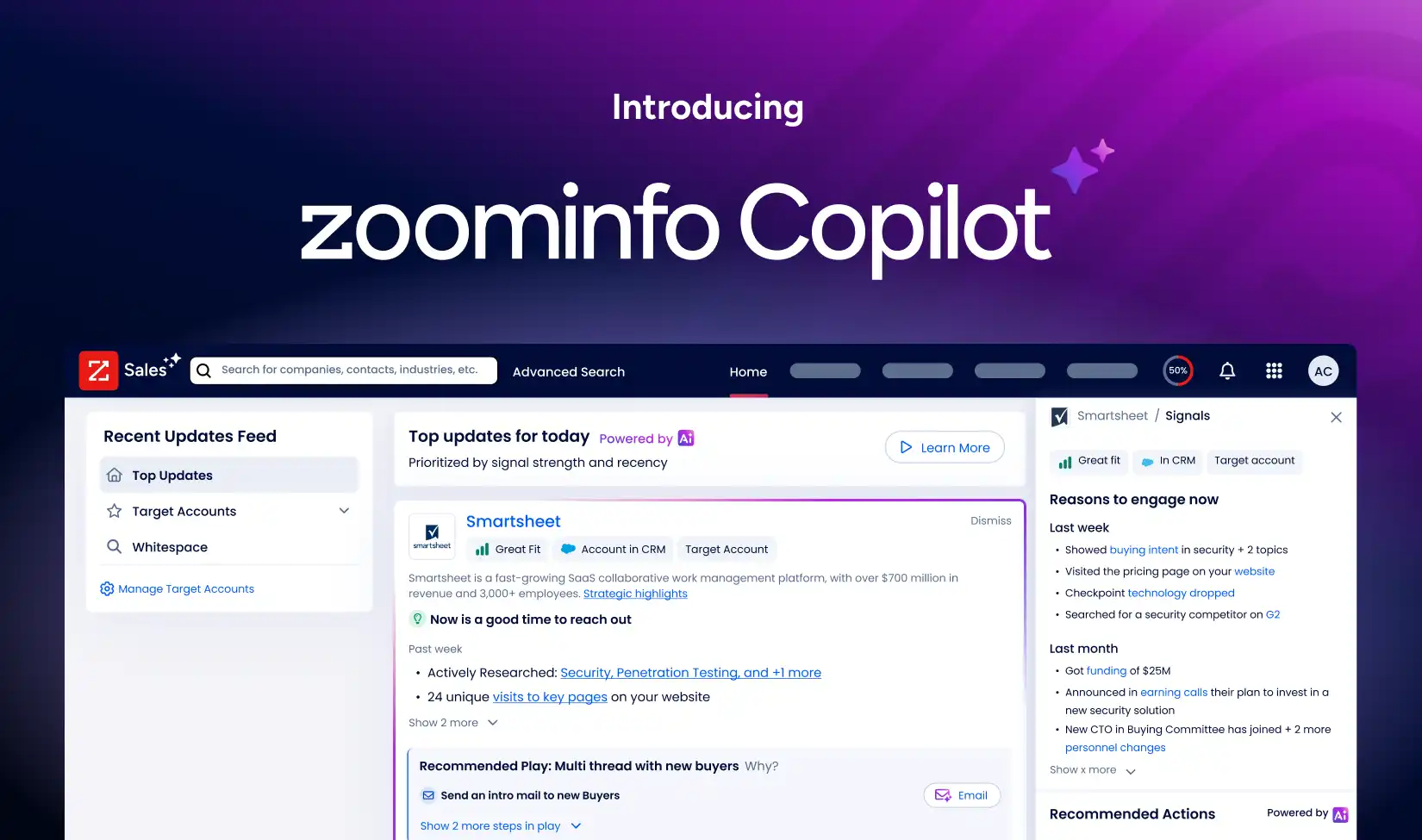
Copilot is the seller-facing expression of that stack. It combines CRM history with ZoomInfo data, ranks accounts and suggests why now. GTM Workspace broadens that consolidated view, while GTM Studio gives operations and marketing teams a canvas for signal-triggered plays. In 2026, GTM.AI pushed the same idea outside ZoomInfo’s own interface. Its APIs and MCP connectors are meant to ground configured agents in ZoomInfo’s data from tools such as Microsoft Copilot, Salesforce, HubSpot, ChatGPT and Claude.
A useful signal stack
The data bargain
ZoomInfo says its engine gathers billions of data points from millions of sources, then standardizes, matches, verifies and cleans them with machine learning, research analysts and data scientists. Public sources, licensed sources and a contributory network all play a part. Lite users can receive additional credits if they elect to participate in that network. Administrators of connected systems should read the privacy controls and decide what contribution settings fit company policy.
No commercial contact database stays perfect. People switch jobs, companies merge, phone carriers recycle numbers and small-business websites go stale. The relevant question is not whether a demo produces ten sparkling records. It is the valid-email rate, direct-dial connect rate and field accuracy across a sample shaped like your territory. A cybersecurity company selling to Fortune 1000 CISOs and a recruiter hunting regional plant managers are buying very different slices of the graph.
“The database is huge. Your evaluation should be small, specific and ruthless.”YesPress buyer’s rule
Independent review sites show the split. G2 listed ZoomInfo’s seller portfolio at 4.5 out of 5 across 12,898 reviews in September 2026. Capterra showed ZoomInfo Sales at 4.1 from 322 reviews, with efficient prospecting and breadth among recurring positives; price and inconsistent reliability appeared among the negatives. Gartner Peer Insights featured an enterprise user who valued enterprise coverage and intent but found stale mid-market records and duplicates. Trustpilot’s company-level score was far harsher, driven heavily by complaints about support, cancellation and personal-data concerns. These audiences are not identical, so the ratings should not be averaged into mush.
Pricing: the fog is a feature
ZoomInfo does not publish a simple paid price card. Quotes vary with the products, seats, functionality, credits, geographic data and number of records managed. The company says subscriptions generally run one to three years and are non-cancelable. Capterra marks pricing as contact-vendor and lists a free trial. ZoomInfo Lite provides limited free access. AWS Marketplace has displayed package examples in five figures, including a $15,000 Talent base package and a $39,000 Operations enrichment package, but those are examples rather than a universal menu.
Reddit pricing threads are anecdotal, yet useful for preparing questions. Buyers report materially different deals for similar-looking seat counts, often in the mid-five figures annually. The lesson is not to treat a forum number as a quote. It is to demand a line-item proposal, map every credit to a behavior, and model renewal cost before procurement celebrates a first-year discount.
| Buyer question | Good evidence | Warning sign |
|---|---|---|
| Does the data fit us? | A blind sample from your CRM, scored field by field | A polished list chosen by the vendor |
| Will reps use it? | Two-week workflow test with activity logs | Demo applause without assigned users |
| Is intent useful? | Lift against a control group over a full cycle | Interesting signals with no conversion path |
| What will it cost? | All-in year-one and renewal totals in writing | Seat price without credits, add-ons or regions |
A trial plan that earns an answer
Bring a few hundred records representing your actual market, including accounts you know well and ones your team has struggled to penetrate. Hide the known answers. Measure match rate, valid business email rate, direct-dial connection, title accuracy, company hierarchy and useful signal coverage. Then ask sellers to complete real tasks inside the CRM and browser extension. Export speed is less important than whether the correct person receives a relevant message.
Test the hard segment
Include small firms, non-US regions or niche roles if they matter. Easy enterprise records can flatter any demo.
Count outcomes
Track conversations, meetings and qualified pipeline. A downloaded contact is inventory, not revenue.
Audit the plumbing
Check deduplication, field precedence, routing, permissions and how quickly changes reach the CRM.
Calendar the exit
Record the renewal notice date, cancellation channel, price cap and data-retention steps before signing.
Compare alternatives by job, not by feature-count theater. Apollo can suit teams wanting prospecting and engagement at a lower, more transparent entry point. Cognism often enters evaluations focused on European coverage and compliance. 6sense and Demandbase deserve attention when account intent and advertising orchestration dominate. Clay appeals to operators who want composable enrichment across multiple providers. Sales Navigator remains hard to ignore for relationship mapping and current job context. A blended stack may improve coverage, but it also adds vendors, failure points and reconciliation work.
The verdict
ZoomInfo makes a persuasive case when a coordinated revenue team needs broad B2B intelligence to flow through many systems and can prove that better prioritization becomes pipeline. Its scale, integrations and new agent-facing layer give it reach that point tools struggle to match. Small teams should resist buying the whole machine for one data export. Every buyer should test freshness in their own market and negotiate the contract with the same care they apply to the data.
The curious backstory
The modern ZoomInfo began as DiscoverOrg, founded by Henry Schuck and Kirk Brown in 2007. DiscoverOrg acquired the older Zoom Information business in February 2019 and took its name later that year. The company went public in June 2020 at $21 a share. In May 2025 it changed its Nasdaq ticker from ZI to GTM, a tidy piece of corporate semiotics: the market category became the stock symbol. It also assembled much of today’s breadth through acquisitions including RainKing, NeverBounce, Datanyze, Insent, Chorus.ai and RingLead.
That history explains the product’s personality. ZoomInfo feels like a collection of revenue jobs pulled toward one data gravity well. The ambition in 2026 is to make the interface optional: let agents, spreadsheets, CRMs and collaboration tools call the graph directly. If that works, ZoomInfo becomes less a destination and more a utility beneath the work. Buyers still need to inspect the utility bill.