For seven years, the company now called Terret helped sales chiefs make a more believable promise about next quarter. It pulled signals from calls, calendars, email and customer systems, inspected the pipeline, and offered a forecast that did not depend entirely on a rep’s optimism. Useful work. Also, as Terret eventually decided, insufficient work.
A dashboard could flag a falling win rate. It could not explain the exact behavior separating the closers from the rest of the floor, rewrite the playbook, push that playbook to hundreds of sellers and make sure it appeared before the next call. The observation still had to crawl through an analyst, a slide deck, a meeting and a management campaign. By the time the company acted, the interesting problem might have moved on.
That gap is the reason BoostUp became Terret in September 2025. It is also the reason the company’s new flagship, Nexus, is sold as an “answer-to-action engine.” The phrase is marketing, certainly, but it identifies a real bruise in corporate life: firms are better at producing insights than changing behavior.
The original product did not fail. Its boundary did.
Sharad Verma, Amit Sasturkar and Neel Kamal founded BoostUp in 2018. The product began around voice and conversation intelligence, then widened into deal intelligence, machine forecasting and revenue operations. Sasturkar brought search and large-scale data experience from Google and Yahoo; Verma had already built and sold a social-commerce software company. Their early insight was straightforward: a CRM records what a seller remembers to type, while the actual story of a deal leaks across messages, meetings, product usage and support tickets.
Investors paid to pursue that insight. A $6.25 million seed round arrived in 2020, a $6 million Series A in 2021 and a $28.5 million Series B led by NGP Capital in March 2022. The last announcement put total capital above $40 million. BoostUp said revenue had tripled in 2021, its staff had passed 100 and more than 50 customers were using the system. Forrester called it a Strong Performer in its 2022 revenue operations and intelligence report.
So what failed first? Not the forecast. The narrow definition of the job. As customers asked to reduce software sprawl, operating cost and tactical work, the old name described a system that measured revenue performance more neatly than one that powered it. BoostUp’s own explanation of the rebrand is unusually direct: “BoostUp no longer captured that vision.”
The dashboard says win rates fell. It doesn’t say why.Terret’s case for Nexus, July 2026
First build the map. Then release the agents.
Nexus starts with what Terret calls a Revenue Graph. Imagine every account, contact and deal joined to its calls, email, calendar events, product signals, invoices and warehouse records. Structured fields meet messy language. A transcript rarely announces which Salesforce opportunity owns it, so the system uses context to resolve the relationship. The result is meant to be a live model of the commercial world, not a weekly export frozen in a spreadsheet.
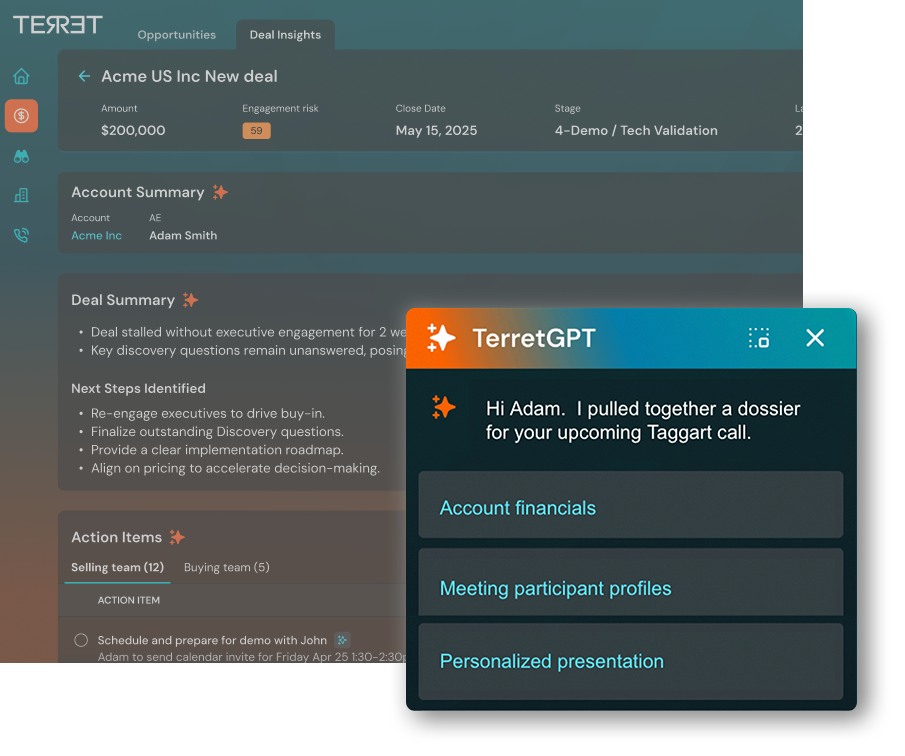
On top of that graph sit “AI Architects.” These are analytic routines built to answer questions broad enough to torment a revenue leader: Why are win rates dropping? Which behaviors distinguish top sellers? Where does one competitor keep beating us? Then agents turn the diagnosis into a workflow, such as generating meeting briefs, updating deal fields, drafting outreach, building mutual action plans or distributing a revised sales play.
The answer-to-action loop
This sequencing is Terret’s most important difference from a generic corporate chatbot. A language model given a few documents can summarize them beautifully. It cannot reliably reason about an enterprise revenue system if it does not know that Thursday’s security call, Friday’s pricing email and a stalled $400,000 opportunity are the same story. Terret argues that the graph supplies the context, while model routing across providers including Mistral, OpenAI, Anthropic and DeepSeek lets the system balance cost, speed and accuracy.
Who buys it, and what are they really buying?
The customer is not an individual seller swiping a card for another browser extension. Terret is enterprise software for CROs, revenue operations teams, sales managers, account executives and customer-success organizations. Pricing is custom, and the sale includes integration with the existing stack. Its public customer wall includes Cloudflare, Udemy, Carta, Grafana Labs, Teradata, AuditBoard, Workato, Mistral AI, Braintrust, Hebbia, Litify, Solera, GoTo and SmartBear.
The immediate purchase is forecasting, conversation intelligence and automation in one subscription. The larger purchase is management capacity. A frontline manager should spend less time reconstructing a deal and more time coaching the moment that changes it. A RevOps leader should not need a new analyst project every time the CRO asks a fresh question. A seller should walk into a call with the account history, risk and relevant play already assembled.
The competitive set is crowded. Clari owns mindshare in forecasting; Gong in conversation intelligence; Outreach in sales engagement; People.ai and Aviso attack adjacent revenue-data problems. Salesforce reporting, spreadsheets and internally built data lakes remain the stubborn alternatives. Terret’s answer is breadth: fewer point tools, one graph, and agents available in the CRM, Slack, web and mobile workflows people already use.
The company publishes striking customer claims, including forecast error moving from 5 percent to below 1 percent and Integral doubling annual bookings. Those are useful signals, not universal promises. The honest test is whether the connected system changes decisions faster than a competent RevOps team could, after accounting for integration, governance and adoption.
What changed their mind
Justin Shriber joined as CEO in early 2024 after leadership roles at Siebel, Oracle, LinkedIn and several sales-software companies. He was not one of the original founders, despite some current profile shorthand describing him as a co-founder. His arrival coincided with the widening ambition: take the predictive foundation and move closer to the work itself.
Customers provided the shove. Forecast accuracy mattered, but leaders wanted to scale without matching every revenue increase with more reps, analysts and administrators. They wanted fewer isolated systems and less human middleware between finding a problem and fixing it. Terret launched a “Virtual Revenue Fleet” at the rebrand, then kept rebuilding. When Nexus became generally available in July 2026, Shriber wrote that some early agents had been reconstructed entirely and “a few product names didn’t survive the year.” That is less a confession of collapse than evidence that the first agent vocabulary was not yet the product.
The part worth stealing
- Pick one expensive operating question, not a vague “AI transformation.”
- Connect only the sources required to answer it with trustworthy context.
- Turn the observed pattern into a named, reviewable play.
- Insert that play into the tool and moment where work already happens.
- Measure whether behavior and outcomes change, then feed the result back.
When the loop breaks
The model will not travel well everywhere. A tiny sales team with ten deals can inspect its pipeline without constructing a graph. A business with little digital exhaust, unstable definitions or sparse historical wins gives the system weak material. If leadership cannot agree on what a qualified opportunity means, automation will distribute the disagreement at machine speed.
Nor should every action be autonomous. Pricing concessions, sensitive outreach and forecast commitments carry political and financial consequences. They need permissions, audit trails and human judgment. Terret says it has held SOC 2 Type 2 certification since 2020, runs on AWS with encryption and offers access controls. Those are table stakes for the data involved, not a substitute for a customer deciding what an agent may change.
There is also a human trap. Great sellers do not win only because they follow visible sequences. They earn trust, recognize odd exceptions and improvise. A system trained to clone last year’s winners can turn a useful pattern into stale orthodoxy. The better role for Terret is to remove reconstruction and repetition, then summon the person when taste, negotiation or empathy matters.
That makes Terret’s market position easier to understand. It is not merely another AI sales assistant, and it is no longer content to be a forecasting application. It wants to become the connective layer between revenue evidence and revenue behavior. The name comes from the small ring on a horse’s harness that guides the reins. The company also has a ferret mascot, because apparently one animal metaphor could not carry the whole quota.
The joke hides a disciplined idea. Software has spent decades helping companies see. The next contest is over who can act without becoming reckless. Terret has capital, enterprise references and seven years of scar tissue from the forecasting market. Nexus is the attempt to convert all three into a loop that closes before the quarter does.