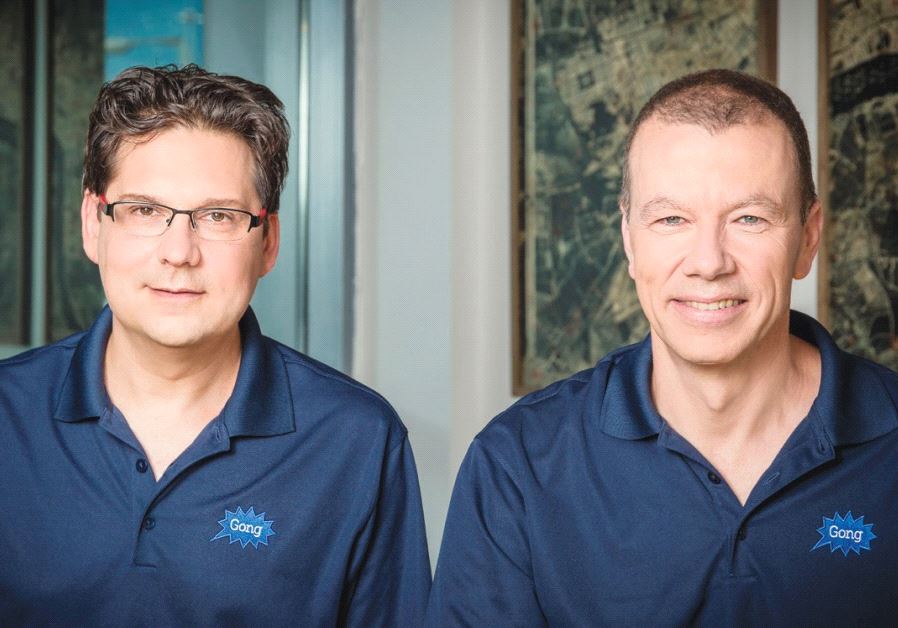
The first version of Gong did not look like an operating system. It listened. In 2015, Amit Bendov had recently run Sisense and was bothered by the information leak inside every sales organization: customers said thousands of words, a rep typed a few dozen into the CRM, and management treated the residue as reality. Bendov took the problem to Eilon Reshef, a product builder then on sabbatical. Their proposal was mildly unnerving and commercially sharp: record the conversation, analyze it, and let the call testify for itself.
This was before every meeting app offered a summary and before “agent” became a suffix attached to quarterly plans. Investors worried about recording consent. Sales leaders assumed reps would hate being watched. One adviser urged Gong to build its own speech-recognition engine, a magnificent way for a tiny company to spend a year proving the wrong thing.
The founders used outside transcription instead. Accuracy was rough enough that they did not initially show the full transcript. The demo focused on a useful trick: type a competitor’s name and jump to the exact moments customers mentioned it. Searchable evidence beat pristine plumbing. It remains the most copyable choice in Gong’s story.
The beta ended. The checks arrived.
By early 2016, Gong had recruited 12 design partners through the founders’ network. They watched how people used the alpha, then performed a test with more nerve than nuance: the free period was over; would the companies buy? Eleven said yes within roughly three months. The group produced about $100,000 in annual recurring revenue. The twelfth later paid, too.
That conversion changed the question from “Will anyone tolerate recorded calls?” to “How much of the revenue process can this evidence improve?” It also told Gong when to hire. Bendov kept closing early deals until the company had won customers outside his network. Only then did it add an SDR. A large prospect met at a Chicago trade show was told the product was not ready for an enterprise deployment. Gong returned a year later and won the account. The company calls this instinct “No sugar.” It is easier to print on a culture page than to practice while chasing a quarter.
The CRM contains what someone remembered to type. Gong made a business from everything that disappeared before the typing began.The founding wedge, in one sentence
The timing cooperated. Remote selling turned calls into the office. In 2020, Gong said revenue had grown 2.5 times year to date, raised $200 million at a $2.2 billion valuation, and acquired sales-analytics startup Vayo. In June 2021, Franklin Templeton led a $250 million Series E at a $7.25 billion valuation. Total disclosed funding reached $584 million.
A recorder ate the sales stack
Today Gong automatically captures calls, meetings, emails, notes, and CRM records. Its models identify topics, objections, next steps, competitor mentions, talk patterns, and deal risks. A rep can review a meeting or draft follow-up. A manager can compare calls, score behaviors, and coach from game tape. Revenue operations can inspect pipeline and submit a forecast. Enablement teams can see whether a new message appears in the field. Customer-success and account teams can inherit the actual history instead of a cheerful handoff note.
How a conversation becomes a workflow
The product names reveal the expansion. Gong Engage competes with sales-sequencing tools. Forecast tackles pipeline inspection and the weekly number. Enable handles coaching, readiness, and initiative adoption. Data Cloud exports enriched records to analytics systems. More than 300 integrations connect the platform to systems including Salesforce, Microsoft 365, Dynamics 365, Zoom, Slack, and Okta.
In 2025, Gong began describing specialized agents that answer questions, spot themes, prepare briefs, and review deals. The 2026 “Revenue Harness” pushes further: agents can plan and act within permissions, with human review and measurement. Model Context Protocol support lets outside assistants query Gong’s governed context. The wager is that a general model becomes more valuable when grounded in the customer history Gong already owns.
The new bill has seats - and compute
Gong sells annual enterprise subscriptions, not a cheerful self-serve plan. A contract can combine the Foundation platform, seats, applications such as Engage or Forecast, implementation, and services. In 2026 the company documented Gong Credits for heavier AI workflows that process large volumes or run continuously. Some AI use remains included with seats; the expensive background work can be metered.
There is no public standard price card. One independent 2025 breakdown estimated first-year totals near $28,500 for 10 reps, $93,500 for 50, and $169,000 for 100, including platform fees, seats, and services. Those are directional estimates, not Gong quotes. Discounts, applications, implementation, contract length, and negotiation move the number. The blunt takeaway: this is easier to justify when a missed deal is costly and many people can reuse the intelligence.
The customer list fits that math. Gong publishes stories from Google, Nasdaq, Anthropic, monday.com, Udemy, Experian, Chime, Culture Amp, and GHX. The reported outcomes vary: time saved, shorter ramp, higher win rates, tighter forecasts, or larger deals. Treat vendor case-study percentages as examples, not a universal yield. The mechanism is more durable than any single number: one captured conversation can serve the rep, manager, product marketer, success team, and executive forecast.
Its expertise is unusually specific. Generic meeting assistants can produce notes, but Gong has spent a decade modeling revenue vocabulary, account relationships, deal stages, coaching behaviors, and the connection between conversation signals and commercial outcomes. That specialization is the moat it advertises and the burden it must keep earning. The platform has to recognize that “legal” may be a buying-stage signal, that a competitor mention can alter deal risk, and that an unanswered next step matters differently in a renewal than in a first demo. The richer the context, the less useful a generic summary becomes.
Where the spell breaks
A company can buy Gong and still become merely excellent at storing meetings. The software needs conversation volume, reliable calendar and CRM connections, and leaders willing to turn patterns into changed behavior. A six-person sales team with a simple product may get the necessary recording and summaries from Fathom, Avoma, a CRM bundle, or the meeting platform it already pays for. Clari is a serious alternative when forecasting is the center of gravity. Outreach and Salesloft begin from engagement. ZoomInfo Chorus competes directly in conversation intelligence. Salesforce, HubSpot, and Microsoft keep absorbing adjacent features.
Privacy is not a settings-page detail. Recording laws and customer expectations vary. Gong publishes role-based controls, retention options, SOC 2 Type 2 and multiple ISO certifications, but a certificate cannot repair a manager who uses clips to embarrass people. Teams need consent practices, narrow access, clear coaching norms, and a reason to capture each channel. Otherwise “customer reality” feels like employee surveillance with better charts.
Many complex customer conversations; expensive deals; a functioning CRM; managers who coach; multiple teams that reuse the context.
Low call volume; tiny teams; short transactions; dirty systems; no change-management owner; recording constraints; insight without action.
The playbook worth stealing
Do not copy Gong by adding a recorder to an AI pitch. Copy its sequence. Start with a source of truth people currently compress or ignore. Recruit design partners who feel the pain. Build the smallest interface that exposes a valuable moment. Watch actual use. End the free period. Ask for money before the product looks inevitable. Postpone bespoke infrastructure until it changes the customer outcome.
Then preserve the wedge while expanding. Gong’s platform works because Forecast, Engage, Enable, and agents can share the same interaction history. The test for any adjacent product is whether that shared context makes it meaningfully better than a specialist. If it does not, “operating system” is just an expensive way to say bundle.
Gong’s latest chapter is less settled than its origin. It says ARR crossed $500 million in May 2026, up more than 55 percent year over year in its latest quarter. The company now wants agents to execute revenue work, not simply describe it. That introduces tougher questions about permissions, accuracy, accountability, and consumption costs. But the original idea survives all the new packaging: before a machine can recommend the next move, it needs a faithful account of the last one.