The short version
- Artisan's Ava finds prospects, researches them, writes outreach, handles replies, and books meetings.
- The company combines the AI worker with the tools she needs: data, enrichment, intent, sequencing, deliverability, dialing workflows, and CRM sync.
- Its first product hallucinated and churned customers. Tighter prompts, harder qualification, and human approval gates followed.
- Current pricing is custom. The last widely reported public starting point was $15,000 a year in 2024.
- The copyable idea: automate a complete, measurable job - but draw the human handoff before you switch on autonomy.
There is a peculiar kind of sales employee who can spend a Tuesday discovering ten thousand strangers, reading what their companies buy, composing a private note to each of them, watching for replies, and slipping meetings onto the correct calendars. She does not sleep. She also does not exist. Artisan calls her Ava, and for a while the San Francisco company advertised her with all the delicacy of a brick through a window: Stop Hiring Humans.
The slogan worked as advertising. It provoked posts, vandalism, news stories, even death threats, according to the company. It obscured a better story. Artisan was not merely trying to write cold email with a language model. It was trying to make one system responsible for the entire top of a sales funnel - the data, the research, the message, the reply, and the booked meeting. In a market full of tools that each rent one wrench, Artisan wanted to sell the mechanic.
The jungle, the agency, and the first job to go
Jaspar Carmichael-Jack says the idea arrived in January 2023, while he was conducting a detox in Tulum. He locked himself in an Airbnb, thought about work, and kept returning to all the labor people performed because software had not yet learned to take responsibility for it. His earlier marketing agency had taught him the rhythms of go-to-market work. Business development looked ripe: build lists, check facts, update records, draft emails, schedule meetings. Important in aggregate, numbing one by one.
He founded Artisan with Sam Stallings, an IBM veteran and product engineer. Ava was their first “Artisan.” The beta led customers through a short onboarding conversation, scraped their websites into a knowledge base, searched hundreds of millions of contacts, and ghostwrote email. Before a mature product existed, the founders put up a landing page and collected interest. The waitlist reportedly reached 5,000. In early 2024, Artisan joined Y Combinator.
The first go-to-market motion was product-led, and it struggled. In May 2024 the company turned to direct sales. By September, Artisan said annual recurring revenue had climbed from roughly $200,000 to $1.3 million. The lesson is wonderfully unfashionable: a product that promises to replace part of a sales team may still need a salesperson to explain the promise.
What failed first was the writing
The early emails were bad. Carmichael-Jack later said he cringed looking at the YC-era copy. Ava hallucinated. Response rates disappointed. Customers left. These were not cosmetic bugs. An AI BDR is trusted to speak in a customer's name, at volume, to people the customer hopes to impress. One invented detail, multiplied by a thousand, is a reputation problem with a send button.
“We've historically sold to a lot of the wrong customers.”Jaspar Carmichael-Jack, on learning that agentic outbound cannot be sold like ordinary seat-based SaaS
Artisan tightened prompts with Anthropic, collected information in more rigid forms, and reduced the room in which the model could improvise a fact. It introduced approval gates and escalation rules. It also changed who it would sell to. Some businesses produced too few replies; others produced a swamp of low-quality interest that humans had to drain. Artisan stopped accepting some categories, including offshore development agencies, and offered break clauses. In 2025 it also piloted success-based pricing through Paid.ai, charging per response rather than simply per month.
Version-one temptation
- Sell autonomy to everyone
- Let the model write freely
- Measure output volume
- Treat review as friction
The learned version
- Qualify the workflow first
- Feed constrained context
- Measure replies and meetings
- Expand autonomy as trust grows
That is what changed the company's mind: churn made customer fit impossible to ignore. An ordinary SaaS tool can be sold to a weak-fit buyer and remain quietly unused. An autonomous agent acts. If it is wrong, it is wrong in public. Qualification, therefore, becomes part of product safety.
A worker with her own toolbox
Ava's distinction is less the prose than the plumbing. The current platform can search a large B2B database, enrich a lead from more than twenty sources, watch signals such as funding or a leadership hire, identify website visitors, and draw context from Salesforce or HubSpot. It creates sequences, tests variations, protects deliverability, answers routine objections, and routes a meeting to the account owner. A central operator can run it for hundreds of representatives who never need to learn the tool.
That consolidation is Artisan's competitive wager. 11x, AiSDR, and Regie.ai sell variations on the AI-SDR idea. The older alternative is a relay race among ZoomInfo or Apollo, Clay, Outreach or Salesloft, an intent tool, a dialer, a CRM, and the humans who move data between them. Artisan argues that fragmentation makes accountability dissolve. If the campaign fails, was it the list, enrichment, sequence, timing, or rep? Put the job in one system and the result can be priced as a cost per lead, reply, or meeting.
The handoff, drawn honestly
Why the robot will not call you
In 2026, presenting Ava 2.0, Carmichael-Jack said Artisan would not make autonomous cold calls. The legal footing is treacherous, and humans are still better at the conversation. Ava queues the call, supplies talking points, and drafts the follow-up. A representative picks up the phone. It is the most credible boundary in the product because it is a boundary.
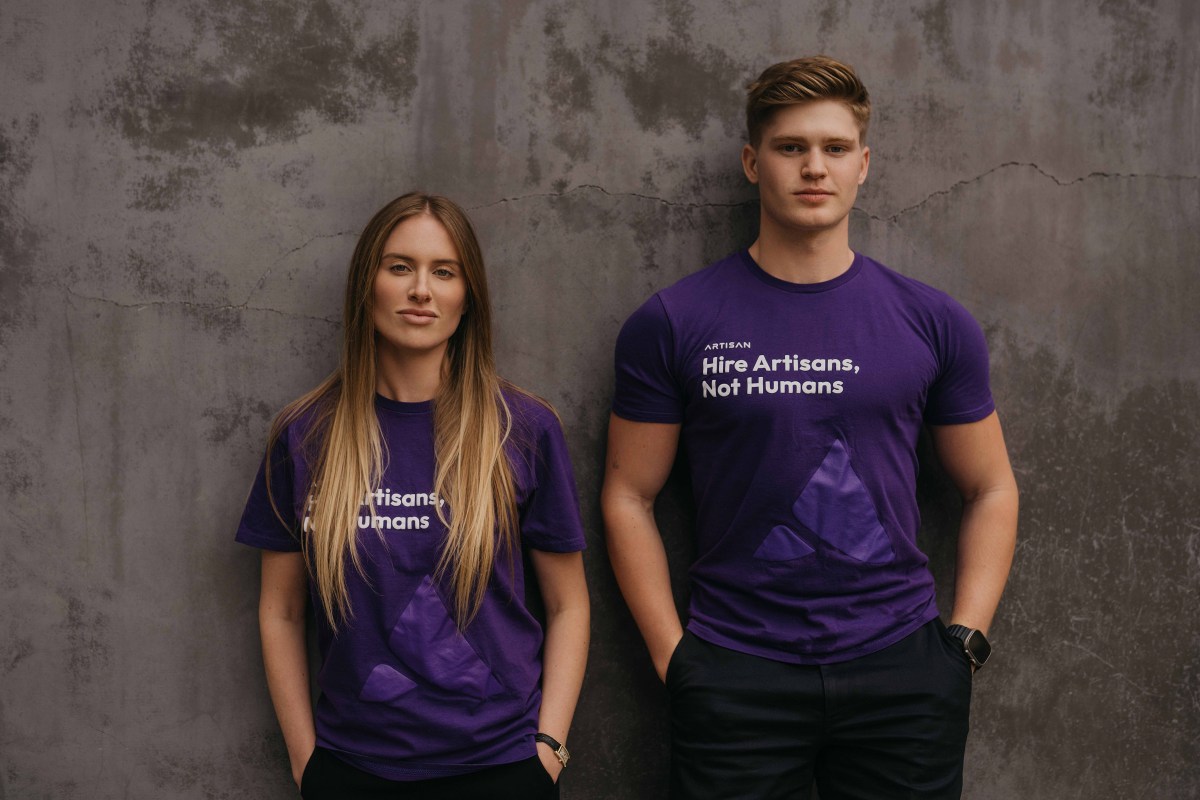
Artisan eventually retired “Stop Hiring Humans” for “be more human.” The company that had spent a reported $2 million making salespeople feel replaceable advertised for a human BDR. The role, however, was rewritten: cold calls, conferences, social selling, and difficult escalations, while Ava handled lists, sequences, and routine replies. The about-face was partly brand repair, partly product truth. Automation did not remove the person. It moved the person to the moment where personhood mattered.
What an operator can steal
The first copyable move is to automate a job with an observable finish line, not a bag of tasks. “Write emails” rewards activity; “book qualified meetings within these rules” rewards an outcome. The second is to collect demand before polishing the machinery. Artisan's early landing page gave it prospects to learn from. The third is to keep approval switched on until the error rate, data quality, and escalation logic justify turning it off. Autonomy should be earned in increments.
There is also a clean test for fit. This approach needs a known ideal customer, enough addressable volume to justify the setup, trustworthy company context, and an offer that can survive a digital first touch. It weakens when every sale begins with a delicate diagnosis, when regulation constrains outreach, when the market is tiny, or when the seller has not yet learned who buys and why. AI can scale a motion. It can also scale the absence of one.
Artisan's public customer results are promising but selective: SumUp was said to receive 8 to 15 positive replies a week; SaaStr reported a 4.4 percent positive reply rate in one case study; another SaaStr presentation described 7,000 emails over six weeks at 3.6 percent. Those figures do not abolish the need for a salesperson. They define when a salesperson gets to begin.
The company started with a science-fiction character: the tireless synthetic colleague. Its product became more convincing as it acquired less cinematic things - suppression lists, audit logs, CRM ownership, approval gates, compliance controls, and a real human in a shared Slack channel. The loud billboard claimed the future belonged to a machine. The quieter software suggests the future belongs to whoever designs the handoff.