The odd thing about the people who made Amplemarket is that they did not set out to be salespeople. João Batalha studied computer science. His brother Luís worked in physics. Their friend Micael Oliveira earned a doctorate in high energy particle physics. The three built a Shopify app called Orankl, then discovered an awkward truth: making software was only half the job. Somebody had to find buyers.
Prospecting meant searching for names, checking whether those names still worked at a company, writing emails, and remembering when to follow up. A missed reply could erase an afternoon’s research. The founders tried to automate their own routine. By late 2019, that exercise had become Amplemarket, a product for other business-to-business sales teams facing the same pile of tabs.
The short version
- Amplemarket sells a subscription platform for finding B2B prospects, spotting buying signals, and contacting them across channels.
- Its public Startup plan costs $600 a month on an annual term for two users; larger plans are quoted.
- The bet is operational: a useful signal should lead to a specific person, a sensible message, and a recorded next step.
- Its best fit is a team running a real outbound motion across more than one channel.

A scientist’s least favorite experiment
In a 2022 note about the company’s funding, João said the founders learned sales “the hard way.” The problem they noticed was less romantic than an AI pitch: too much administrative labor and too many disconnected tools. A database might supply a name. Another service might verify an email. A sequencing app might send the message. A CRM would record what happened, if anyone remembered to update it.
Amplemarket’s response was to put those acts in one workflow. Its search tools identify companies and contacts. Signal features look for reasons to reach out, including job changes, competitive activity, and social engagement. Duo Copilot researches a prospect and prepares a sequence; a rep can review the wording. The platform then handles email, phone, social, and other messaging stages, monitors deliverability, and records activity in connected systems such as Salesforce or HubSpot.
It is easy to call this “AI sales.” The more precise description is a machine for preserving context. A name without a reason to call is just another name. A reason without a reachable person is gossip. And a beautifully written email that lands in spam is a small literary tragedy with no audience.
The useful unit is a completed handoff, not another lead in a list.
What the customer actually buys
The platform serves founders doing their own selling, sales development representatives building pipeline, account executives working named accounts, and revenue operations teams who need cleaner handoffs. A small team can use the search database and sequences without stitching together a separate enrichment product, social automation tool, and email warmup service. Larger teams can route signals, manage territories, and connect outreach to a CRM.
That bundle is Amplemarket’s answer to Apollo, Outreach, Salesloft, ZoomInfo, and narrower data or engagement products. Those rivals differ considerably; the point is that Amplemarket wants to own the journey from lead discovery to follow-up. Its 2026 Workflows feature makes the ambition clearer. A bounced email can trigger another action. A booked meeting can update a CRM field or stop outreach to other people at the same account. A sequence that ends without a reply can move someone into a later nurture track. Routine good intentions finally acquire a schedule.
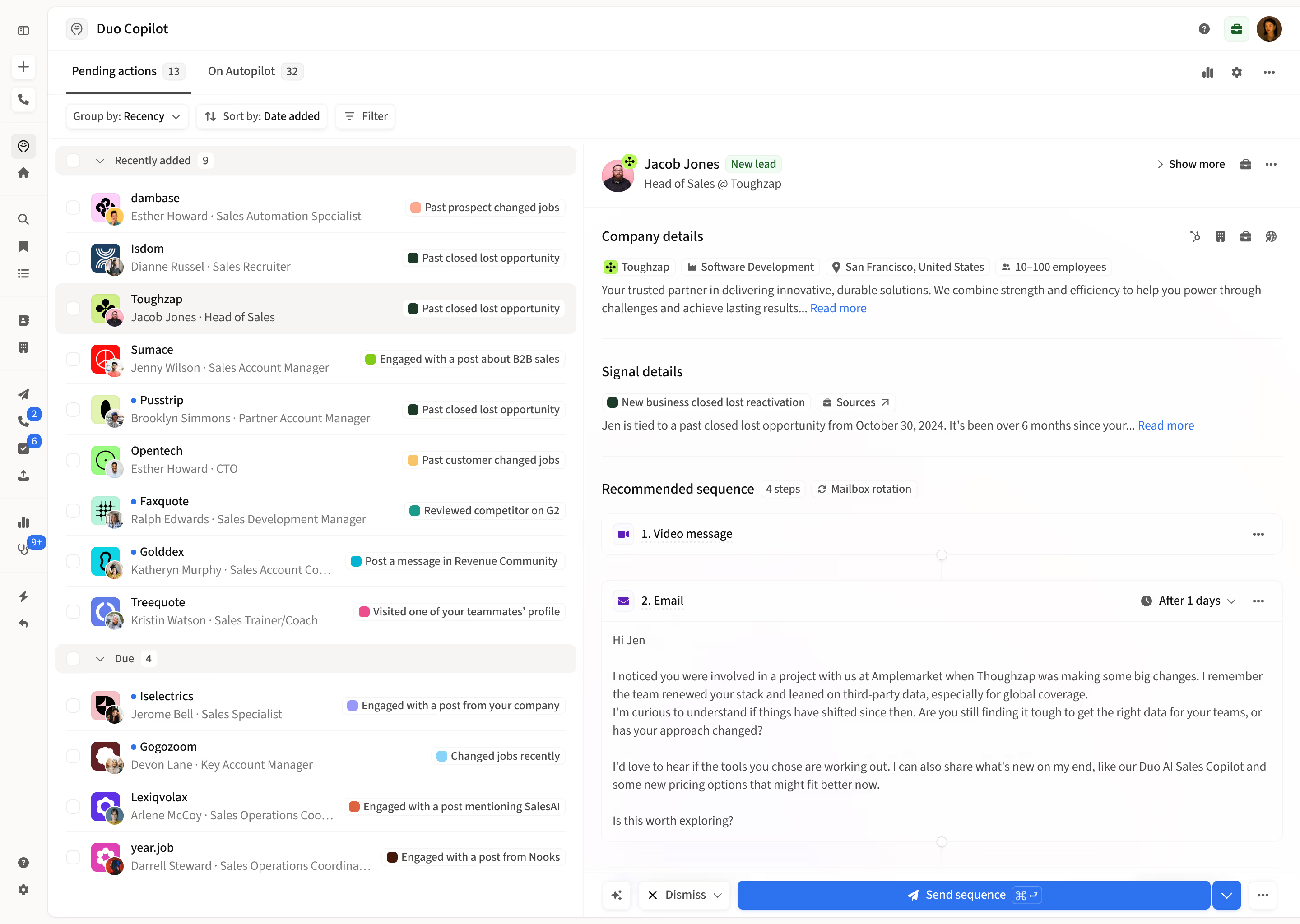
The public price gives the promise a useful edge. Startup starts at $600 per month on an annual contract and includes two users. Growth and Elite are custom priced, with more included seats and support. Credits meter some data and AI actions, and extra seats or add-ons can increase the bill. The new Parallel Dialer, which calls multiple numbers and passes a live answer to a rep, is sold as an add-on. A buyer should compare the full quote with the cost of tools it can genuinely retire, not with the cheapest individual app in the stack.
“We use AI to frame the foundation. Then reps add oversight.”Thanbir Moktadir, LILT
The evidence is in the handoffs
Customer stories give the theory some texture, though they are case studies, not controlled experiments. Deel began using Amplemarket in 2020. In its published account, its sales team reported an average 17.8% reply rate and more than 20 meetings per SDR each month. Deel also grew revenue twentyfold in a year. The company’s growth involved far more than one vendor; the useful observation is that its reps wanted contact data, outreach, and deliverability to cooperate.
Sendoso offers the sharpest account of what failed first. Its BDR team briefly left Amplemarket for a cheaper platform. According to Katie Penner, its head of sender relations, the team’s mail began landing in spam, contact data worsened, and replies fell. Sendoso returned to Amplemarket and said inbox placement and reply rates recovered. That is a customer’s account, not a promise that any software can fix a damaged sending reputation. It does show why deliverability belongs in the purchase decision before anyone judges the prose of an email.
LILT’s example is unusually practical. The translation company says it cut sales tooling costs by roughly 56% after consolidating licenses into Amplemarket, and its reps spent 20 to 30% less time on non-selling tasks. DataStax says it generated more than 150 enterprise opportunities in eight months using Duo Copilot. These are each company’s reported results. They suggest where to look for value: fewer subscriptions, less list building, more contact with people who have a reason to listen.
The company’s own path explains its current product shape. It announced $12 million in combined Seed and Series A funding in 2022, co-led by Comcast Ventures and Armilar Venture Partners. In 2024 it developed the AI Sales Copilot and was named a Gartner Cool Vendor in Generative AI for Sales. Its 2025 brand shift put Duo at the center of the story. In 2026 it added Workflows, AI reply drafts in Duo Inbox, integrations that let agents work from other software, and a native Parallel Dialer. Each addition closes one more gap where a sales task might otherwise go missing.
A method worth borrowing
The transferable idea is smaller than the product. Choose a signal that genuinely changes when a buyer might care. Decide exactly which person should receive the message. Give the rep the context and a draft, then ask for a human check: Is the claim true? Is the timing fair? Would this email make sense if the recipient forwarded it to a colleague? Finally, define what happens after a reply, a bounce, or silence. That last rule is where most tidy diagrams meet the Monday morning calendar.
A team doing only occasional cold email may have little reason to pay for a broad platform. An account team with a working CRM, several outreach channels, and too many licenses has a stronger case. Even there, consolidation works only when the data is good for its specific market and reps use the shared process. More automation cannot rescue a weak audience or an irrelevant message.
Amplemarket’s founders came to sales as an unwelcome part of building software. That outsider’s irritation produced a useful question: what if the tedious steps between noticing a buyer and speaking with one were treated as a single job? The answer is still a tool, and tools do not earn trust on their own. But they can give a person time to do the part that does.