The least glamorous moment in a sales call may be the most valuable one. The prospect hangs up. The rep chooses a disposition. A note gets typed, or does not. Somewhere between the conversation and the customer record, a forecast becomes slightly more truthful or slightly more fictional. Conquer built its business in that gap.
The Reno-based software company began as DialSource, an enterprise telephony specialist founded by Joshua Tillman in 2005. Its original job was practical: connect calling to Salesforce and Microsoft Dynamics, help large sales and service teams move through work faster, and make sure activity returned to the CRM. In 2021, DialSource renamed itself Conquer and introduced Cadence, expanding the proposition from a dialer into an omnichannel engagement system. Calls, email, text, social touches, scripts and next steps could be orchestrated around the customer record.
That history matters because Conquer is easy to misread as another entrant in the crowded sales-engagement category. Outreach and Salesloft made the category legible. Gong made recorded conversations searchable and coachable. Dialpad and RingCentral modernized business communications. Conquer's argument is narrower: if Salesforce is already the operating center of a large revenue team, the engagement software should run inside it, not next door with a sync process acting as interpreter.
“When logging is faster than any workaround, reps actually do it.”Greg Moran, chief executive officer
The first thing that broke was the call
One Conquer case study follows a Fortune 500 waste-and-energy company whose previous call system produced lag, crashes and distorted audio. Inbound callers were routed incorrectly. Some calls went unreported. Technical support, according to the customer account, was unresponsive. The failure spread: incomplete records weakened reporting, inconsistent numbers eroded trust, and managers could not coach from a clean account of what reps had done.
The company switched for better telephony, native Salesforce capture and help that answered back. Conquer says the customer subsequently recorded a 34 percent increase in call connections, 20 percent longer call durations and 10 percent more outbound calls. Those are vendor-published figures, not an independent experiment, but they reveal what buyers were paying to fix. The purchase was not about decorating a pipeline dashboard. It was about making the basic exchange between seller and customer reliable enough to measure.
A second case involved a large financial-services provider. High inbound hold times were costing business; the customer estimated that one in five deals was being left on the table. Thousands of inside sellers also needed consistent prioritization and coaching. Conquer's skill-based routing and guided workflows reportedly cut wait time by 98.3 percent. The dramatic number grew from a very ordinary product decision: route the customer quickly, then tell the rep what to do next without leaving the record.
A sales stack with fewer seams
Conquer Voice handles carrier-grade inbound and outbound calling. Cadence sequences email, phone, SMS and social steps. Text adds SMS, MMS and WhatsApp. AI Insights listens during and after conversations, surfacing battle cards, transcripts, summaries and coaching signals. These tools are sold to enterprise sales, service and revenue-operations teams, the people who feel every missing activity when month-end forecasting begins.
The practical advantage is data lineage. A call originates on the Salesforce record, the outcome is logged there, and the next task can be generated from the same context. Leaders see current activity rather than a delayed replica. Compliance rules can ride with the workflow. The system can stop an automated sequence when a human replies, sparing a newly engaged prospect from the robotic follow-up that says, in effect, nobody noticed them.
The constraint is equally clear. Conquer is most persuasive when Salesforce is already the center of gravity, the sales motion is complex, and incomplete activity has a measurable cost. A small team with a light pipeline, no dedicated operations function and a preference for self-serve pricing may find a simpler bundle more sensible. A company standardized on another CRM will not receive the full benefit of Conquer's current Salesforce-native pitch. Architecture is both moat and boundary.
Then the company bought both sides of the deal
In 2025, Conquer made two acquisitions that stretched the product beyond seller outreach. Full Circle Insights, acquired in May, brought marketing attribution, funnel analytics and account-based marketing measurement. The logic was upstream: show which campaigns and touches created pipeline, then connect that evidence to the execution engine already living in Salesforce.
Five months later came Buyerstage, an AI-assisted digital sales room. It organizes content, mutual action plans, stakeholders and buyer engagement in one shared space. That move was downstream. Conquer could already guide a rep's work; Buyerstage added a cleaner surface for the buying group, whose approval loops and forwarded PDFs are often invisible to the seller.
DialSource starts with the call
Enterprise telephony becomes the wedge into CRM workflow.
Conquer adds the cadence
The rebrand arrives with guided, omnichannel revenue engagement.
Full Circle adds the cause
Marketing attribution connects campaigns to pipeline and revenue.
Buyerstage adds the room
Buyer behavior and mutual plans become part of deal execution.
Voice Plus leaves the desk
Calls, meetings and notes sync from a field rep's phone.
Together, the purchases outline a larger ambition. A marketer sees which demand worked. A seller receives the next action. A manager hears what happened in the call. A buyer finds the plan and material in one room. The CRM holds the record. Conquer does not claim to replace Salesforce; it wants to turn the database into the place where revenue work is actually performed.
The mobile product explains the whole company
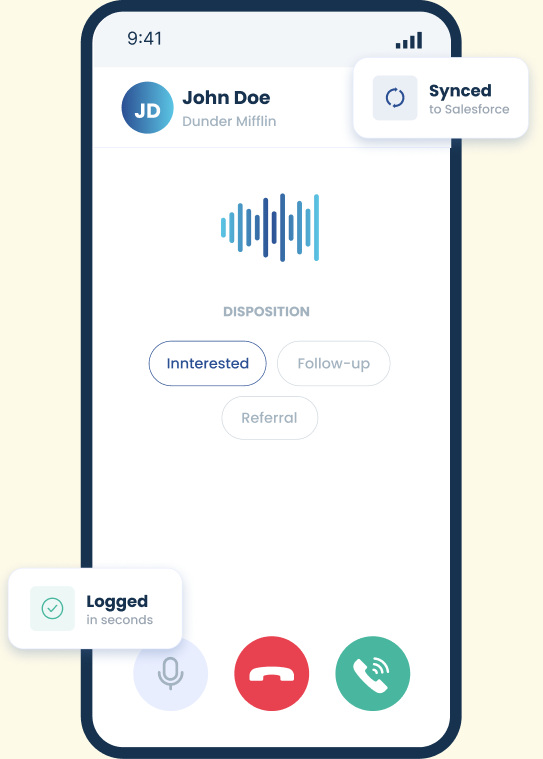
Voice Plus, launched in January 2026 for iOS and Android, is a small product with a revealing premise. Field sellers often finish a day of meetings with notes scattered across paper, memory and their phones. Updating the CRM becomes a second shift at night, which means it is rushed or skipped. Managers inherit incomplete activity and unreliable forecasts.
Conquer did not squeeze a desktop CRM onto a smaller screen. Voice Plus focuses on one-tap calling, in-person meeting capture, voice-to-text notes, structured dispositions and immediate Salesforce synchronization. The company says an activity can be logged in under 30 seconds. The Google Play listing requires an active Conquer Voice license, a reminder that this is an extension of the enterprise system, not a freemium side project.
Conquer's best idea is not “more AI.” It is making the correct record the easiest record to create.
What the buyer is actually buying
Conquer sells enterprise software through demos and custom quotes; it does not publish a standard price card. The likely bill depends on products, users, call usage, implementation and support. That makes a clean dollar comparison difficult. It also signals the intended customer: an organization large enough that routing, permissions, recording, integrations and rollout deserve configuration.
Public customer references include ADP, Paychex, Paycor, Waste Management, Optum, VSP, Hibu, Toast and the University of Iowa's work with Learfield Amplify. The company has described some deployments as among the largest in the Salesforce ecosystem. Its LinkedIn page listed about 85 employees in 2026. Greg Moran now leads the company; founder Joshua Tillman, who ran DialSource through its earlier expansion, is no longer listed on the current leadership page.
Choose Conquer when
Salesforce is the daily workspace, calling matters, data completeness affects forecasts, and the organization can support an enterprise rollout.
Look elsewhere when
The team needs a prospect database first, runs a simple low-volume motion, uses another CRM, or requires instant self-serve pricing.
What another operator can copy
- Start with the failure customers can hear or count, not the category slogan.
- Capture data at the moment work happens; cleanup later is a tax and a trust problem.
- Expand along the workflow. Conquer moved from communication to sequence, insight, attribution and buyer collaboration.
- Design mobile around the field job, not around feature parity with the desktop.
The company's funding history includes a $10 million Camden Partners-led round in 2020, following earlier disclosed rounds associated with DCA Capital Partners and others. Conquer is also identified as a holding of Camden Partners and Evergreen Mountain Equity Partners. That patient, growth-equity-shaped path fits the product: enterprise infrastructure improves through long deployments, reference customers and accumulated workflow knowledge more often than through a viral launch.
Conquer still faces a visibility problem. An Aragon Research assessment in 2023 listed market awareness outside the United States as its challenge. The competitive field has only grown noisier, while Salesforce continues to develop its own engagement products. Native architecture is not a permanent pass; Conquer must keep proving that its telephony, service and joined-up data are better than the incumbent's bundle or a collection of specialized tools.
Still, there is a pleasing coherence to the company's evolution. DialSource fixed the call. Conquer organized the follow-up. Full Circle explains where the opportunity came from. Buyerstage shows what the buying committee did next. Voice Plus catches the meeting that happened away from a desk. The names have changed, but the job has not: keep the story of a sale from disappearing between systems.