The least glamorous moment in enterprise sales may also be the most expensive: a rep finishes a good meeting, closes the tablet, and begins the administrative migration. Notes go into the CRM. A price gets checked elsewhere. An order waits for another system. Marketing never learns which slide mattered. The buyer receives a generic attachment two days later. Everyone owns a piece of the process, so nobody owns the experience.
Pitcher has spent 15 years attacking that migration. Its software is a mobile front end for the full field-sales day - preparation, approved content, presentation, customer data, pricing, inventory, ordering, follow-up, coaching and analytics. It connects to the systems an enterprise already has, including Salesforce, SAP, Microsoft Dynamics and content repositories, then gives the rep one place to work. If the internet disappears in a hospital corridor, factory or store aisle, the work continues and syncs later.
01 / The original bet
An iPad was a clue, not the product
Founder Mert Yentur started Pitcher in Zürich after the first iPad arrived. He did not merely see a new canvas for prettier presentations. He saw a portable computer that could replace the bag of binders, catalogs and forms carried by people selling complicated products. The early wedge was e-detailing and closed-loop marketing, especially for pharmaceutical and life-sciences teams that had to show current, approved material and record what happened.
That distinction mattered. A presentation app ends when the last slide closes. A selling system becomes more valuable as it absorbs the work around the presentation. Pitcher added content management, customer records, store audits, route planning, order capture, analytics and remote engagement. The company calls the resulting product a Selling Experience Platform. The plainer description is more useful: it is the rep's control panel.
“Field reps work in environments where connectivity is unreliable or unavailable.”Jim Franzel, Pitcher product executive
The old model failed first at the seams. A content portal could distribute a deck but could not see inventory. A CRM could preserve the account record but did not help a rep assemble the right meeting. An order system could transact but knew little about the conversation that produced the order. Pitcher's product expansion followed those seams instead of inventing unrelated features.
One rep, one continuous loop
02 / What the customer buys
Fewer tabs, fewer loose ends
Pitcher is aimed at enterprises with field teams, complex products and enough operational friction to justify integration. Public customers show the range: Mondelēz in consumer goods, Azurity in pharmaceuticals, Vontobel in investment management, Fujirebio in diagnostics, Sika in construction chemicals and Silhouette in eyewear. The common denominator is not industry. It is a seller who needs current information, a tailored conversation and a next action while standing in front of a customer.
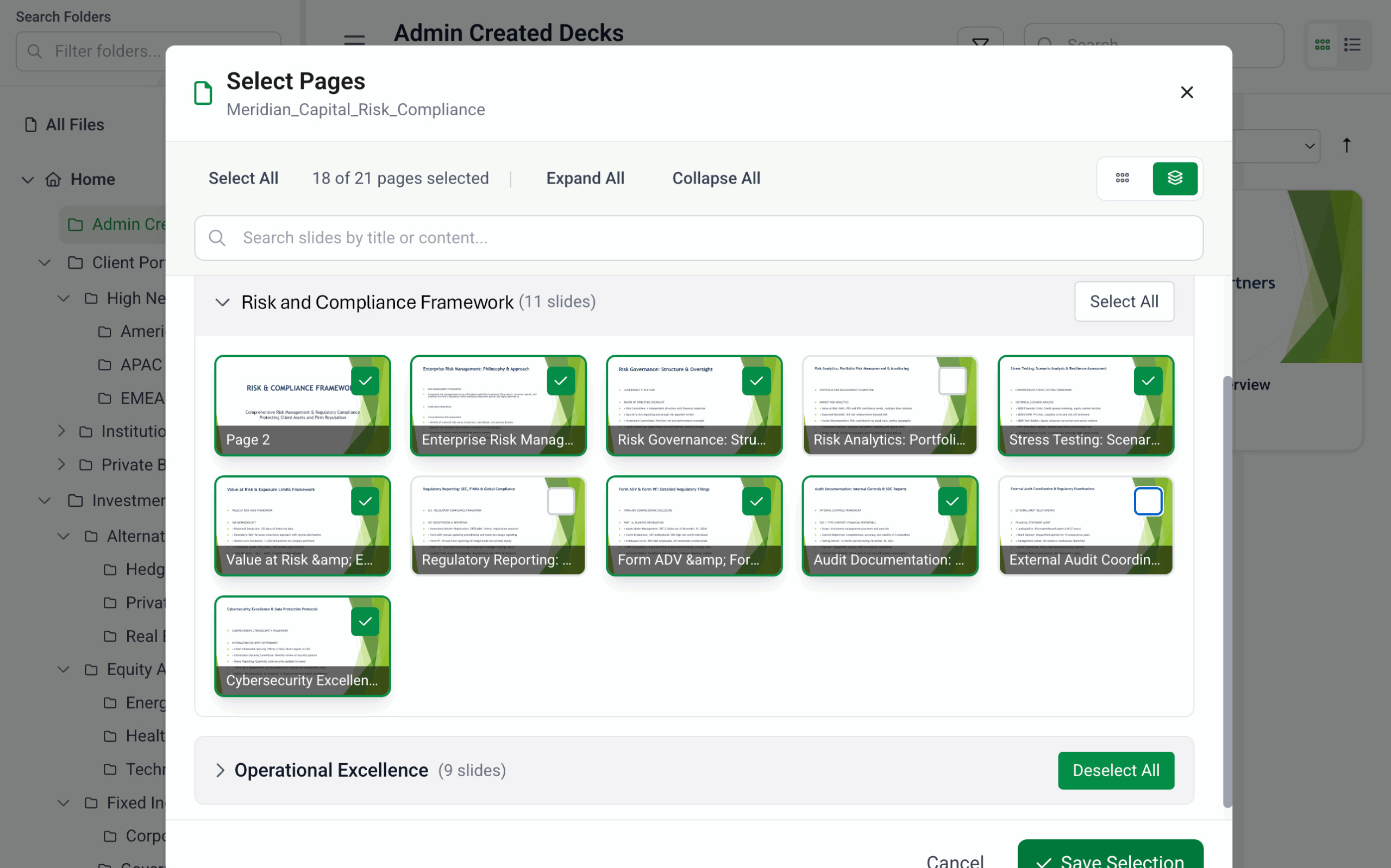
The rep-facing app, Pitcher Impact, handles presentations, tasks, audits and orders. Pitcher Admin gives managers control over content, permissions, users and templates. Digital Sales Rooms turn the post-call package into a trackable microsite rather than a heap of attachments. PIA, the company's intelligent agent, assists with meeting preparation, deck generation, recommended actions, roleplay and critique. Pathways automates compliant, personalized presentations. Catalyst, released in March 2026, lets an administrator describe a small data-connected sales app in natural language and deploy it inside Pitcher.
The business model is enterprise SaaS, sold through a personalized demo and configured deployment. Pitcher does not post a standard price card. That is unsurprising for software that may touch identity, CRM, ERP, inventory, content governance and regional data rules. It does make the buying argument more demanding. The customer has to value time returned to reps, faster order capture, better adoption and cleaner activity data, not simply another software seat.
03 / AI after the plumbing
The chatbot arrived after the hard integrations
Pitcher's current language is AI-native, but the interesting part is chronological. The company spent years building the context an assistant needs before adding the assistant. PIA can suggest the next account because the platform can read CRM history and engagement signals. It can draft a meeting deck because approved content and customer data are already connected. It can critique a call because the meeting and the performance rubric occupy the same environment.
That sequence is worth noticing in a market crowded with generic copilots. AI is most useful here when it reduces a known delay: the minutes spent hunting for content, the manual summary after a call, the guess about which store deserves a visit. It is less persuasive when it becomes decoration. In regulated sales, a creative answer can be a liability. Pitcher's pitch is controlled personalization from governed material, with compliance filters and auditable systems around it.
A 2026 partnership with French retail-tech company EasyPicky makes this concrete. A field worker records a short phone video of a shelf, even offline. EasyPicky's image recognition identifies availability, out-of-stocks, placement and display compliance. That information flows into Pitcher, where it can shape visit priorities and next-best-action recommendations. The AI is not writing a sonnet about crackers. It is telling a rep where the crackers are missing.
04 / The market test
Where Pitcher fits - and where it does not
Pitcher competes in a busy sales-enablement market with Highspot, Seismic, Showpad, Allego, Mediafly and Mindtickle. Those products overlap in content, coaching, engagement and analytics. Pitcher's sharper claim is field execution: mobile use, offline continuity, deep configuration and the ability to move from a presentation into inventory, pricing and an order without leaving the experience.
That breadth can be an advantage or a warning label. Pitcher is a plausible fit when hundreds or thousands of reps must follow consistent workflows across regions, when content changes frequently, when connectivity is uneven, or when sales touches regulated material and operational data. It is less compelling for a small inside-sales team with a simple product, reliable internet and a CRM that already covers the day. It also will not rescue a rollout with no executive sponsor, messy source data or reps who were never asked how they work.
Pitcher itself recommends two implementation conditions that sound obvious because most good advice does: visible executive support and interviews with users across sales, marketing, training and operations. The platform says deployments can take as little as four to six weeks. That clock is believable only when the company knows which workflows matter, which systems are authoritative and who can approve a change. Configuration cannot settle an organizational argument.
What a builder can steal
- Start with one expensive handoff, then follow the user's workflow on both sides of it.
- Treat offline behavior as a product mode with a full lifecycle, not a cached brochure.
- Put AI on top of trusted context and approved actions instead of asking a model to invent the process.
- Choose customers for whom integration depth is a feature, not procurement punishment.
05 / The next chapter
From a super app to an app factory
Crest Rock Partners made an undisclosed strategic growth investment in 2022. The company said the money would accelerate product work, AI, analytics and its partner network. In 2024, Pitcher announced record quarterly SaaS revenue and named Mondelēz, Azurity and Vontobel as new customers, without publishing the dollar figure. Kevin Chew, an enterprise-software executive with experience at Seismic, SAP and Oracle, became CEO in 2025. Yentur moved into the Chief Innovation Officer role.
The 2026 releases show the direction. Catalyst opens the platform to micro-apps built by revenue-operations teams. Rep Cockpit turns signals into a ranked daily view. Next Best Action pulls more deeply from CRM activity. Offline now covers planned and unplanned calls, reporting and follow-up tasks before synchronizing later. Pitcher is trying to become both the place a field rep works and the place an enterprise shapes how that work should happen.
The risk is the same one carried by every all-in-one platform: the promise of consolidation can create a larger thing to configure, govern and teach. Pitcher's answer is flexibility and a seller-first interface. The proof will not be the number of features inside the box. It will be whether a rep can open the app on a Monday morning, know where to go, know what to show, take the order and leave with less clerical work than before.
That is the quiet appeal of the company. Pitcher began with a fashionable device, but its durable idea was never the tablet. It was continuity. The sales call is not an isolated performance. It is a chain of decisions before, during and after two people meet. Software earns its place when fewer links fall on the floor.