Before a clinic could learn, somebody had to find a gap in two calendars. Allurion’s commercial representative would visit, sit down with a physician, and explain the company’s weight-management programme and device. Multiply that appointment by a network of clinics and the problem becomes obvious: useful knowledge is travelling at the speed of a diary.
In Allurion’s published account, scheduling constraints and limited access to resources made training inconsistent. The company changed the arrangement. Bigtincan supplied a learning environment and a library of sales and marketing material. Clinics could start accessing information without waiting for the next visit. The sales representative remained useful; the appointment ceased to be the sole doorway to knowledge.
- The job: connect approved sales material, learning, practice and buyer engagement.
- The useful detail: Allurion put five digital modules before a two-week in-person training event.
- The price to distinguish: Vector’s A$183 million acquisition value is a company purchase price, not a software bill.
- The change: Bigtincan went private in April 2025 and combined with Showpad that October.
The first thing to break was the timetable
Allurion’s design is more interesting than the usual declaration that a business has “gone digital.” New commercial staff and clinics worked through five modules before a two-week training event. Afterwards, the learning library stayed available. Preparation, face-to-face instruction and continuing access became successive parts of the same process.
Its quizzes were used before lessons as well as after them. A quiz at the end checks retention. A quiz at the beginning lets somebody discover what they need to learn. That is a small reversal with a useful consequence: the learner arrives with a question, rather than merely an obligation.
“My favorite features are the quizzes.”Matthew Wright, Allurion’s VP of Global Professional Education
The case study reports that clinics completing Allurion’s training journey were 67% more productive than other clinics. That deserves the description it actually has: a customer-reported comparison. It does not establish that buying software produces a 67% improvement. The teaching, the people and the clinics matter too. The repeatable idea is the sequence.
A programme design worth examining; not a universal prescription.
A library that follows you out the door
Bigtincan began in 2011, founded by David Keane and Geoff Cohen in Sydney. A 2022 founder interview places its early office above a coffee shop. The location supplies the charming origin detail. The more revealing detail is what Keane thought mobile devices were for: getting useful company information to people working with customers.
His definition of the user was wider than the job title on a sales badge: “it’s really anybody that’s working with a customer.” That helps explain a product serving store associates, channel partners and service teams as well as enterprise sales representatives.

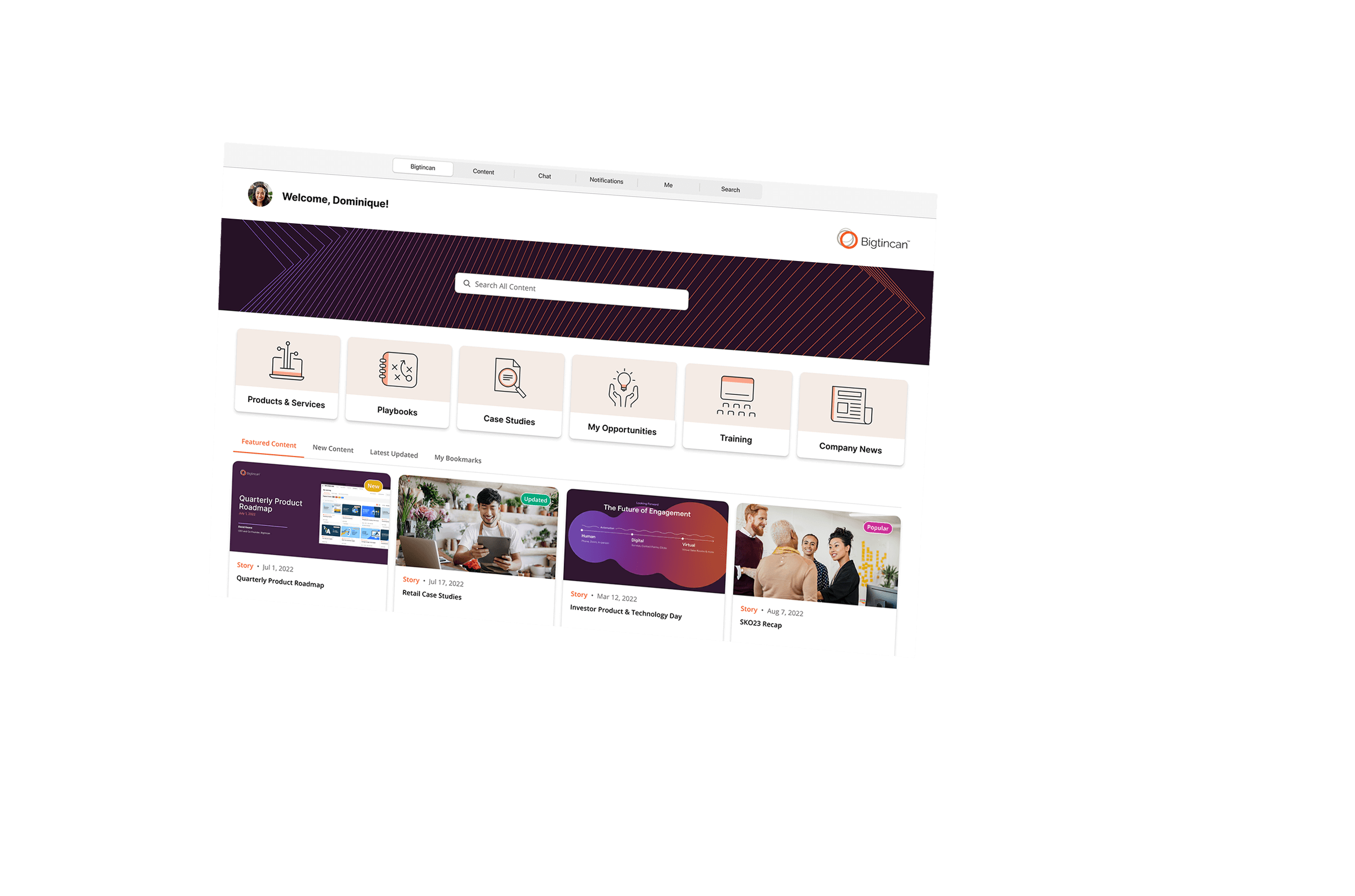
Content software organizes and distributes approved material. Learning tools turn information into courses and assessments. Engagement tools help sellers share material and see what buyers do with it. Bigtincan’s argument is that these jobs belong together. A product change should reach the brochure, the training and the next customer conversation without three departments discovering it independently.
Its mobile and offline content access has a particularly sensible audience: people whose working day happens outside a desk. A representative in a hospital, an industrial site or a dealership needs the relevant material there. Connectivity is a condition of the building, not a measure of the salesperson’s commitment.
The customer roster in the August 2025 merger announcement included Abbott, AT&T, Clorox, Merck and Winnebago. Across those businesses, product knowledge can be extensive, messaging needs control, and customer-facing teams are distributed. The expertise Bigtincan sells is the machinery for keeping those teams supplied and prepared.
The buyer in the rehearsal room
AI adds another layer to that machinery. Genie Assistant can answer questions about company material, help draft content and query analytics. Digital sales rooms gather resources for a particular buyer. AuthoringAI helps produce learning assets. These tools have different jobs; bundling them under one clever name does not make the jobs interchangeable.
RolePlayAI offers the more amusing proposition: a buyer who exists expressly to let you practise. Bigtincan describes scenarios with skeptical personalities and practice in different languages. Its own enablement team uses the tool to rehearse conversations. A mirror has many virtues, but asking an awkward follow-up question is seldom one of them.
The November 2025 update removed the push-to-talk waiting pattern and allowed the simulated customer to interrupt. It also added Deep Research, which combines approved internal material with configurable web resources to build research reports. The intended use is practical: account briefs, competitor analysis and preparation for an informed conversation.
The important constraint follows from the product design. Approved information needs an owner. A convincing generated answer still needs accurate product material underneath it. For a prospective customer, a sensible demo uses their own difficult question and their own permission rules. Fluency is easy to admire; an answer that belongs in the meeting is the better test.
A$183 million, then a former rival
Bigtincan expanded partly by buying capabilities. Brainshark brought enterprise readiness, coaching, authoring and scorecards through a deal announced in 2021. ClearSlide added engagement and content tracking. Other acquisitions widened mobile learning, content automation and interactive experiences. The resulting breadth was assembled over years.
There is a financial wrinkle worth keeping in the picture. Bigtincan’s FY2024 presentation reported A$117.1 million in total operating revenue and other income, compared with about A$123.1 million the previous year. It also reported positive operating cash flow. A substantial software business can improve its cash position while revenue goes backwards; the measures answer different questions.
Total operating revenue + other income
Historical standalone Bigtincan figures, rounded. These are not the combined company’s current revenues.
In April 2025, Vector Capital completed its acquisition for A$0.22 a share in cash, at an approximate transaction value of A$183 million. Bigtincan became private. By October 30, Vector had also completed its Showpad acquisition and combined the businesses under the Showpad brand, with Apratim Purakayastha as CEO.

Vector’s stated rationale pairs Bigtincan’s AI and learning strengths with Showpad’s content management and buyer engagement. The closing announcement put the combined customer count above 2,000 across 50 countries. In 2026, Showpad’s company history describes a platform focused on complex field selling. A former independent alternative had become the name on the combined business.
Steal the sequence, not the shopping list
The commercial model is enterprise subscription software with services and support. Bigtincan’s public pricing page describes Essential and Elite packages, with smaller starts in readiness, content or engagement, and asks buyers to request a quote. A budget therefore needs a defined scope: users, modules, integrations, support and the work of getting material ready.
Seismic, Highspot and Allego occupy overlapping territory. Bigtincan’s distinctive history combines mobile content delivery, acquired readiness tools and AI practice; the Showpad combination adds another substantial content and engagement foundation. Feature lists alone will have trouble settling the choice. The better comparison is a real workflow, from the question a buyer asks to the answer a seller finds and shares.
For a team considering adoption, Allurion supplies a useful starting point. Identify what makes people wait. Put necessary preparation before expensive live time. Keep the approved reference material available afterwards. Measure whether people can perform the task, alongside whether they opened the course.
That approach needs maintained content, somebody accountable for the learning programme and enough repetition to justify the setup. A small team with simple products may have little reason to buy an extensive platform. A large team without a reliable information owner can acquire a tidier place to store confusion. Bigtincan’s case becomes persuasive when the company already has valuable knowledge and needs it to travel further than the next calendar invitation.