Imagine a new sales representative preparing for a call. A buyer has an objection. Someone on the team has handled it before, perhaps brilliantly. The answer lives in a recording, a message thread, or a colleague’s memory. The new rep has a search box, fifteen minutes, and a growing suspicion that the company’s most valuable knowledge has terrible filing habits.
This is the situation Flockjay is built to address. Its software brings sales content, learning, and coaching into one system. The interesting part is where the lessons come from: the people already doing the work. A successful seller becomes more than a name at the top of a leaderboard. Their reasoning can become something another person learns.
- The job: organize sales knowledge, train revenue teams, and support coaching.
- The twist: Flockjay began as a bootcamp for people trying to enter tech sales.
- The bet: useful lessons already exist inside a team, if someone captures them.
- The test: look for changes in customer conversations, beyond finished courses.
The answer is somewhere in Slack
Flockjay describes a win story as an account of how a deal happened: the buyer’s circumstances, the objections, the turning points, and the outcome. That is different from a congratulatory announcement. “We won” is pleasant. Explaining what finally persuaded the buyer gives the next seller something to work with.
Its knowledge-capture approach works through existing tools, including Slack, Salesforce, Gong, and Notion. Prompts ask sellers to record lessons at useful moments. An organization can gather those contributions, connect people with subject experts, and build a shared record of experience. The premise is modest enough to be believable: a team probably knows more than any one member can conveniently retrieve.
A classroom with a different door
Founded in 2018 by Shaan Hathiramani, Flockjay entered Y Combinator’s Winter 2019 batch. Its original classroom taught tech sales. This offered a route into the technology industry for people whose strongest skill might be talking to customers rather than writing software. The mission was access, particularly for people from backgrounds poorly represented in tech.
The 2021 program catalog makes the idea concrete. It describes 160 hours over ten weeks: sales fundamentals, inbound qualification, outbound prospecting, tools, and interview readiness. Students practiced for an entry-level sales development role. The structure was vocational and specific. There was a job at the far end of the syllabus, rather than a vague invitation to become more employable.

Flockjay’s January 2021 financing announcement described an $11 million Series A led by e.ventures, with investors including Lightspeed and Salesforce Ventures. It also described a Gong mentorship collaboration for graduates. Even in the school’s first act, the ambition extended beyond the final lesson: connect people to practitioners who could help them continue developing.
“Our mission is to empower upward mobility through education and access.”Flockjay’s published mission
The pivot had a bill
The catalog listed full tuition at $7,650, with a $6,000 upfront option for eligible US students outside California. Deferred tuition was another route. Those were the economics of the school, with students paying for a promised path into work.
In August 2021, Flockjay cut at least half its workforce while pivoting toward B2B software. In September 2022, TIME reported complaints from former students about reduced coaching, disappointing job support, and tuition obligations. These were reported student experiences, rather than a universal account of every graduate. They nevertheless belong in the company’s history.
The company’s January 2022 platform announcement supplied its explanation for the new direction: barriers to advancement continued after the ten-week program. Flockjay had learned from working with sales teams that people needed support inside the job. Its Sales Elevation Platform would move learning into that setting. Course Report now marks the historical bootcamp as closed.
Job seekers
Sales fundamentals
Student tuition
Revenue teams
Shared field knowledge
B2B software
A library that knows why you came
Today, the content-management product offers natural-language search and guided experiences around sales material. Administrators can receive reminders about aging content. Resources can appear inside the systems sellers already use. This matters because finding a file and finding an answer are different tasks. A rep asking about a buyer’s objection does not necessarily know the title of the document that addresses it.
Flockjay’s AI product adds answers alongside existing content and describes a model tuned for sales enablement. Its positioning places search, learning, and performance together. The distinction worth investigating in a demo is whether that connection feels useful during an actual task. An elegant library that takes too long to navigate still leaves the seller improvising.
Make the winning call teach the next one
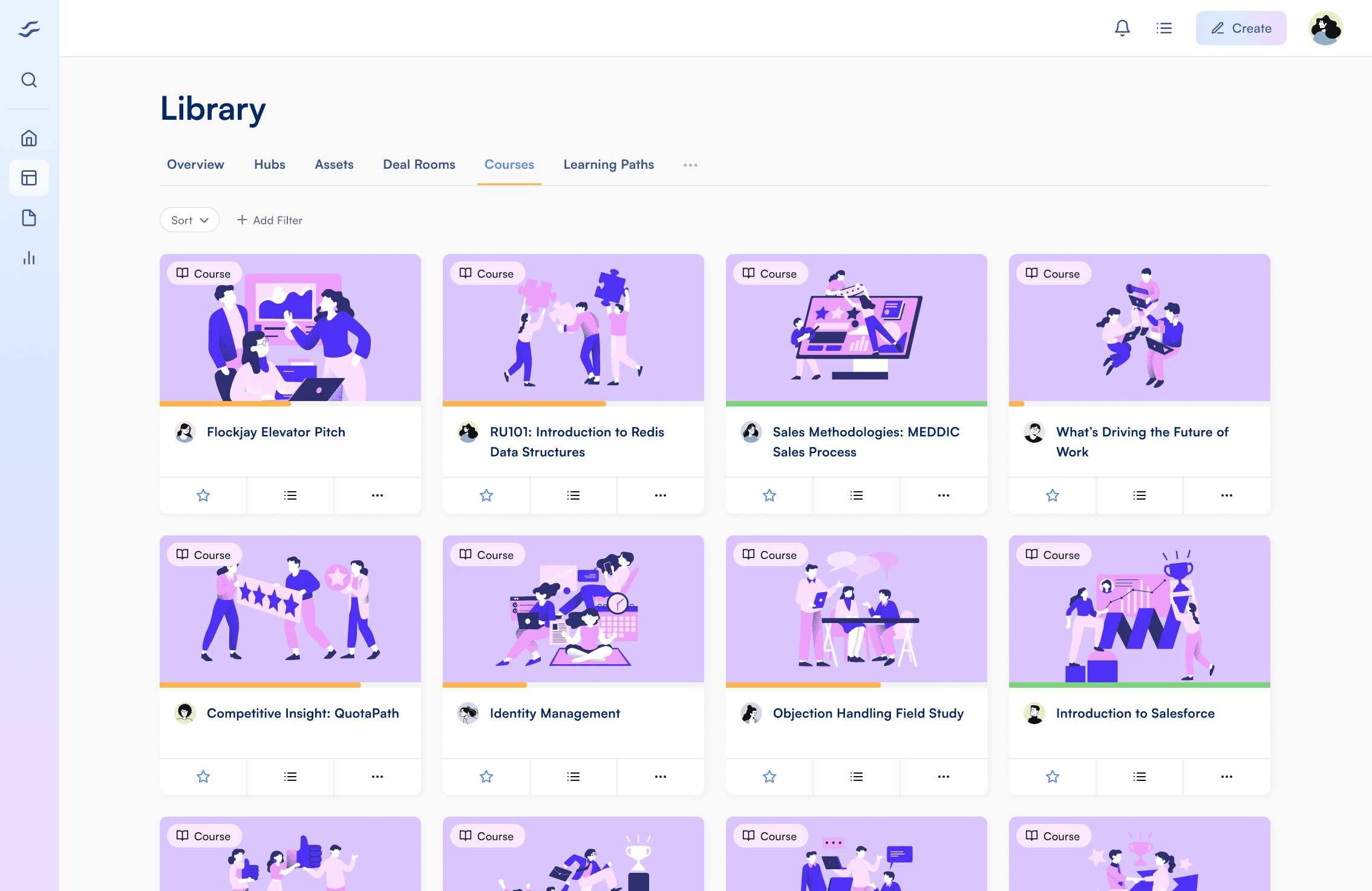
The learning product emphasizes small lessons, peer contributions, and role-based assignments. It describes HR-system integrations that can automatically add people and assign relevant content. New hires can follow a structured path; experienced sellers can contribute techniques learned in the field. That makes the platform a place where the curriculum can change as the market does.
The coaching side assesses seller interactions against a chosen sales methodology or custom framework. Managers can set alerts around performance indicators, review emerging problems across teams, and capture deal insights. Its purpose is to direct scarce coaching time toward the conversations that need attention.
Flockjay calls its measurement approach “Prove and Improve.” Identify a skill gap in calls and deal data, deliver training aimed at that gap, then examine subsequent behavior and outcomes. The intellectual appeal is the return journey. A course should lead back to the work that made the course necessary.
- 01Find the gapCalls + deal signals
- 02Teach against itLessons + practice
- 03Check the fieldBehavior + outcomes
Who buys the second act?
The buyer is now an organization: sales enablement, revenue operations, or sales leadership. Flockjay’s homepage displays logos including HG Insights, Cognition, Obsidian, Harness, and Anomalo. The commercial route begins with a booked demo. The problem being sold is familiar to growing revenue teams: training, content, and everyday selling have drifted into separate systems.
Flockjay sits in the sales enablement market alongside Seismic, Highspot, Mindtickle, and Showpad. Its pitch emphasizes a unified product and peer learning. Buyers should read that as a proposition to test. Competitors also offer broad capabilities; having several functions under one login does not establish better adoption or better results.
Flockjay’s advertised count. Connections include call intelligence, CRM, chat, and content tools.
The integrations are central to the proposition. Gong, Chorus, and Clari CoPilot supply recordings. Salesforce connects resources to selling workflows. Teams supports content search and natural-language questions; Zoom supports live training and attendance capture. The practical value is avoiding another destination that the rep must remember to visit.
Practice before the buyer arrives
The company’s AI Roleplay announcement describes configurable buyer personas and custom scoring rubrics. A manager can create a skeptical executive or a technical evaluator, then let a rep rehearse discovery, pricing, or objections. This makes practice easier to schedule than repeatedly borrowing a colleague. It also lets teams rehearse their own scenarios rather than a generic sales conversation.
Another announcement introduces an MCP server that lets AI assistants access readiness, coaching scorecards, and content-performance information. A manager could ask about a rep’s learning progress and recent call evaluations in one query. Both additions extend the same idea: useful knowledge should be available when someone has a question, rather than only when they open the correct dashboard.
Copy the habit before buying the software
A team can borrow the central habit immediately. After a meaningful deal, record the buyer’s problem, the difficult objection, the turning point, and the outcome. Have a knowledgeable colleague review it. Put it somewhere the next seller will encounter it. This is an editorial recommendation drawn from Flockjay’s capture-and-teach approach; software makes the routine easier to repeat.
Adoption still depends on people. Old pricing, poorly explained wins, and careless scoring rubrics can produce confident but unhelpful guidance. A team with little repeatable selling, few recorded interactions, or no owner for content maintenance may gain less from the system. In a trial, use real questions, inspect the answers, and check whether reps carry the lesson into later calls.
Flockjay’s own recent enablement panel shifts attention from producing more material to judging relevance and impact. That is a sensible place for its second act to land. The sales floor already contains a considerable education. Flockjay’s opportunity is to make more of that education available to the person who needs it next.
Visit Flockjay ↗ · Explore the product ↗ · Read its blog ↗