Consider the missing sale. The shopper has seen the advertisement, remembered the brand, and arrived with money to spend. Then comes the shelf: the wrong packet, the empty space, the promotional display that never materialized. Somewhere between the brand’s plan and the customer’s basket, a perfectly respectable strategy has gone astray.
StayinFront works in that awkward interval. It makes mobile software for the people sent into stores to check products, take orders, sell displays, and put things right. Its consumer goods customers include brands and the agencies that represent them. Its separate life sciences business equips pharmaceutical and biotechnology field teams with CRM. Both businesses concern the same unglamorous question: what information does a person need during a customer visit?
- The job: help field teams choose stores, inspect shelves, sell, and measure results.
- The useful twist: shelf image recognition can run on the rep’s device, including offline.
- The extra persuasion: Augment shows proposed displays in the actual retail space.
- The buying test: measure better store outcomes, alongside the cost of getting them.
The answer has to arrive before the rep leaves
Retail execution is a wonderfully dry name for a very physical business. Someone must notice that a product is missing. Someone must distinguish a distribution problem from a placement problem. Someone must have a conversation with a store manager who has other things to do. A dashboard at headquarters cannot perform these small negotiations.
StayinFront TouchCG is the mobile working tool in its Retail Optimization Platform, or ROP. It supports shelf audits, promotion checks, orders, and selling. Image recognition adds a way to gather shelf information without asking a representative to type every observation into rows and columns. Shelf Builder supplies a visual representation of the shelf; guided selling helps turn the observations into proposed actions.
The company’s July 2025 On-Device AI announcement identifies a particular nuisance in earlier workflows: server-based processing could take minutes or longer. A representative might have to wait, switch applications, or receive the useful answer after the useful moment. StayinFront moved recognition onto the device and says results arrive in seconds, without an internet connection.
“Processing images directly on a device reduces the time to results from minutes to seconds.”
Sam Barclay, Chief Growth Officer · July 2025
This is the interesting engineering choice. A fast answer changes what can happen in the visit. The rep can examine a suspected gap while standing beside it, rather than leave a photograph behind for later interpretation. The advertised speed remains a vendor claim; its practical value depends on the products, photographs, and devices used in a real deployment.
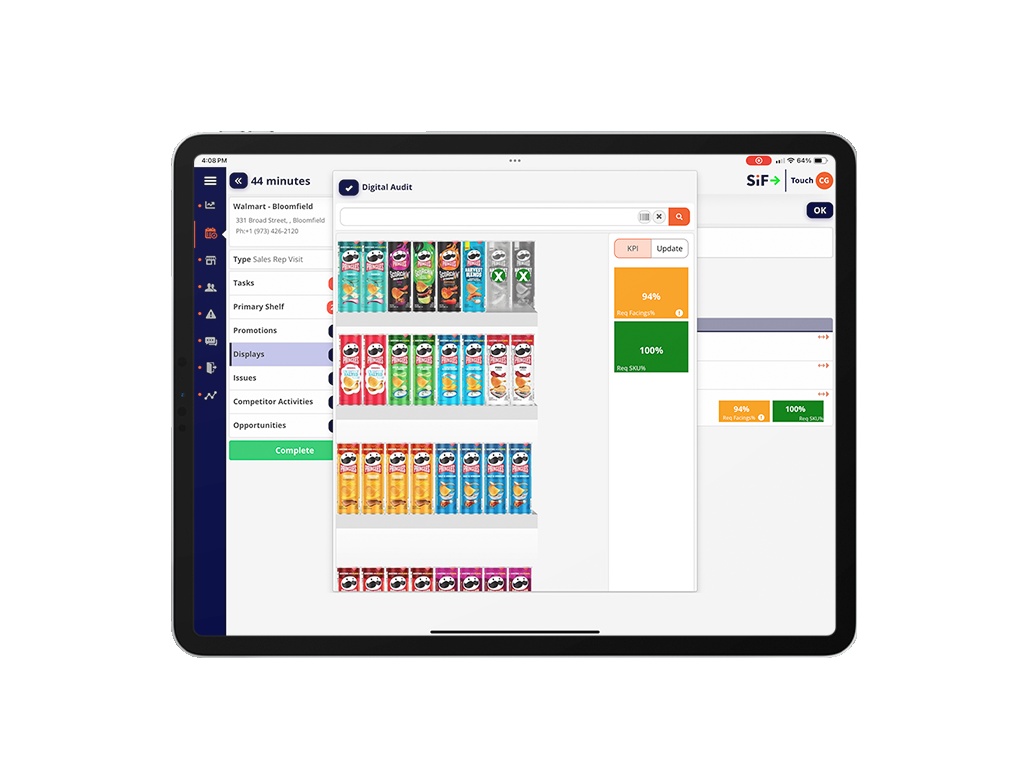
The company’s spice-and-flavoring case study makes the problem pleasingly concrete. Similar-looking products, misplaced stock, and poor visibility can conceal missing items. Recognition helps flag missing SKUs and facing gaps. An August 2025 pilot announcement applied the same idea to an unnamed large US ice cream maker: build freezer planograms from photographs, then check missing products and layout compliance. Even ice cream needs paperwork.
The shortest route can be the wrong one
Before the shelf comes another decision: which shelf deserves a visit today? A route can be tidy, economical, and commercially disappointing. Sending someone to the nearest stores tells you about distance. It tells you considerably less about where that person might recover a sale.
StayinFront Dynamic Routing combines estimated store opportunity with geography and working constraints. Its Retail Data Insight calculations estimate the dollar value of visiting a store. The routing tool groups stores and considers factors such as travel distance, the workday, and promotional calendars. The resulting visit plan sits within TouchCG’s calendar.
- 01ChooseOpportunity + location
- 02InspectPhotograph + recognition
- 03ActFix, pitch, order
- 04MeasureIntervention + outcome
Each handoff matters. An accurate observation earns its keep when someone can use it.
The attraction is the connection among these jobs. Retail data helps choose the store; shelf information helps choose the action; the sales tool helps make the case; analytics examines the result. A buyer should assess those handoffs. Four impressive screens can still make one cumbersome visit if the rep has to shuttle between them.
There are credible alternatives. Salesforce Consumer Goods Cloud offers retail execution, visit planning, mobile orders, and offline capabilities. StayinFront’s case rests on its particular combination of field workflows, retail analytics, shelf recognition, and integrated selling tools. Offline access alone does not settle the comparison. The question is how well each system handles the buyer’s actual stores and processes.
A refrigerator that has not arrived yet
The most theatrical part of the toolkit is also among the easiest to understand. A rep wants a manager to accept a new display. The manager wants to know what it will do to the space. A beautifully designed presentation can leave both people politely imagining different objects.
Augment lets a sales team place a 3D simulation in the retail environment through a phone or tablet. StayinFront integrates it with PitchBook, its tool for store-specific presentations. The proposed display becomes visible in the place where it would stand.
This was a relationship before it was an acquisition. StayinFront and Augment announced their integration partnership in January 2016. StayinFront acquired Paris-based SAS Augment in May 2024. The deal extended an established product relationship, rather than introducing an unrelated novelty to the catalogue.
In September 2025, Augment announced a renewed and expanded partnership with Coca-Cola HBC across 28 markets. The relationship began with deployment in 2017. The announcement describes simulations of fridges, chillers, tables, umbrellas, and branded merchandise, including pre-selling assets before physical production. The point is wonderfully ordinary: make the proposed object easier to judge before anyone has to move it.
The accountant behind the aisle
Founder Thomas Buckley’s biography supplies an apt detail. He has an accounting background, spent five years at KPMG, and earned an executive MBA in finance. The company dates his founding of StayinFront to 2000 and identifies Redi-Direct as its parent. The preoccupation with measuring field activity makes sense in that light.

StayinFront reports deployments in more than 50 countries across six continents. Its public customer material names PepsiCo, Arla Foods UK, L’Oréal, Kimberly-Clark, Advantage Solutions, and Wells Enterprises. These are different operations with a common need: coordinate people working beyond the office.
Its life sciences product, TouchRx, handles a different visit. Pharmaceutical and biotech teams use it for territory management and engagement with healthcare professionals. The wider offering includes content, analytics, compliance tools, and coaching. In that market, Veeva Vault CRM is a relevant alternative. The two StayinFront businesses share mobile field work, while the details of the customer conversation differ substantially.
Recent announcements show continued attention to agencies and regional expansion. In June 2026, Grupo Cosmic and StayinFront announced a partnership intended to bring ROP to more than 10,000 retail associates across Mexico and Latin America. In September, StayinFront announced a multi-year LATAM agreement with an unnamed household goods company. These describe commercial commitments; they do not establish that every planned user is already live.
The bill includes more than software
StayinFront sells enterprise software through licensing and support agreements, with public announcements frequently describing multi-year contracts. The economic question extends beyond the licence: preparing product and store data, integrating systems, configuring workflows, training people, and administering the rollout all deserve a place in the business case.
A company-published digital transformation case study reports an average overall sales uplift of 3% to 4%. It also describes variation by market and category, with revenue gains from just under 1% in modern-trade household goods to 6% in traditional-trade grocery. That spread is more useful than a single triumphant number. The same tool meets different opportunities in different places.
Average overall sales uplift reported in a digital transformation study spanning six named markets.
A reported outcome, not a forecast for a new customer.A visit-completion count measures whether someone went. A photograph measures what someone saw. Neither, alone, establishes what the visit earned. A sensible evaluation records the intervention, follows the relevant sales and execution measures, and considers what else changed: promotion, price, stock availability, or season. The company’s emphasis on ROI is useful precisely because the measurement is demanding.
Give the software your difficult shelf
The copyable lesson is to organize work around a decision. Which store merits attention? Which problem can the rep address? What evidence will persuade the manager? What result will show that the intervention helped? These questions remain useful even for a team starting with a spreadsheet.
For a buyer, an appropriate pilot should include the awkward cases: similar packaging, poorly organized shelves, missing stock, and weak connectivity. Check recognition on the intended devices. Follow the rep through the entire visit. Include the cost of training and the time spent correcting errors. Compare outcomes with a credible baseline before broadening the deployment.
There are practical boundaries. Bad product data makes a poor starting point. A recognized gap still needs stock, permission, and someone to act. A supply-chain shortage cannot be repaired by rearranging the shelf; StayinFront’s own supply-chain material distinguishes those upstream issues from store execution. The system earns its place when accurate information reaches a person who can change something. Ideally, before the shopper does.