interactive-demos
(6)
Walnut sells the demo without the drama
A software demo can be a tiny theatre of embarrassment. Walnut turns it into a reusable, personalized experience - and gives sales teams a record of what buyers actually explored.
Reprise and the Demo That Would Not Break
A product demo is supposed to make the software look easy. Reprise built a business around the awkward work required to make that happen, from replacing bad sample data to cloning an entire app before the meeting starts.
The Demo That Refused to Break
A software sale can be lost to a blank screen. Demostack built a business around making the product demonstration stable, specific and easy to pass along.

Tacpoint makes complicated software easier to say yes to
A payment demo, an ATM dashboard, a talking webpage. Tacpoint’s work reveals how much of enterprise design is really the business of helping people understand what happens next.
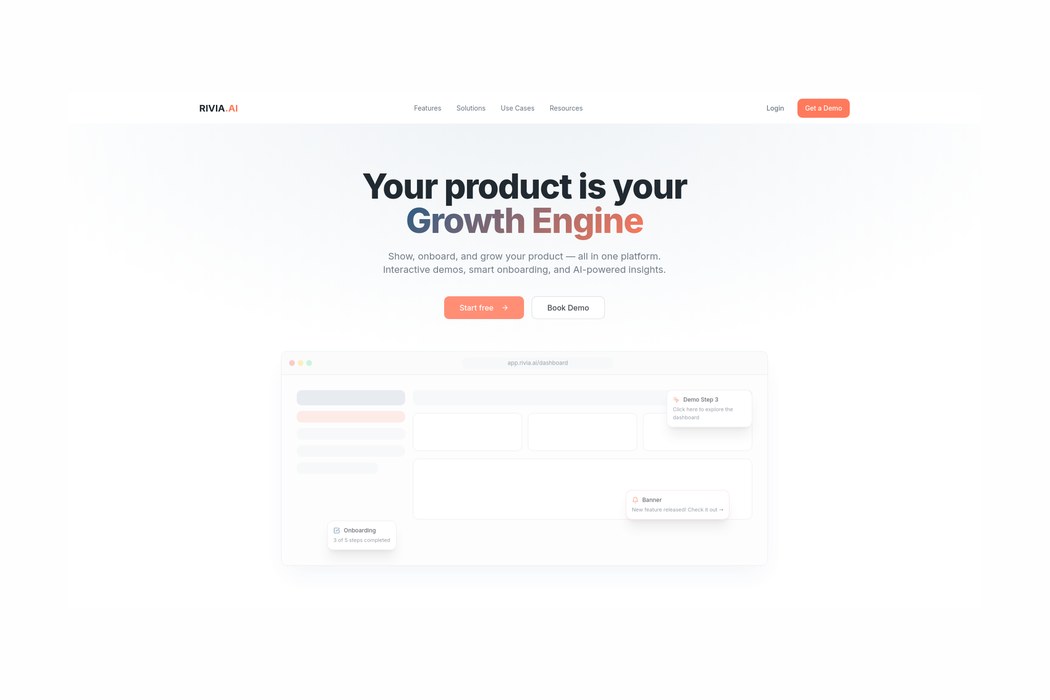
Rivia.AI
Rivia.AI is a Bengaluru-based, Y Combinator (S21) startup that lets marketing, sales and demand-generation teams build interactive, self-guided product demos without code. Using a Chrome extension, teams capture pixel-perfect clones of their live product, layer on guided tours, checklists and video narration, then share or embed the demos and track how prospects engage. It positions itself as an affordable alternative to demo platforms like Walnut, Storylane and Navattic.

Caroline Clark
Caroline Clark is the CEO and co-founder of Arcade, the San Francisco software company that turned the dreaded product demo into something people actually want to watch. After product marketing at Atlassian and a stint at Sequoia Capital, she started Arcade in 2021 to kill the screenshots-and-gifs grind she lived through firsthand. Today more than 14,000 companies, from Salesforce to Zapier to Carta, build interactive demos and AI-generated product videos on Arcade, which raised a $14M Series A led by Kleiner Perkins in November 2024. Clark borrows the feel of video games, pulsating dots, satisfying load times, to make B2B software feel like play, and runs the company on a borrowed Sequoia creed: rigor, discipline, and focus on quality.