The first thing a software buyer usually sees is the part a seller is most afraid to show. A demo account has yesterday's sample data. A shared sandbox has been touched by someone else. A feature works in production but the network chooses the exact wrong moment to hesitate. On screen, all of this looks less like a technical inconvenience than a verdict on the product.
Reprise exists in that uncomfortable gap. The Boston company lets teams prepare a version of their software for the moment it must explain itself: a guided tour for a visitor on a website, a tailored live presentation for a prospect, or an independent clone that can be explored without a real product login. The company sells to enterprise software teams whose product is too involved to explain with a few slides and too important to entrust to a temperamental test environment.
- Reprise turns software into interactive demos that can be edited, shared, measured and reused.
- Replay builds guided tours; Reveal changes a live demo; Replicate creates a standalone application clone.
- Its customers include Pendo, Cloudera, Databricks, Hireology and Litera.
- The useful idea: build one approved demo, then tailor the data and path for each buyer.
The deck came later
The company was founded in 2020 by Sam Clemens, Bryan Stevenson and Evan Powell. Powell, who had sold software, recognized the problem quickly when Stevenson floated the idea: demos closed deals, but preparing them consumed engineering time and left the presenter at the mercy of glitches. Powell took the concept to people in sales and marketing before the team committed. Their enthusiasm helped turn the idea into a company.
The first $3 million came from Accomplice and Glasswing Ventures while Reprise still had prototype technology and no signed customer. Clemens later recalled that the founders raised it through phone calls during the first months of the pandemic. They had no pitch deck. They did, however, have a product to build. Pendo became the first enterprise customer, followed by roughly half a dozen others.
Then an odd distribution channel appeared: board meetings. Investors on customers' boards saw the demos those customers had built. They began calling Reprise. This time, the founders made a deck because it could contain something more persuasive than a forecast - actual customers and their working demos. Bain Capital Ventures led a $17 million Series A in February 2021. ICONIQ Growth led a $62 million Series B that November, bringing total funding to $82 million. At that announcement, Reprise reported year-over-year annual recurring revenue growth above 900 percent. It was a young company's rate of change, not a current growth figure.
“We had nothing to show in a deck and therefore no deck.”Sam Clemens, on Reprise's seed round
Three degrees of control
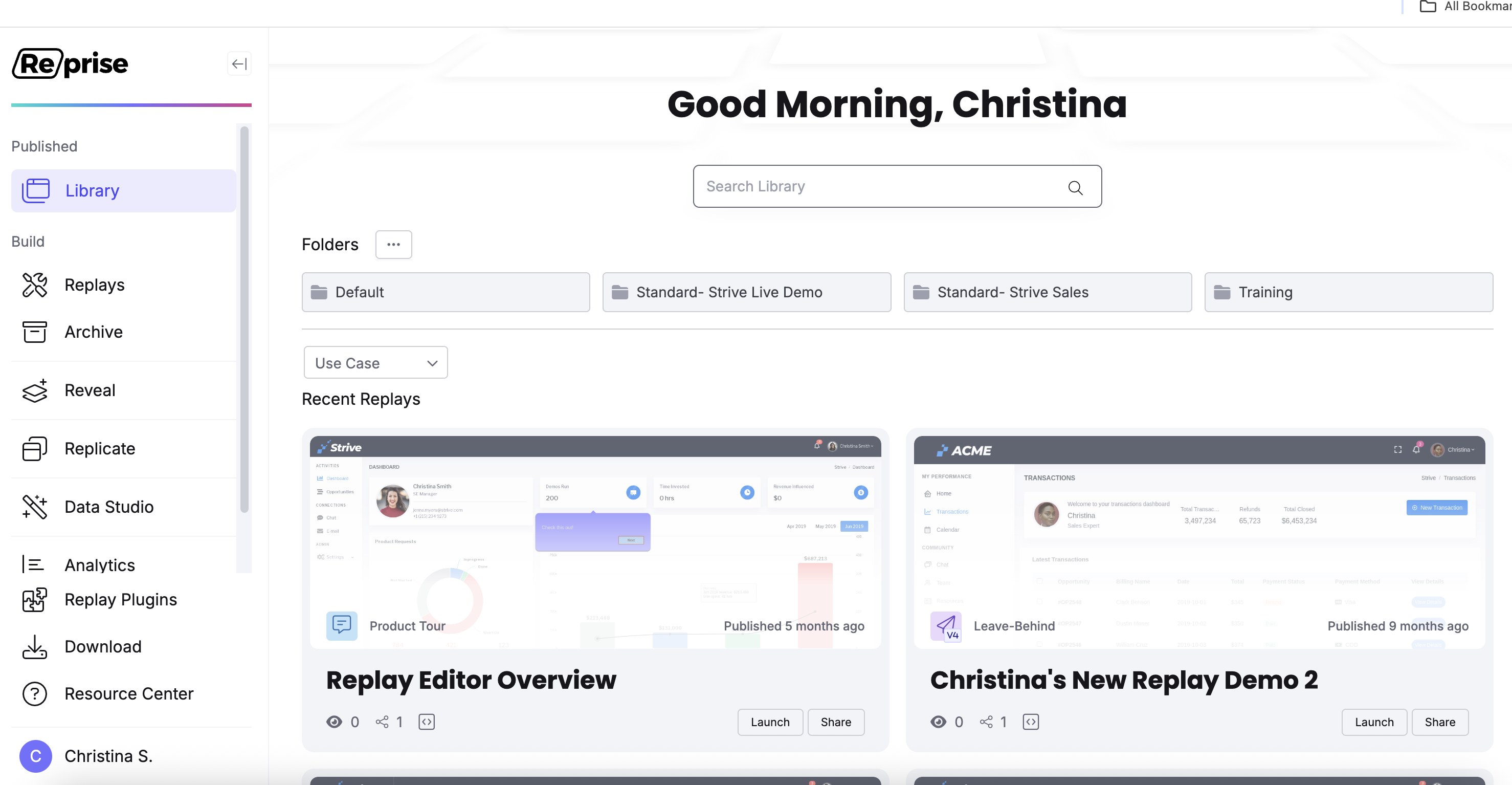
Reprise's product line makes more sense as a set of answers to one question: how much of the real application can this particular demo safely depend on? Replay captures the product and turns it into an interactive, guided tour. It suits a website visitor or a buyer who needs a clear path through a complicated interface. Reveal sits over a live application, letting a presenter change text, images, charts and other elements on demand. Replicate goes further. It captures the front end and the requests and responses behind selected workflows, creating a standalone clone that can behave like the app without sending the buyer into production.
Replay
A controlled tour, built for a buyer who needs a path.
Reveal
A live experience with prospect-specific content layered on top.
Replicate
A separate application environment for freer interaction.
The distinction matters when a product is full of workflows, permissions and data dependencies. A tour can illustrate one sequence beautifully and still frustrate a buyer who wants to turn left. A clone offers more room, but the team must decide which behavior needs to be captured and maintained. Reprise's own documentation is clear that clone scope and supported behavior depend on the application and its configuration. The platform also offers demo data injection, so a dashboard can show a healthcare prospect healthcare data rather than a suspiciously generic row of names.
A demo is a team sport, even when one person presents
The most revealing customer stories are less about prettier screens than about who is allowed to demonstrate the product. Litera, a legal technology company with a growing portfolio, used Reprise as the basis for a certification program across product lines. Before the ILTACON conference, it trained more than 100 people in two days. At the event, Litera says its team delivered over 400 Reprise-powered demos in three days. It reports more than 6,000 Reprise sessions since June 2025. Those are customer-reported figures, but they illustrate an operational change: the demonstration no longer lived solely in the head of the most experienced solutions engineer.
Hireology took another route. Its product marketing team built seven website tours and eight deeper leave-behind tours for sales conversations. The company says deals using the tours closed 50 percent faster. Reprise's HubSpot integration let Hireology measure engagement within its sales process. Pendo built a library of tours that Reprise says has drawn more than 200,000 views. Cloudera used reusable, customizable demos to show a complex cloud product across industries while reducing the burden of running demo environments.
Certified across product lines in two days before an industry conference.
Faster sales cycles for deals that used its Reprise product tours.
These results are reported by the named customers and describe their own programs, not a typical outcome promised by Reprise.
The rehearsal now has an agent
Reprise's newer work aims at the chores before the curtain rises. Its Agentic Demo Builder, announced in 2025, is designed to identify and fix capture problems such as expired tokens, hardcoded domains and broken requests. In June 2026 the company launched Reprise MCP, a connection that exposes more than 100 demo-authoring tools to compatible AI agents. The proposed workflow is quite specific: take account context from a call or CRM record, assemble a relevant demo, change branding and copy, inject suitable data, then create a guide.
That is a change in interface as much as in technology. The seller can request a prepared demo in an agent rather than moving among capture, editing and data tools. The result still needs human review. A plausible dataset is not the same as an accurate claim, and a beautifully guided path cannot rescue a meeting in which the seller has misunderstood the buyer. Reprise's strongest claim is narrower and more useful: it can make the preparation repeatable.
What the company actually sells
Reprise is enterprise SaaS, sold through a trial and sales process rather than a public price card. The customer is usually a software company with enough demos, presenters and product complexity to justify a shared platform. Sales gets a reliable story for the next call. Marketing gets interactive tours that can live on a site or in a campaign. Presales gets a way to govern templates, data and technical fidelity. Leadership gets analytics on how those experiences are used. Role-based controls and security certifications matter because the demos may touch sensitive product behavior and customer context.
There are plenty of alternatives for interactive product tours, including Storylane, Navattic, Walnut and Demostack. A smaller team seeking one simple guided tour may find less machinery useful. Reprise's distinction is the breadth of its demo modes, particularly the isolated application clone, gathered under one enterprise library. That breadth has a cost in setup and editorial discipline: somebody must decide what the demo should prove, what may be changed and who keeps it current.
Choose one buyer question, build one approved demo that answers it, and give the team a controlled way to tailor the data. Then measure what happens after buyers use it. The useful unit is a repeatable conversation, not an impressive screenshot.
A demo is a promise made in public. Reprise's business is helping companies keep that promise even when the live product, the shared account or the network would rather improvise. The best preparation stays invisible. The buyer simply sees the software work.