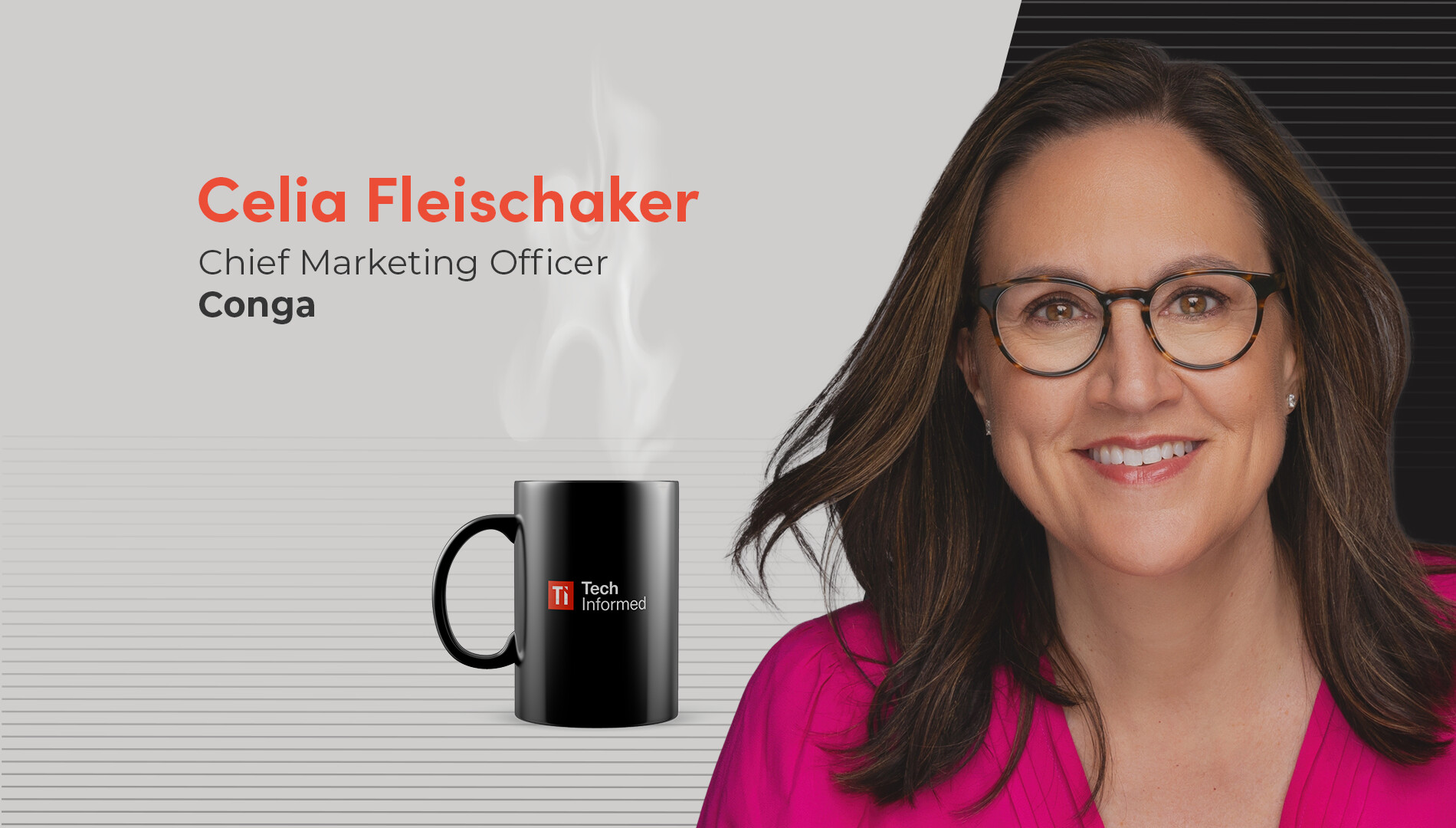
The first rule of the Fleischaker family computer was that pleasure required programming. Celia Fleischaker's father brought home an Apple IIe and told his daughter she could play as many games as she wanted, on one condition: she had to code them herself. She did. She kept taking coding classes through high school, and when she arrived at the University of Virginia's business school, she declared her destination with the confidence of someone who had already met the machine. She wanted to work for a software company.
This was not the standard childhood prelude to a marketing career. It was, however, excellent training for the kind of marketer Fleischaker would become. Code is logic made operational. Marketing, at least as she practices it, is logic made legible. Her recurring question is not merely what a product does, but why it matters to the person expected to buy it, use it, explain it, or stake a budget on it.
Today she is the chief marketing officer of Conga, the enterprise-software company whose products cover configure-price-quote, contract lifecycle management, and document automation. The nouns are sturdy, industrial, and unlikely to improve anyone's dinner conversation. Fleischaker's job is to make their business consequences clear. Conga is her fifth CMO post in technology. The number sounds restless until you notice the long apprenticeship beneath it.
Epicor, PROS, Verint, isolved, and Conga. Each role involved a company whose technology, market, or identity was changing and needed a clearer account of itself.
One badge, a succession of educations
Fleischaker spent roughly two decades in the corporate lineage that became Epicor. She entered through the small software world of FocusSoft and Platinum Software, then moved through a business enlarged by acquisition. She has said the experience felt less like remaining still than receiving a new education every few years. Ownership changed. Strategy changed. The organization grew from a small operation into a billion-dollar enterprise-software company. Her vantage point changed with it.
She worked in product marketing, where the marketer must live close enough to engineering to understand the thing being built. She spent time in field marketing, close to regions and sales. She learned corporate marketing, where a collection of products and constituencies must somehow sound like one company. By the time she became Epicor's CMO in 2015, she had occupied much of the organization she was being asked to lead.
“The translation bit is so important.”Celia Fleischaker, on product marketing
It is the most economical description of her operating philosophy. Product marketers, in her telling, understand what a technology does and then cross the dangerous little bridge to why anybody should care. The role rewards technical curiosity without permitting technical vanity. A product may be intricate. Its explanation does not earn the right to be.
Five CMO chapters
Cloud-first growth
AI commerce and pricing
Post-spin identity
People technology
Connected commerce
At Epicor, recognition followed the work. The marketing organization received a Creative Media Award for search, earned a BrightEdge Hero Award nomination for SEO, and shared a Telly award with agency Binary Pulse for a corporate video. Fleischaker also received repeated invitations to the company's Chairman's Circle. Yet when asked years later to name her largest career achievement, she did not reach for any of these.
When the company changes faster than its story
In late 2017, Fleischaker left Epicor for PROS. The move was deliberate. After years inside a private-equity-owned business, she wanted public-company experience. PROS had shifted quickly toward the cloud, worked heavily with AI, and sold software close to the customer and the commercial decision. It offered familiar scale with unfamiliar tests.
Three years later came a tougher piece of corporate theatre. Fleischaker joined Verint in September 2020, mid-pandemic, while the company prepared to separate a substantial cybersecurity business. The remaining Verint, about $1.3 billion before the roughly $500 million separation described in her 2021 interview, needed to become legible as a customer-engagement software company. A two-decade-old name had acquired a new center of gravity. The market's memory had not received the memo.
The response began with research among employees, customers, prospects, and analysts. Fleischaker's team identified influential employees across functions and tenures, asked how they saw the business, and returned to them as the positioning developed. Customers were briefed. Employees saw the story before the wider market did. An internal community and gamified feedback invited the organization to participate rather than politely receive.
The translation loop
The gratifying moment arrived when customers began using Verint's fresh terminology back to the company. Language had crossed the line from campaign copy into shared description. Still, Fleischaker's public retrospective was not self-congratulatory. She wished the team had pushed harder on employee ambassadors. More pointedly, she said she should have insisted on an early brand study, a baseline against which the repositioning could later be measured. Few things reveal an operator more clearly than the measurement she admits she missed.
“I care about top of funnel, but most people outside marketing really care about pipeline.”Celia Fleischaker, on the metric that travels
Her preferred commercial language is similarly plain. Social engagement and web traffic have value, but qualified pipeline gets attention beyond the marketing department. In her definition, sales has accepted the opportunity, begun talking with the prospect, and put resources behind the deal. This view gives marketing a demanding audience: not only the people who encounter the campaign, but the colleagues who must trust what arrives from it.
The achievement that does not fit on a dashboard
At PROS, Fleischaker served as executive adviser to Blaze, an employee resource group focused on women's professional development. In a 2020 interview, she named the growth of women she had managed and mentored as the professional accomplishment that made her proudest. Seeing someone advance into a vice president or CMO role mattered because her influence could continue in another person's choices.
Her advice separates two figures often carelessly merged. A mentor gives counsel. A sponsor goes further, spending social capital to advocate when the aspiring leader is absent from the room. Fleischaker recommends both, along with networks inside and outside one's employer. The outside view matters particularly in a career spent for many years within one organization; it keeps the walls from becoming the horizon.
Her public conversations about leadership return to self-advocacy, candid feedback, transparency, kindness, and humor. Former colleagues describe an executive who can move between market strategy and the metrics that matter to a board, while recognizing the work that happens behind the scenes. The combination is not sentimental. A high-performing team is also a system, and neglected people are rather more consequential than neglected software.
The theme extends into her writing. Fleischaker has argued that marketing tools can improve employee experience: audience segmentation can make internal communication more relevant; journey mapping can expose weak points in an employee's path; storytelling can turn values on a wall into recognizable behavior. The proposal is characteristic. Take a useful mechanism from one department, translate it, and put it to work for another group of humans.
AI at work, cardboard pieces at rest
Conga appointed Fleischaker CMO in July 2025. The portfolio brings together quoting, contracting, and document automation, now with AI laid across the platform. For Fleischaker, the role gathered earlier threads: CPQ territory she already knew, a global customer base, enterprise transformation, and the recurring need to connect product, brand, and customer engagement.
She uses AI daily. Conga's internal GPT tool helps employees retrieve company knowledge within defined safeguards; the marketing team has explored content, research, and synthetic personas. Yet her view of adoption contains a familiar practical brake. Tools do not deliver their full value when people have not been taught how to use them. The obstacle is not merely access to intelligence. It is organizational learning.
At a 2025 gathering in Paris, she described customers facing political, economic, and trade uncertainty while also trying to understand new AI rules. Conga's research among 1,500 decision-makers found confidence varied by company size and country. Fleischaker resisted flattening the figures into one cheerful number. The headline may say readiness. The detail says uneven readiness, which is where the work begins.
Her method of leaving that work is delightfully analog. Fleischaker likes jigsaw puzzles. The tactile concentration lets her switch off from technology and, as often happens when attention is pointed elsewhere, gives better thoughts room to arrive. Her husband cooks; she happily takes the beneficiary's role. There is coffee, plenty of it, with milk and one packet of sweetener.
The puzzle is an irresistible metaphor, but Fleischaker's career does not need the decoration. Its pieces already connect. The child who wanted games learned the code. The product marketer learned the market. The long-tenured executive learned every few years to see the same company anew. The five-time CMO learned that a brand begins inside, succeeds when customers can say it back, and earns trust when it contributes to the pipeline. Along the way, she decided that the best evidence of leadership might be another woman stepping into a larger room.
Enterprise software will always generate more complexity than charm. Fleischaker's work has been to respect the former without surrendering the latter. Make the system understandable. Invite the people who live with it into the explanation. Measure what moves. Admit what you should have measured sooner. Then, when the screen has had enough of you, find the edge pieces.