On May 15, 2024, Emily He gave herself an unusually demanding birthday present: a new job. She left Microsoft, where she had led marketing for business applications through the first great rush of Copilot, and became chief marketing officer of Gong. Birthday cake is generally less complicated than a category full of ambitious software, anxious buyers and the most overworked two letters in business. He appeared delighted anyway.
Her announcement was cheerful, but the move had a precise logic. Microsoft had given her a panoramic view of how AI might alter sales, service, marketing, finance, supply chains and IT. Gong offered the chance to go narrower and deeper. Its software captures what happens in customer calls, meetings and messages, then turns those interactions into signals a revenue team can use. For a marketer who keeps returning to the customer as the source of truth, this was not a leap into the unknown. It was a move closer to the microphone.
He arrived with more than 20 years in enterprise technology. Her résumé travels through CRM, supply-chain systems, talent management, event software and cloud business applications. The products changed. The persistent question did not: how do complicated tools become useful to the people expected to change their work around them?
A career built between people and systems
He grew up in China and came to the United States for college and graduate school. With an MBA from Stanford Graduate School of Business, completed in 1998, she built experience in marketing, corporate strategy and business development at companies including AT&T, Siebel Systems, Oracle and E2open. Those were formative years for business software: databases became workflows, workflows became platforms, and every platform promised to make a company more intelligent. Someone still had to explain why any of it mattered.
By 2014 she was CMO of Saba Software, responsible for a wide global marketing remit that included product marketing, demand generation, communications, customer marketing and field enablement. Saba sold technology for learning and talent management, which placed her in an argument she would revisit often: machines change the workplace, but the outcome depends on whether people learn, adapt and participate.
Then came DoubleDutch, the mobile event-technology company. Live events look like a different species from enterprise systems until one notices their shared obsession: human behavior translated into data. Who arrived? What caught their attention? Which connection mattered? DoubleDutch tried to make a room legible without draining the life out of it. He served as its CMO before returning to Oracle, where she rose through senior marketing leadership and wrote and spoke about AI, talent and the future of work.
CMO
CMO
SVP
Corporate VP
CMO
At Microsoft, He took responsibility for global marketing strategy and growth around Dynamics 365, Power Platform and products aimed at line-of-business buyers. Copilot moved from dazzling demonstration to practical business question on her watch. What should it do? How should a company deploy it? Which buying criteria make sense? How does a leader persuade a team to trust it? The important shift, in her telling, was from excitement about the technology to evidence of business value.
“When it comes to AI, I think we've gone beyond hype. Now, customers are really asking for tangible business outcomes and business benefits.”Emily He, 2024
The polite impatience with AI washing
He is an AI optimist with a working smoke detector. She has criticized “AI washing,” the habit of putting the term into every product name and message while leaving product truth to arrive on a later train. Her preferred evidence is almost comically sensible: show what the technology knows, show how it helps, show another customer who has made it work.
That skepticism extends to marketing's favorite AI trick, content generation. He has acknowledged its usefulness for social posts, collateral and other bounded tasks. She gives the machine less credit for brand strategy, product positioning and the deep connections that make customers stay. Those require cross-functional context, cultural fluency and a feel for people. The prompt box is helpful. It is not the boardroom.
A qualitative rendering of He's stated division between AI-proficient tasks and work requiring broad context, creativity and human connection.
The deeper opportunity is listening at scale. Marketers once inferred buyer intent from form fills, page views and whatever a salesperson remembered to type into a CRM. Conversation intelligence offers a less theatrical route: examine what customers actually ask about technology, priorities, competitors, pricing and packaging. The result can shape messages, next steps and even the product itself.
In 2026, He introduced Gong Labs Trends, a recurring research series built from aggregated signals across millions of customer conversations. The premise suits her: when the market changes every few weeks, the CMO cannot wait for the quarterly survey to discover what buyers cared about last quarter. Listen to the conversations already happening.
One customer, fewer departmental alibis
He's other recurring argument concerns the organizational chart. Marketing and sales, she says, have behaved like runners in a relay race. Marketing builds awareness and pipeline, hands over a lead, and treats the baton pass as the end of its athletic obligations. Buyers do not honor these neat departmental borders. They circle, pause, return, invite colleagues, ask support questions early and discover product details late.
Her alternative is a single revenue team, with product, marketing, sales and customer success agreeing on common goals and full-funnel measures. Marketing should understand acquisition cost and revenue impact, not merely celebrate activity at the top. AI can help by preserving context through the journey and customizing the next interaction. But alignment is ultimately a management choice. A model cannot repair incentives that leaders decline to share.
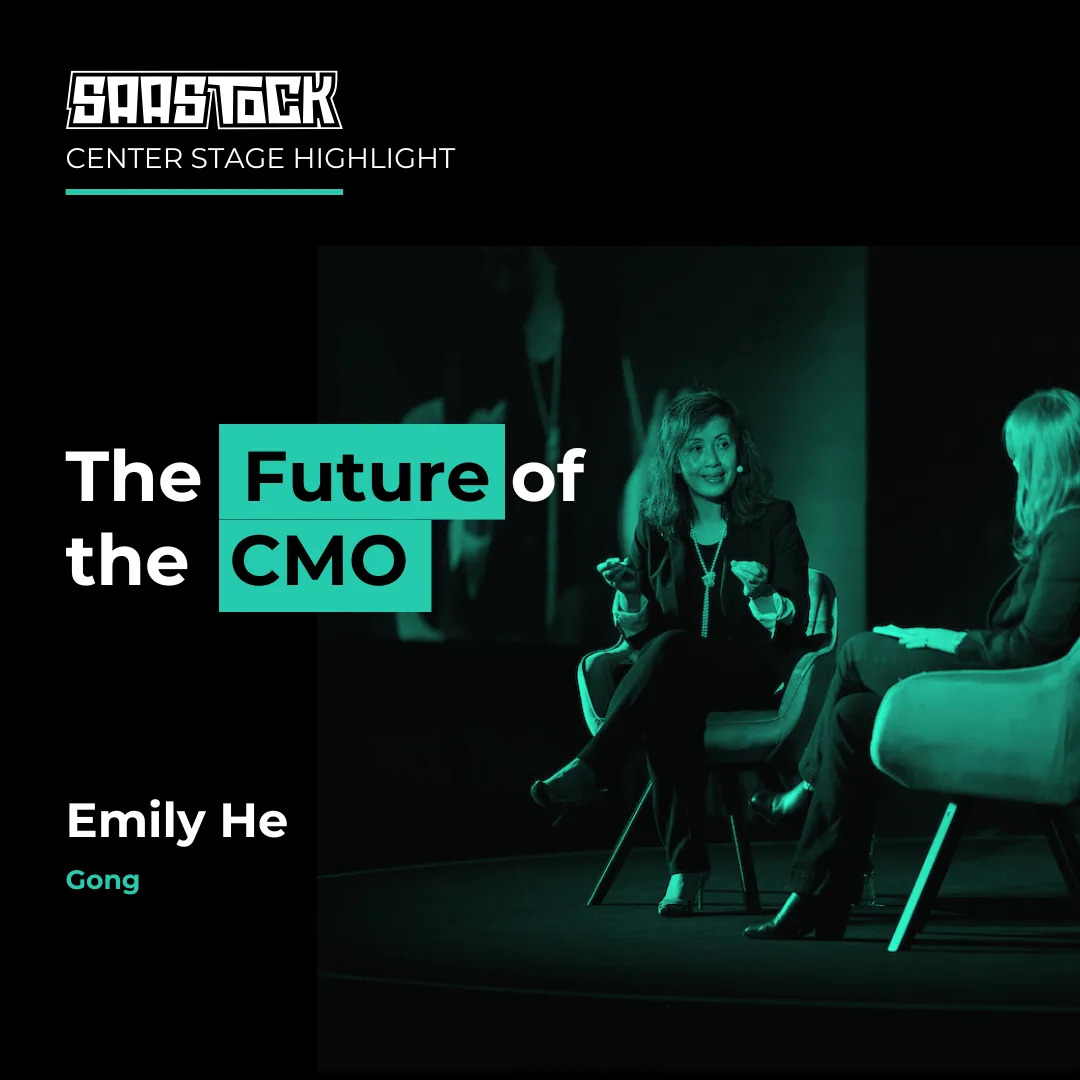
“Work with product, customer success and the sales team to come up with a common set of KPIs and metrics.”Emily He at SaaStock Europe
This makes He an operator as much as a storyteller. A former colleague describes a leader who can define a bold vision, communicate it and empower teams to carry it forward. Her own language tends toward practical verbs: capture, train, measure, deploy, adopt. Even “Nirvana,” her playful name for a consistent experience across the customer journey, comes with data plumbing attached.
The traveler and the learn-it-all
There is a personal clue in her appetite for travel. He has visited more than 60 countries, often with her family. Global marketing can turn the world into segments and regions; travel restores the inconvenient details. Customs differ. Humor fails to clear immigration. A message that sounds inevitable in California may arrive somewhere else wearing the wrong shoes.
Her LinkedIn profile lists English and Chinese, and her Stanford years included the High Tech Club, Asia Club and a Certificate of Global Management program. She has also embraced Microsoft's “learn-it-all” maxim, the useful rebuke to executive certainty popularized by Satya Nadella. Experimentation matters because failure supplies information. Curiosity is not decoration for a leader; it is part of the operating system.
That principle now meets the age of agents. Gong's recent work has focused on AI that can prepare research, find risks, draft follow-ups and support coaching, while retaining governance and human oversight. In 2026 the company launched its Revenue Harness and made Gong available through Microsoft Marketplace, reconnecting He with the ecosystem she had left two birthdays earlier. Her public comments emphasize context, trust and adoption. The clever agent that nobody trusts is merely an expensive party guest.
He has lately pointed to Daniel Pink's books Drive and To Sell Is Human as favorites. The choice is telling. Both are concerned with what moves people, and He argues that this becomes more important as technology improves. AI can inspect a sea of language. It can recommend the next action. It cannot relieve leaders of the need to communicate, motivate and decide.
What the signal sounds like
The through line of Emily He's career is not a particular product category. It is the distance between what software promises and what organizations manage to do with it. She has worked on that gap from the era of CRM to the era of Copilot and revenue agents. Each wave produces new capability, then encounters the ancient complications of attention, confidence and habit.
Her response is neither resistance nor surrender. Start with good data. Ground it in the customer's words. Choose the work where AI is genuinely proficient. Decide what outcome matters. Give teams a shared scorecard. Then pay attention to whether anybody uses the thing.
It is not the loudest philosophy in technology, where volume is frequently mistaken for velocity. It may be the more durable one. On her birthday, He chose a company built to listen. The work since then has been to make sure listening leads somewhere.