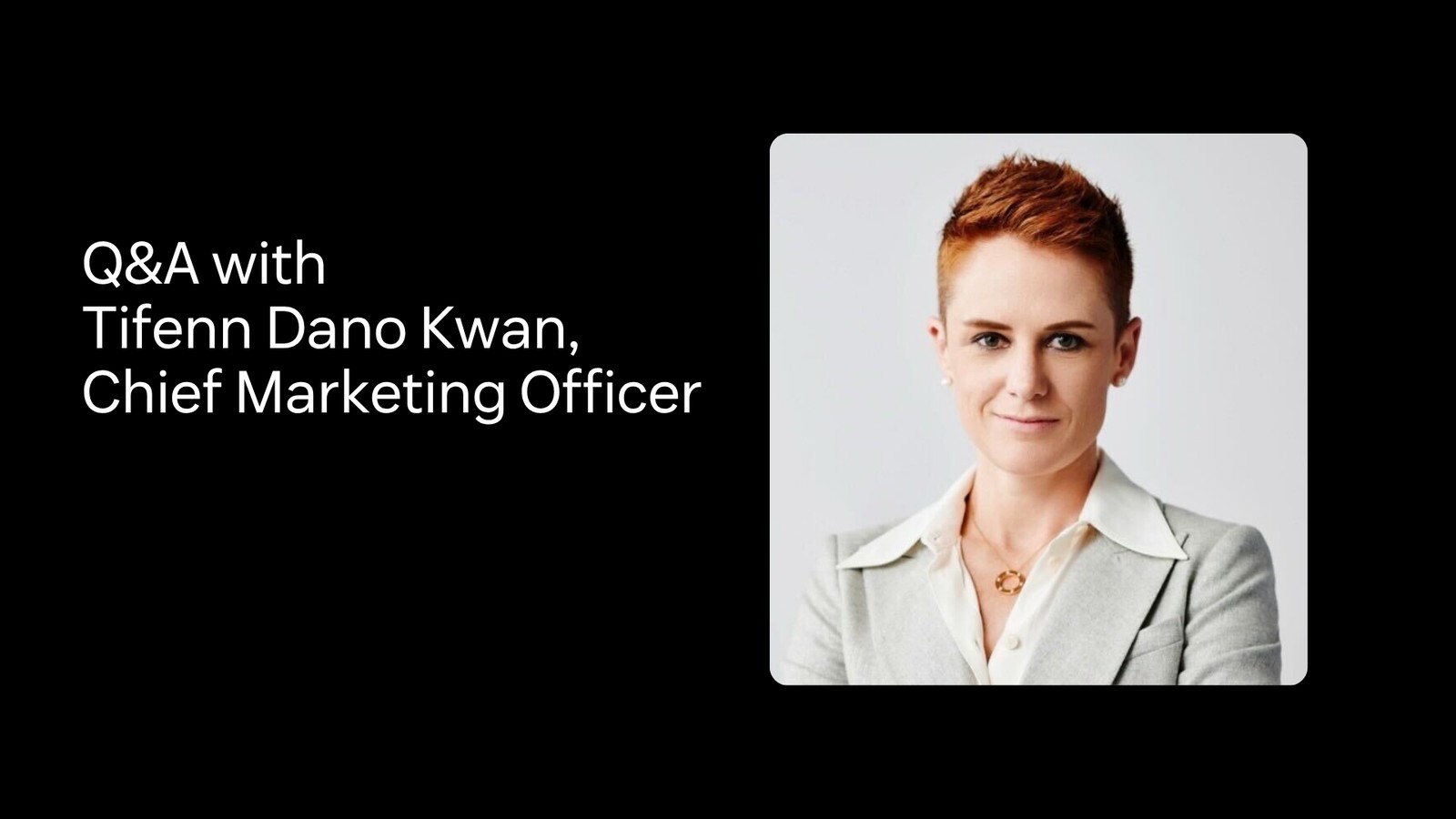
On her first week at Zendesk, Tifenn Dano Kwan did the sensible thing for a new executive: she ignored the onboarding documents. There was a customer conference underway, so the incoming Chief Marketing Officer went to Relate and learned the company by meeting the people who buy from it, sell it, build alongside it and argue about it. “My onboarding was with the people on the ground,” she said afterward. It is difficult to imagine a neater introduction to her operating style. Begin with motion. Find the humans. Read the paperwork once reality has had the first word.
Dano Kwan arrived at Zendesk in May 2026 with a résumé that reads like a compact history of business software: SAP Ariba and SAP Fieldglass, then Dropbox, Collibra and Amplitude. She had marketed procurement networks, cloud collaboration, data intelligence and digital analytics. Now came customer service in the age of AI, a familiar category being pulled toward unfamiliar economics. Zendesk was talking less about counting seats and tickets, more about charging for outcomes and delivering resolutions through autonomous agents. The assignment was partly a change of language. It was also a change of machinery.
Her response was characteristically plain. The first priority was pipeline. It would always be pipeline. The second was readiness for an AI transformation, including the brand work required to make Zendesk legible as an AI-first company. Some executives announce a hundred-day listening tour. Dano Kwan arrived with a noun, a transformation and a deadline implied by both.
The view from left and right
The idea she returns to is the “integrated marketer.” The phrase risks sounding like conference-room upholstery until she explains it as a physical habit: are you looking left and right for colleagues and stakeholders, or building only for yourself? Marketing, in this account, is less a department than a junction. Product has to supply truth. Sales has to supply friction. Customers supply the inconvenient details. The marketer’s job is to turn those separate signals into movement everyone can recognize.
This philosophy has a sharp edge. Dano Kwan wants marketers to regard themselves as business people who happen to work in marketing, not decorative specialists invited in when the serious decisions are finished. She was making that case at SAP Ariba in 2019, before the latest AI cycle made every function reconsider its job description. The modern team, she argued, needed creative people and scientific thinkers in balance. It had to be digital, data-driven, automated and personalized without losing the emotional craft that makes anyone notice.
The integrated marketer also provides her theory of leadership. Great leaders, she says, are multipliers. They deliberately hire people stronger than themselves in particular disciplines, then arrange the conditions for those strengths to compound. This is not the executive as resident genius. It is the executive as attentive editor, choosing the cast, clarifying the plot and cutting the scenes in which departments perform for themselves.
At Amplitude, the theory met a product whose entire argument was measurement. Dano Kwan joined in 2022 to oversee corporate, product and revenue marketing. By the end of her tenure, Zendesk said, website traffic had risen 52 percent year over year and the global marketing engine accounted for more than a third of marketing-sourced pipeline. Those figures are useful not because they settle every question about attribution - no marketing number ever will - but because they expose her preferred unit of credibility. Activity is a cost. Movement is an answer.
Twelve launches, one orchestra
A favorite project from her SAP years makes the operating model easier to see. Within weeks of joining SAP Ariba, Dano Kwan was handed twelve product innovations to launch on stage at the company’s global user conference. There were fewer than two months to prepare. Marketing and product had to behave as one team, which sounds obvious in hindsight and feels impossible on a Tuesday afternoon when both groups have their own vocabulary, deadlines and anxieties.
The team launched all twelve, produced more than 130 marketing assets and helped increase pipeline by 30 percent year over year. Her stated strength is creating order where it does not exist. The revealing part is the scale of the disorder she seems to enjoy: a dozen launches, a ticking clock, two functions that must stop translating past one another. Some people arrange flowers. Dano Kwan arranges dependencies.
Her career itself has been an exercise in translation. The executive posts stretch across Paris, Sydney, Singapore and San Francisco, with roughly thirteen years at SAP before the sequence of CMO appointments began to accelerate. She moved from a sprawling enterprise company to Dropbox in 2020, joined data-intelligence company Collibra in 2021, then went to Amplitude the following year. Each change required a different story about how people work, store knowledge or understand customers. The repeated task was to take technical capability, find the business consequence and build a team capable of saying it consistently.
The ten-minute maxim
Before the scorecards and C-suite titles, there was a business-school interview. Dano Kwan was offered two subjects and ten minutes to prepare a short talk. She chose a single line: “When there is a will, there is a way.” It followed her, as compact maxims tend to do when they survive contact with actual work.
Years later, the phrase became connected to the biggest professional risk she had taken. When the opportunity for her first CMO job appeared, she did not believe she was ready. She applied anyway. In her telling, the people encouraging her were responding less to a checklist of completed accomplishments than to what she represented: the ability to make meaningful connections across different teams and build bridges an organization needed. The promotion was not a medal for knowing everything. It was a wager on her ability to assemble what she did not know.
Determination can become tiresome theater in executive profiles. Hers is more interesting because it arrives paired with feedback. A perfected formula can become obsolete when the environment changes, she says, so leaders need a learner’s mindset and the willingness to hear what no longer works. Will without adaptation merely drives the wrong road faster. She knows something about roads: she has written about motorcycling as a metaphor for her first year as a CMO. The image was not subtle - technology accelerates, so fasten the helmet - but subtlety is of limited value when the light turns green.
Proof, people and the AI promise
Why Zendesk? Dano Kwan’s public answer begins with brand and proprietary data. A recognized customer-service company has years of interactions and industry knowledge that a new entrant cannot manufacture overnight. She believes AI winners will own distinctive data and turn it into business outcomes quickly. Zendesk’s move from ticketing toward resolution, and from seat-based pricing toward outcome-based pricing, made the promise measurable. The word “agentic” may be fashionable. A resolved problem is blessedly old-fashioned.
Then her answer shifts from moats to manners. She met the leadership team and wanted to know whether they were good human beings. At this point in her career, she said, she wanted to work with good people. It is a disarming criterion only because corporate announcements usually pretend that character is impossible to inspect. Dano Kwan treats it as operating infrastructure. Integration depends on candor. Feedback depends on trust. A multiplier cannot multiply a room whose members are busy protecting themselves.
There are lighter clues to the person outside the machine. She has described returning from the work of herding corporate cats to a wife and three dogs: two miniature long-haired dachshunds and a rescued Southeast Asian village dog. She enjoys international horseback riding with her spouse and is a certified yoga teacher. At Amplitude, she carried forward a tradition of quarterly marketing awards because she remembered receiving them before she became a CMO. Recognition, like data, works best when it reaches the person who can act on it.
She also likes advertising that produces real emotion. Among the campaigns she has praised are a comic Dunkin’ Super Bowl spot with Ben Affleck and Nike’s “Dream Crazy.” That taste complicates the portrait in a useful way. The pipeline operator is not asking marketing to become an accounting annex. She wants the gasp and the graph. The difficulty, and perhaps the whole job, is arranging for them to describe the same thing.
Zendesk is now the test. Dano Kwan must take an established name, a fast-shifting product story and a market swimming in AI claims, then give customers a reason to distinguish proof from promise. Her advantage is that she does not appear enchanted by slogans alone. She asks where the pipeline comes from, whether the organization is shaped around the goal and who has been left out of the room.
Look left. Look right. Learn what changed. Keep the number honest. The instructions are simple enough to fit on a card, which is precisely what makes carrying them out such serious work.