The people were opening the emails. They were clicking the links. And then they were leaving. For a marketing team, this is an awkward little mystery: the usual indicators say the relationship is healthy, while the exit door keeps swinging. At HubSpot, the investigation led somewhere less glamorous than a new campaign. It led to the email preferences page.
- A HubSpot media brand led by marketers who also run the operation.
- Free podcasts, a newsletter and workflows for turning ideas into tests.
- The best reason to follow: explanations that connect a result to a decision.
The page nobody wanted to fix
Readers faced as many as 35 subscriptions in an unstructured list. A request for fewer emails could become a request for none. The team reorganized the choices, removed distractions and clarified the routes through the page. Marketing Against the Grain’s September 2026 account reports a 34% fall in the unsubscribe rate, retaining an estimated 22,000 subscribers in one month.
“This is a trust moment, not a conversion funnel.”
Marcio Veiga, HubSpot marketer
That is the kind of detail that earns a place in a colleague’s inbox. It gives the colleague somewhere to look. The result belongs to HubSpot’s email operation, and the lesson travels because the problem is recognizable: a customer wants a small adjustment, and a business makes the adjustment unnecessarily hard.
A microphone inside the machine
Marketing Against the Grain began in 2022 as a podcast hosted by Kipp Bodnar and Kieran Flanagan. The original trailer invited listeners to begin on April 5. Bodnar was HubSpot’s chief marketing officer; Flanagan was its senior vice president of marketing. They were opening a conversation from inside a company whose business depends on helping other companies attract and manage customers.
The distinction matters. A consultant can describe what a company ought to do. An operator has to decide what gets done with the people and systems already in the room. HubSpot’s launch announcement connected Flanagan to international expansion, product-led growth and the media team behind The Hustle acquisition. It connected Bodnar to the company’s global marketing work. Those backgrounds supply the show’s point of view.
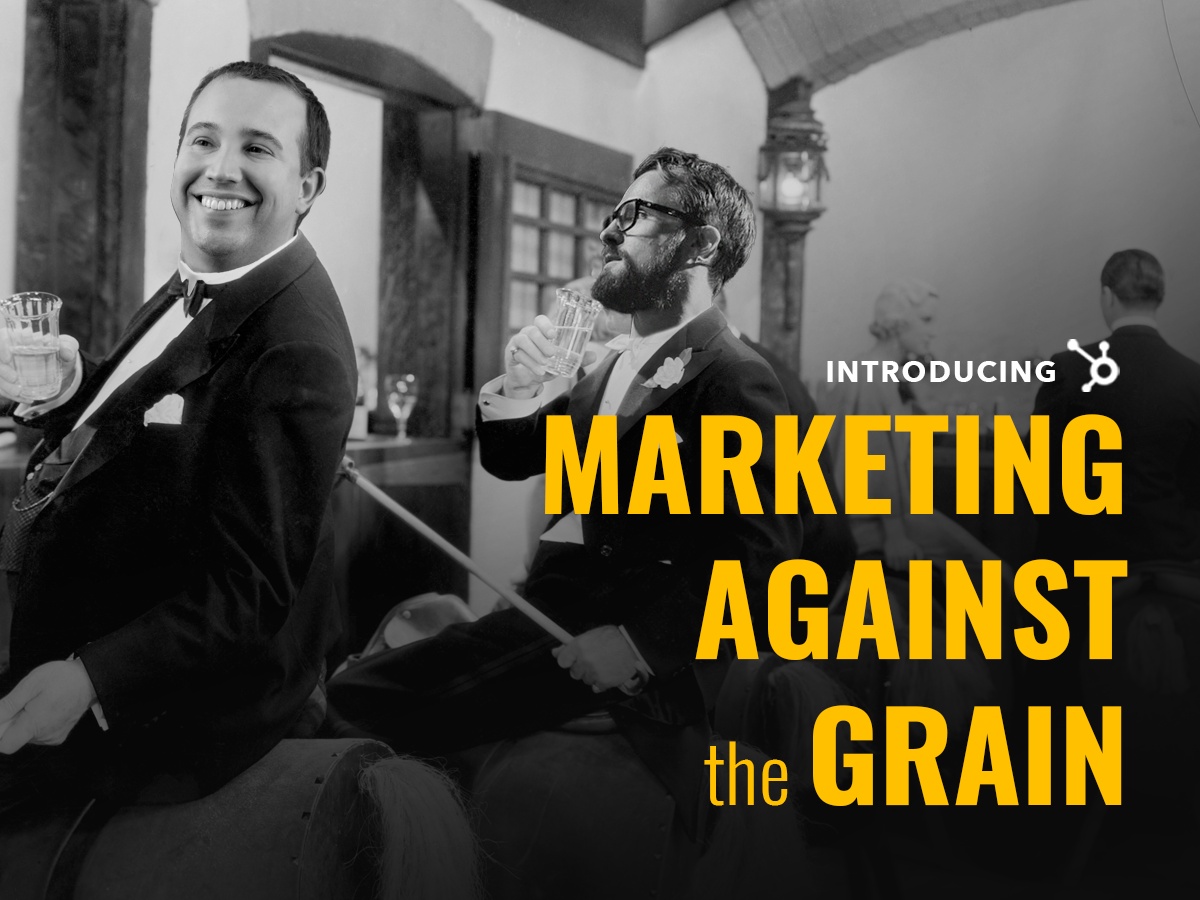
Its market is professional attention. A marketer deciding between another podcast, a growth newsletter or a course has a finite lunch break. The show’s proposition is access to the thinking behind the tactic: which problem mattered, which assumptions survived, which experiment deserves another attempt. For a small team, that can shorten the distance between hearing about a change and forming a useful response.
The lesson has several doors
Today, the brand’s website offers a newsletter alongside the audio and video show. Its About page reports more than 150,000 newsletter readers. That is a publisher-reported audience figure, rather than an audited measure. The important design choice is the combination: you can listen to an argument, read a campaign breakdown or pick up a workflow when you are ready to make something.
The resource hub includes prompts for building lead-generation tools, producing ads and repurposing content. An article can explain a decision without asking you to watch an entire conversation. A video can show the steps a written summary compresses. These formats serve different moments in a working day. Discovery happens on the commute; implementation happens with a browser open and a deadline approaching.

The public episodes and newsletter are free. The commercial logic is visible in the signup disclosure: HubSpot may contact subscribers about its content, products and services. The reasonable inference is that useful media builds familiarity with the software business supporting it. This creates an incentive to teach, and an incentive to keep HubSpot in the conversation. Readers benefit from understanding both.
Compared with a quick tactical show such as Marketing School, this is a different invitation: spend time with an operator’s reasoning. Compared with a specialist content-marketing discussion such as This Old Marketing, its published subjects range across growth, channels and AI. Your choice depends on the question you brought, and how much detail you need before acting.
Faster tools, slower judgment
The original trailer included Web3 among its subjects. The current resource hub gives considerable space to AI workflows. The change captures a recurring problem for marketing education: the tools keep moving, while the learner still needs to decide whether a particular tool belongs in a particular job.
In a 2024 article, Bodnar and Flanagan described three barriers to AI imagery: concerns about privacy and security, expectations that the tool would do everything, and a lack of clear boundaries. Their proposed uses were specific, including ad variations and editing. They also advised traditional methods when a single flawless image is required, and cautioned against inventing representations of real customers.
By January 2026, a published Claude Skills walkthrough showed how to package expertise into reusable instructions, including brand guidance for presentations. That is a useful progression from asking for an output to specifying the knowledge behind it. A template becomes more valuable when someone understands the assumptions it contains.
Take one idea back to work
The hosts’ startup distribution writing emphasizes product-channel fit: finding a route to customers that suits the thing being sold. Apply the same test to their advice. A channel that serves a software company may make little sense for a neighborhood business. A workflow that depends on clean customer data will struggle when the underlying records are unreliable.
A useful way to consume the brand is therefore selective. Pick an episode because it addresses a problem you have. Write down the hypothesis, the conditions and the measure that would change your decision. Try a small version. Free listening still costs attention; implementation adds staff time, tools and sometimes media spending. Treat the experiment as a purchase that needs a reason.
Marketing Against the Grain works best as a prompt for better observation. The email story leaves you with a modest assignment: experience your own system as a customer. Somewhere between the campaign everybody discusses and the settings page everybody ignores, there may be a better question waiting.
Keep the conversation going
Visit the website · Explore the workflows · Read the email experiment · Read the distribution essay
Watch the original introduction · Watch the Claude Skills walkthrough · YouTube interviews and demos · Apple Podcasts · Spotify