The first useful signal in Bruno Bertini's career arrived through a help desk. He was troubleshooting contact-center problems, working beside the agents who inherited every dropped thread, awkward system and impatient caller. It was an unvarnished education in customer experience: the elegant diagram belonged to the vendor; the messy Tuesday afternoon belonged to the agent.
Bertini listened. He heard the stories and the recurring frustrations, then followed the work outward into communications, telephony, digital strategy and customer engagement. Consulting put him in rooms with business leaders evaluating contact-center systems. The view widened from a single problem ticket to the uneasy seam between an internal workforce and the customers it served.
Today, as chief marketing officer of 8x8, he works several floors above the proverbial help desk. Yet his argument has barely moved: technology earns its place through the experience it enables, and business buyers are still human beings with memories. The vocabulary around him is dense with initials - UCaaS, CCaaS, CPaaS - but Bertini's instinct is to look for the person buried underneath them.
“NEVER underestimate the power of a memory.”Bruno Bertini, on an early lesson that stayed with him
A zigzag with a destination
His path was not the tidy ascent of a lifelong brand marketer. There was guest-services and operations work at Walt Disney World in 2004 and 2005, then the operational and consulting side of customer experience. At Genesys, where he spent more than eight years, he crossed functional borders again: regional sales leadership for digital solutions, Latin America marketing, Americas revenue and growth marketing, then global partnerships, alliances and ecosystem marketing.
Freshworks recruited him in 2022 to lead global demand generation and growth marketing. In September 2023, 8x8 named him CMO, his first time in the top marketing seat. He arrived with more than 15 years in contact centers and customer experience, but also with working knowledge of how sales pressure feels, how partner ecosystems move and how a customer problem sounds before anyone turns it into campaign language.
He now describes the route as a zigzag and treats it as an advantage. The modern CMO, in his telling, cannot be confined to campaigns. The job touches buyer psychology, organizational transformation, pipeline, retention, product positioning and culture. A perfectly straight career might have offered altitude. His gave him peripheral vision.
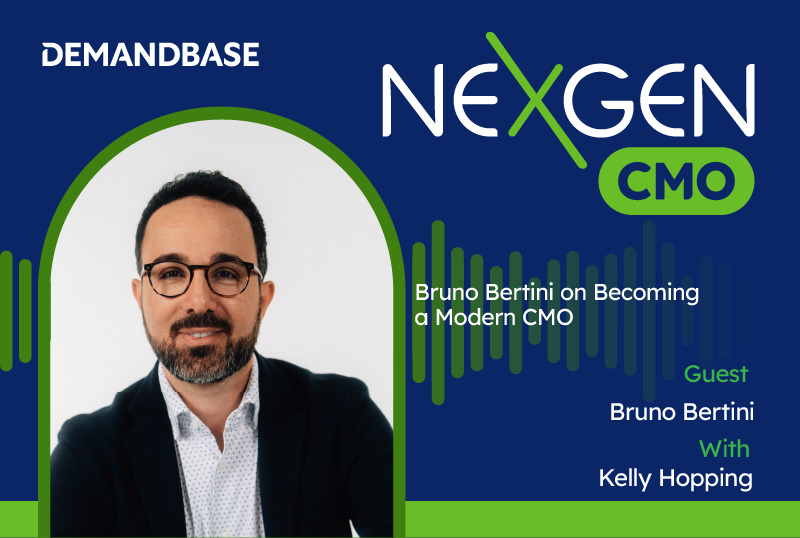
The expensive middle
Bertini joined a company with a long communications history and a perception problem to solve. 8x8 was widely associated with voice and unified communications. The company wanted customers and the market to see a broader platform joining contact center, unified communications and communications APIs around customer experience.
A rebrand announced in November 2024 supplied the visible change: color, language and a promise to help customer-experience leaders move past fragmented systems. The less photogenic work sat beneath it. Positioning had to travel through website copy, sales material, executive voices, product language and internal behavior. Bertini likes a submarine metaphor for this. Marketing is the periscope, visible above the waterline. Culture, integration and alignment are the large machinery below.
This is where his claim that buying software also means subscribing to a culture becomes more than a nice line. Enterprise software is a long relationship conducted through implementations, support calls, renewals and the occasional crisis. A fresh logo can introduce a promise; only the operating company can keep it.
Bertini's metaphorical share of the work that sits “under the waterline”: culture, integration and alignment. The periscope is the part the market sees.
Give the customer the camera
The next move was more playful. The Power of You, launched in 2025, turned actual 8x8 customers into the protagonists of cinematic, AI-assisted short films. One fought legacy systems while balanced on a high wire. Another navigated the sort of elaborate visual jeopardy normally denied to people with “information technology” on their business cards.
The conceit corrected a habit Bertini sees throughout B2B marketing: vendors cast customers as evidence for the product. A logo enters the case-study carousel; a quotation confirms the promised efficiency; the software remains the star. His team reversed the billing. The customers were dealing with complexity, connecting teams and carrying accountability. The technology could accept a supporting role.
Participation was initially the difficult part. People accustomed to case studies had not necessarily imagined themselves as cinematic leads. The team previewed concepts one by one and framed the invitation as recognition rather than endorsement. Then the social proof changed direction. After the first films appeared, other customers asked to join. A marketing request had become a waiting list.
“We're using AI to do something radically human: make our customers the protagonists of their own stories, not props in ours.”Bruno Bertini on The Power of You
The campaign's published results came with a welcome dose of adult supervision. Brand familiarity rose 62.6 percent and regard rose 82.8 percent. Over the same period, later-stage pipeline grew 54 percent year over year and win rates rose 52 percent. The campaign ran alongside an SDR overhaul, scaled account-based marketing, new sales enablement and favorable market disruption. It did not produce the commercial movement alone.
Familiarity and regard are brand-tracking changes. Pipeline and win-rate figures are year-over-year. The campaign operated alongside broader sales and go-to-market changes, so the measures should be read as correlated movement, not single-cause attribution.
That caveat makes the case more persuasive, not less. Bertini is fond of emotion, but he is not allergic to a spreadsheet. He talks about campaign touchpoints that accelerate deals, marketing-led objectives, lifetime value and retention. The interesting work occurs where the memorable story and the measurable business share an address.
AI gets a chair, not the throne
Bertini's approach to artificial intelligence has the same mixture of theater and pragmatism. He created an AI CMO video series in which an artificial co-host grills him about brand, performance and leadership. It is a neat piece of stagecraft: the technology becomes a foil, allowing the human executive to argue with the moment's loudest idea.
Behind the bit is a practical workflow. He has discussed using AI to reduce manual work in data enrichment, targeting and creative production. The purpose is to return time and improve signals, not to accumulate tools. His sterner test for enterprise AI is whether it produces a repeatable outcome. Novelty enjoys a short expense-account lunch. Adoption, conversion, lower handling time and better decisions have to pay the bill.
There is an apparent tension here. Generative production helped make The Power of You visually ambitious, while Bertini warns that undisciplined automation creates friction and sameness. His resolution is judgment. AI can enlarge the canvas, but it cannot decide who deserves the center of the frame. In his campaign, that was a human choice before it was a technical one.
The CMO with a baton
The metaphor Bertini uses for the role he wants is orchestration. Customer centricity does not belong to marketing. Product, sales, customer service and the executive team all play it, sometimes in different keys. The CMO's responsibility is to help the organization hear one song.
That makes his first CMO post a test of coordination more than ownership. He has to protect long-term brand equity while answering short-term revenue questions; encourage creative leaps while installing useful measurement; advocate for the customer without pretending to be the only executive who knows one. A baton is visible, but it makes no sound by itself.
Colleagues describe energy, empathy and a willingness to challenge teams to think bigger. Bertini describes himself more simply as down-to-earth. Away from the acronyms, he runs with Rudy, his mini goldendoodle, visits his parents and sisters in Brazil, studies behavioral science, watches films, listens to music and occasionally plays video games with friends. He speaks English, Spanish and Brazilian Portuguese. His favorite business book is Robert Iger's The Ride of a Lifetime, which is consistent with a marketer still fascinated by memory and story.
In 2026, The Power of You earned a Bronze Telly Award for B2B branded content, while 8x8 reported that Bertini received a Platinum Pinnacle Business Award for executive leadership. The trophies are tidy objects. His more revealing victory may be the untidy one: customers saw other customers on screen and wanted in.
What remains human
Bertini's thesis is easy to caricature as a plea for warmer copy. It is more demanding than that. He wants B2B companies to connect emotion to operating reality, customer recognition to commercial outcomes and AI leverage to human judgment. Each pair is uncomfortable because neither half can excuse failure in the other.
The old help-desk lesson survives inside this larger ambition. Listen close enough and the category disappears. A caller wants an answer. An agent wants a system that helps. A buyer wants confidence that the company behind the software will stay coherent after the contract is signed. A marketer wants to make that confidence visible without sanding away the truth.
Two decades after Bertini sat beside contact-center agents, the signal is still coming through. The tools are louder now. His work is to keep hearing the person.