Enterprise software has a language problem. Its products are built from abstractions, sold through acronyms and asked to solve predicaments that sound urgent only after a patient person has translated them. Colleen Langevin has spent more than two decades being that translator. The nouns have changed - records, infrastructure, energy, ERP, identity, pricing - but the assignment has remained remarkably stable: find the human consequence inside a complicated system, make it memorable, and build the machinery that carries the message to market.
Her résumé is not a tour of fashionable consumer brands. It is a passage through the engine rooms of business. At Iron Mountain, the subject was information management and data protection. At Dell, it was enterprise technology. CLEAResult dealt in the useful but decidedly unglamorous work of energy-efficiency programs. Epicor sold industry-specific enterprise software. Quest managed databases, infrastructure and identities. PROS works on the moment when a price, quote or airline offer meets a customer. Langevin's specialty is making such systems sound less like a wiring diagram and more like a decision.
The long apprenticeship in difficult nouns
Langevin earned a communications degree at Purdue University and an MBA at Babson College. The pairing is almost suspiciously apt: language on one side, enterprise on the other. By 2001 she was at Iron Mountain, where she moved through roles in data-protection marketing, intellectual-property management, product management and product marketing before becoming senior vice president of marketing. When Epicor later introduced her to its own market, it credited her Iron Mountain leadership across strategy, product marketing, branding and field marketing during the period in which the company grew beyond $3 billion in revenue.
That progression matters. Product marketing asks what the thing does and for whom. Field marketing asks how the argument travels. Brand asks why anyone should remember. Senior leadership asks whether all three are helping the business. Langevin did not parachute into the last question. She climbed through the earlier ones.
Two years in Dell's Enterprise Solutions Group followed, then nearly four and a half years as CLEAResult's chief marketing officer. In 2014, at the opening of a Tempe facility, she described the company's work without dressing it in green confetti: it provided energy-efficiency programs for utilities across the United States and Canada and aimed to change how people use energy. The same event put the larger promise into ordinary terms - customers lowering their utility bills and local students finding a springboard into technical and leadership careers.
One career, seven varieties of complexity
Pivotal time is her favorite time
Epicor hired Langevin as CMO in February 2018, during a broader assembly of a growth-oriented executive team. Her remit ran from global strategy to corporate marketing, field marketing and teleprospecting. She called it a pivotal moment, then named the technologies pressing on customers' plans: artificial intelligence, big data, blockchain, Industry 4.0 and the Internet of Things. The list has the period flavor of a 2018 conference badge, but her question has aged better: which digital transformations would improve the experiences of employees and customers and drive growth?
In early 2020, she briefly moved from one operating company to a balcony view of many. As managing director of marketing at Vista Consulting Group, she worked on marketing transformations across a portfolio of more than 65 software and technology companies. Five months later, Quest recruited her as CMO. More than the number of businesses, the revealing detail is the speed of the turn. Langevin had seen the recurring mistakes, handoffs and opportunities of software go-to-market systems at portfolio scale. Quest gave her one large system to operate.
“Great brands are built from the inside out.”Colleen Langevin's stated brand philosophy
That philosophy makes brand less decorative and more social. Employees have to recognize it. Customers should be able to locate themselves inside it. Salespeople need language sturdy enough to survive a live conversation. A campaign can purchase attention; a shared idea has to earn repetition.
Three verbs and a place to stand
Quest's 2020 reset shows the method. Its customers faced the next migration, platform and threat. The portfolio was organized around three blunt verbs: Manage. Modernize. Secure. A refreshed visual identity and the line “Where Next Meets Now” gave those pillars a common roof. Underneath came the less photogenic work that makes a brand real - solution messaging, corporate templates, campaign materials for channel partners and an endorsement system for sub-brands such as Foglight, KACE and One Identity.
The point was not merely to announce a new Quest. It was to let a partner use the same pitch, let a seller connect products without tangling the customer in organization charts, and let a buyer understand the shape of the portfolio. The public account of the program repeatedly returns to momentum: keep live demand moving while the language changes around it. Brand transformation, in this telling, is renovation with the shop still open.
When PROS hired Langevin in November 2024, it attached a striking business result to her Quest tenure: the marketing organization and strategy drove significant revenue growth while enterprise valuation more than doubled in 18 months. Corporate announcements naturally favor clean lines between effort and outcome; valuation has many authors. The careful reading is still consequential. Her marketing work was presented as part of an operating story measured in growth, not applause.
The Langevin operating loop
Listen for the customer's next problem → compress the portfolio into usable language → involve employees and customers → arm sales and partners → measure the result in demand, revenue and durable belief.
AI at the checkout, humans in the room
At PROS, Langevin inherited another dense sentence: AI-powered SaaS for pricing, configure-price-quote, revenue management and digital offer marketing. The practical idea is livelier. A manufacturer, distributor or airline has a fleeting chance to assemble the right offer at the right price for a particular buyer. PROS uses data, prediction and automation to help make that decision in real time. Langevin was hired to lead the global marketing organization, scale the demand engine, advance digital marketing and strengthen customer relationships while attracting new ones.
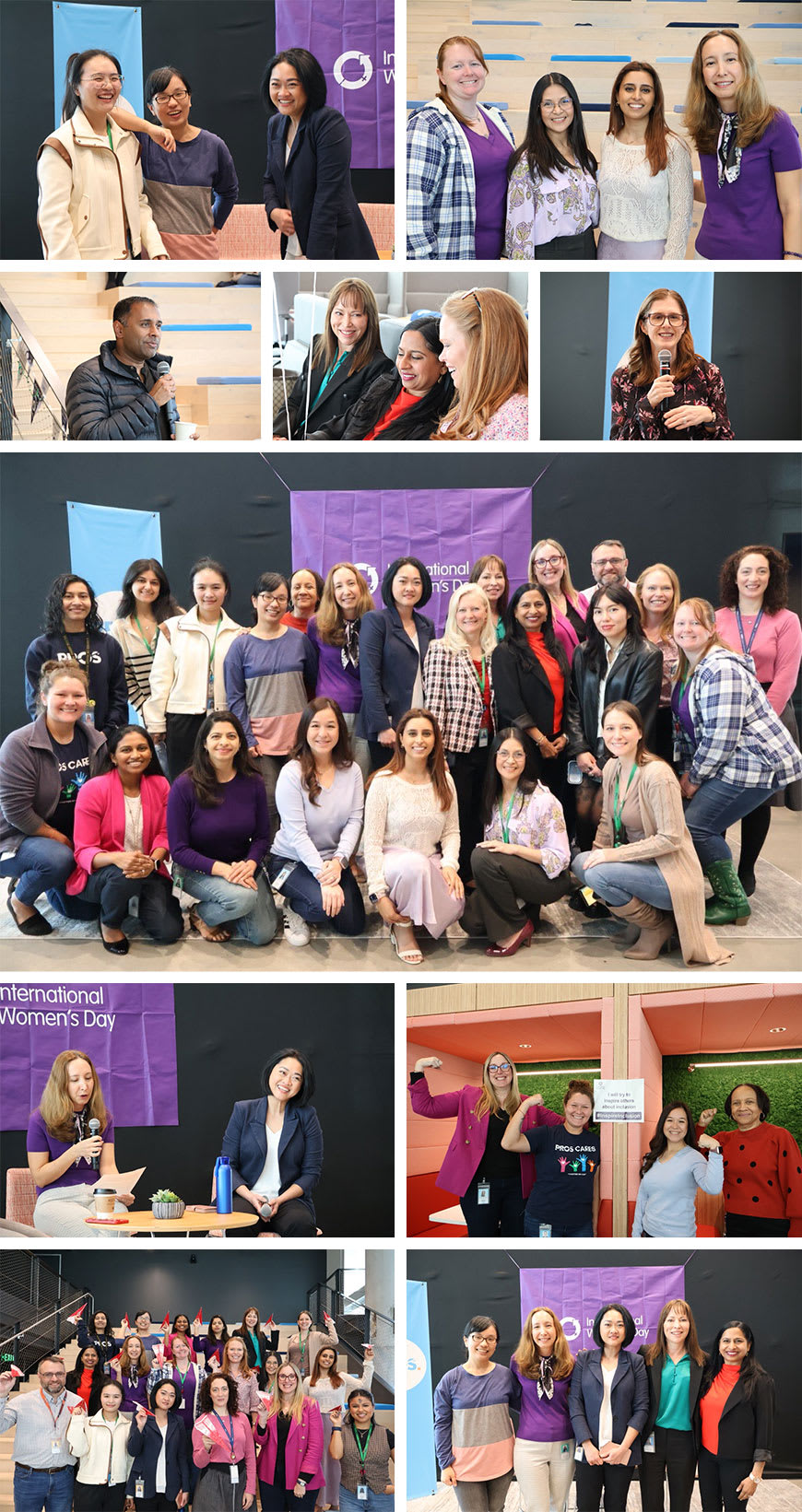
Her public life at the company puts people beside the algorithms. In March 2025 she joined a fireside chat during a PROS International Women's Day program about women in AI. At the company's Outperform gathering, she helped host customer awards and remarked on the dozens of submissions from around the world. Later, in a post celebrating the marketing team, she offered a compact cultural manifesto: “Work hard. Grind thru the obstacles. Get results. And have fun along the way.” Then she thanked a colleague for keeping the group real and the work fun.
The phrasing is unvarnished enough to be useful. Performance cultures are often described as if nobody laughs until the quarter closes. Langevin puts fun inside the work rather than after it. A prior professional biography fills in the offstage picture: Austin with her husband, two sons and rescue dogs; family volunteering; the outdoors; travel undertaken to absorb other cultures. These details do not prove a management philosophy, but they rhyme with the inside-out premise. Organizations, like households, are made of participants rather than target audiences.
The next chapter arrived on schedule
PROS soon entered the sort of corporate passage that has punctuated Langevin's career. In September 2025, Thoma Bravo agreed to acquire the company in an all-cash deal valued at roughly $1.4 billion. Langevin's public reaction was four words: “Excited for our next chapter!” The transaction closed in December. PROS' travel operation became a standalone platform investment, while the B2B business was set to combine with Conga.
For a marketer, such a split creates a cabinet full of delicate questions. What belongs to the enduring brand? Which customers need reassurance? What story can support two more focused futures? Where does accumulated trust travel? The official transaction materials answer the corporate structure. The brand and demand work begins where those diagrams end.
This is why Langevin's career reads less like a sequence of industries than a sequence of thresholds. She moves from the old description to the useful one, from a portfolio to a proposition, from internal plans to words a customer might repeat. The work is part communications, part systems design and part hospitality. Someone has to welcome the market into the next room.
There is a pleasantly unfashionable consistency to it. Tools come and go. Acronyms queue for their brief reign. Enterprise buyers still want to know what changes for them, sellers still need a story they can carry, and employees still notice when the official language does not resemble the company where they work. Langevin's bet is that clarity can be operational, brand can begin with participation, and ambition need not cancel amusement. In the solemn theater of enterprise software, the last point may be the hardest transformation of all.