The difficult thing about enterprise technology is rarely the technology alone. It is the distance between what the system does and what a person can explain after the meeting. Julie O’Brien has spent more than 25 years reducing that distance. Her career crosses media software, internet infrastructure, workplace collaboration, cloud computing, cybersecurity and fraud prevention. The nouns keep changing. Her task does not: find the human consequence inside the technical machinery, then build a team capable of telling that story consistently.
Today, O’Brien is chief marketing officer at Feedzai, the financial crime prevention company. It is a role with arresting scale. Feedzai says its systems protect one billion consumers and $8 trillion in transactions each year. Those numbers belong in a data center; the meaning belongs at a kitchen table. A protected payment might be rent, groceries, a birthday present or a ticket home. The marketer’s job is to keep the second picture visible while explaining the first.
A career built at the moment of explanation
O’Brien’s early résumé places her at Avid Technology and SightPath, a Waltham, Massachusetts company that built systems for delivering rich internet content. Cisco agreed to acquire SightPath in 2000 for roughly $800 million in stock. The deal carried O’Brien into Cisco, where she would spend about 12 years across market development, product marketing, solutions marketing and go-to-market roles.
That is useful training for a translator. Product marketing forces a person to learn what a machine can do. Solutions marketing asks what problem it solves. Go-to-market work adds the awkward final test: can salespeople, partners and customers repeat the idea without the original author standing nearby? Clarity has to survive the handoff.
After Cisco came Box, where O’Brien worked on industry solutions. An analyst who watched Silicon Valley marketers move between companies remembered her as a tireless evangelist who surrendered many Sundays to travel. He knew because he kept seeing her at the airport. It is a wonderfully unpolished detail in an executive biography: before the strategy becomes a case study, someone is dragging a suitcase toward another gate.
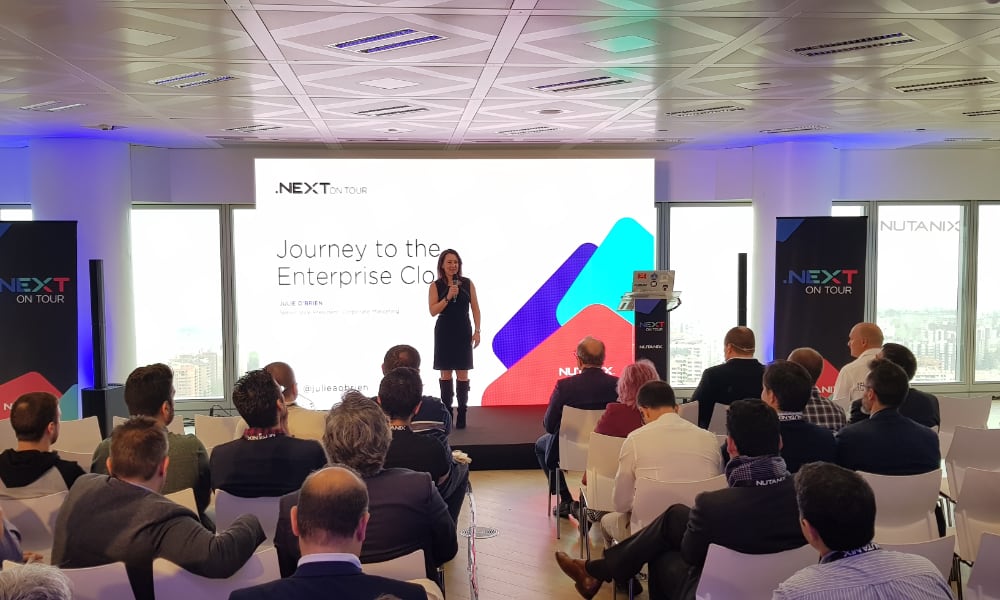
Good Technology followed, with O’Brien taking a vice president role in corporate marketing. Then, in 2015, she joined Nutanix. The company made cloud infrastructure simpler, but simple products do not automatically produce simple stories. O’Brien’s remit grew to include brand, digital work, marketing for acquired products and relationships with customers. She eventually became senior vice president of corporate marketing and led a global organization of roughly 200 people.
The campaign that behaved like a company
Nutanix is where O’Brien’s operating method becomes easiest to see. During her five years there, the company’s customer base grew from about 1,000 to 15,000. Nutanix also went public in 2016. O’Brien’s contribution sat at the junction of brand and demand generation, two disciplines often separated by budgets, reporting lines and temperament.
The “All Together Now” campaign made the argument in both its message and its construction. Nutanix sold a way to bring separate parts of computing infrastructure into one software stack. The campaign personified technologies and cloud applications as people, used bright colors uncommon in enterprise advertising, and borrowed “Happy Together” by The Turtles as an anthem. A product about removing silos became a campaign about people escaping silos. Even the joke did strategic work.
Behind the color was an exacting commercial machine. The marketing team focused on three sales plays. Long before launch, those plays had customer presentations, call scripts, channel materials, webinars, digital media, direct mail and training. O’Brien described targeted outdoor placements near important accounts and “guerrilla marketing takeovers” at events where buyers would gather. The brand promise did not sit above the demand plan like a decorative weather vane. It traveled through it.
“The best ideas often come from inside the company.”Julie O’Brien, on building campaigns with the people already in the room
Her advice to smaller teams had none of the usual executive incense. Bring inside sales, product marketing and customer support into a room. Close the door. Put the demand goal and the brand promise on a whiteboard. Then riff. The recommendation values proximity over prestige. A support colleague knows the customer’s recurring frustration. Sales knows which explanation collapses in conversation. Product marketing knows where accuracy ends and wishful thinking begins. Creativity becomes the result of arranging the room well.
Choosing mission when the timing looked wrong
In the spring of 2020, O’Brien left Nutanix to become CMO of AttackIQ. Friends asked the obvious question: was a season of global disruption a sensible moment to change jobs? Her public answer began with belief. “If you’re a mission-focused person and you find a company in which you believe, now is a great time to make a move.”
The move also changed the stakes of her subject. AttackIQ helped security teams test whether their defenses actually worked against realistic adversary behavior. As offices emptied, company boundaries suddenly stretched across thousands of homes and endpoints. O’Brien wrote that she wanted to go deeper into security and help solve the problems organizations faced in protecting the world. At AttackIQ she built and led the global marketing organization, framing independent security validation as a practical answer to a crowded market.
An acquisition begins a roughly 12-year education in product, solutions and go-to-market work.
O’Brien leads global brand and demand work through an IPO and five years of customer growth.
She chooses cybersecurity during global disruption and builds the global marketing organization.
Cloud-security remediation becomes the next technical category; Dazz is later acquired by Wiz.
The story moves to AI, fraud prevention and trust across the financial ecosystem.
In late 2022, O’Brien joined Dazz, a cloud-security-remediation startup, as CMO. Her description of the product was a miniature lesson in translation: get the right fix to the right person, with the right context, and close the risk window quickly. The language moves from system architecture to the workday of an engineer. Dazz was acquired by Wiz in December 2024, giving O’Brien another view of a company crossing a major threshold.
The customer inside the number
Feedzai announced O’Brien’s appointment in March 2025. She arrived as banks and payment companies were confronting three forces at once: vast consumer-data volumes, migration to the cloud and AI used by both defenders and criminals. Feedzai’s platform spans fraud, identity and anti-money-laundering work. It is a dense category, full of risk scores, models, signals and compliance language. It is also about a stranger trying to empty someone’s account.
O’Brien called financial services a “pivotal moment of transformation” and pointed to Feedzai’s combination of cloud and AI capabilities. Her LinkedIn activity offers a glimpse of how she carries that mission in public. She amplifies fraud-prevention research, celebrates colleagues, recruits marketers and partners, and shares practical warnings. In one recent post, after three friends were hacked, she passed along basic precautions for electronic invitations: inspect the sender, avoid suspicious sign-ins and contact the host. The enterprise subject had become personal before breakfast.
Colleagues’ public recommendations describe a “lead from the front” mentality, empathy, creative problem-solving and an ability to inspire loyalty. The phrases fit the operating record. O’Brien has repeatedly inherited subjects that could disappear into acronym fog, then brought brand, sales, support, partners and customers into the same sentence. She advises startups, mentors marketing leaders and has volunteered with Workforce Opportunity Services, a nonprofit focused on career and educational opportunities for underserved people and veterans.
Technical categories do not need to sound cold. They need a promise sturdy enough for engineers, sellers and customers to use together.
There is a temptation to describe a marketing career through visible artifacts: a campaign, a launch, an event stage, a public-company milestone. O’Brien’s more distinctive achievement is connective tissue. At Nutanix, it linked brand to pipeline. At AttackIQ and Dazz, it linked technical controls to the people responsible for fixing risk. At Feedzai, it links artificial intelligence to the ordinary expectation that money should arrive safely.
The work is part language and part organizational design. The clear phrase matters, but so does who was invited to the whiteboard, whether sales learned the plays, whether customer support recognized the promise and whether the story held up when the executive left the room. O’Brien’s career suggests that a brand becomes credible at exactly that moment. The technology may be complicated. The conversation does not have to be.
Her path also carries a useful lesson about ambition. O’Brien has worked at public corporations and young startups, through an IPO and two acquisitions, yet her stated aspirations keep returning to customers, teams and mission. She speaks about delight without treating it as confetti. In her examples, delight means removing friction: a cloud buyer gets choice, a security engineer gets useful context, a bank sees risk soon enough to act, and a customer keeps control of a payment. The word stays warm because the work beneath it remains specific. Perhaps that is why her career can cross so many technical categories without feeling scattered. The products change, but the promise is always an easier, safer human experience on the other side of complexity.