Elena Filimonova did not arrive in marketing by the ceremonial route. There was no straight climb from junior copywriter to corner-office custodian of the brand. She began closer to the argument itself, in sales and account management, where a claim has to survive contact with a customer. After business school she moved into finance, where enthusiasm is politely asked to bring a spreadsheet. Marketing came later. The order explains more about her than a list of titles does.
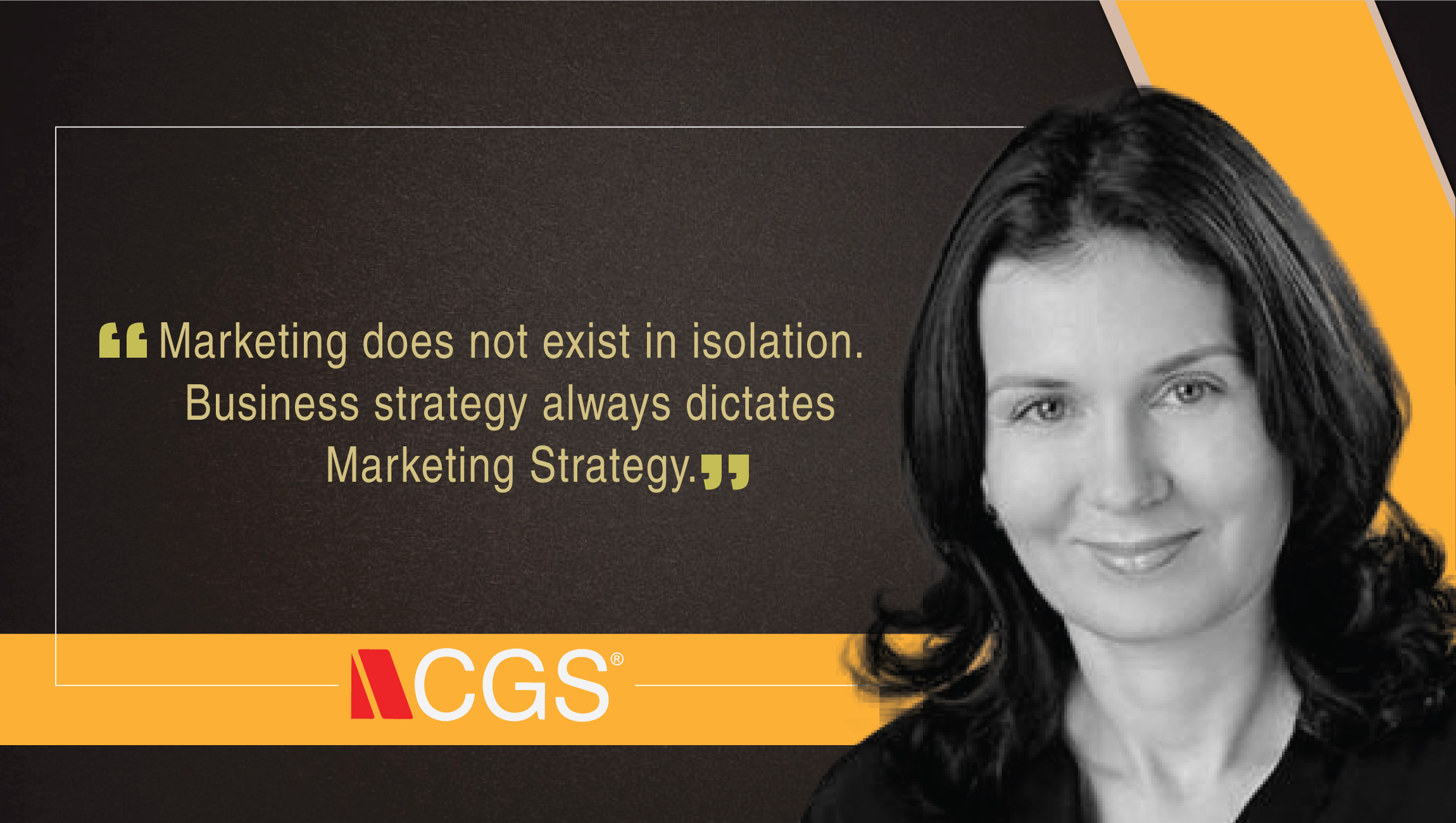
It left her with a sturdy view of the function she would eventually lead: marketing belongs inside the business, not hovering above it with a mood board. “Marketing does not exist in isolation,” she has said. “Business strategy always dictates the Marketing strategy.” Capital letters aside, the sentence is refreshingly short on incense. It turns the CMO from corporate impresario into operator.
That instinct has followed Filimonova through a peculiar and revealing tour of B2B technology. Her résumé passes through market infrastructure, enterprise search, engineering information, outsourcing and business applications, then clinical-trial software. These are not products that sell themselves in a twelve-second video. They sit behind other people's work. Often, the better they perform, the less anyone notices them. Marketing such systems requires an appetite for detail and the good manners to know which details matter.
A career in translation
Filimonova earned a BA from Moscow University of Linguistics and an MBA from Emory University's Goizueta Business School. The pairing looks almost too neat in retrospect: language on one side, organizational logic on the other. Her later career would demand both. To market technical software is to translate continuously, not only between specialists and buyers, but between a product's features and the job somebody needs to finish before lunch.
At Radianz, then owned by Reuters, she worked in a business built around financial connectivity. She later led strategic marketing for BT's global financial-services operation. At FAST, a Microsoft subsidiary, she ran strategic and product marketing for financial services, dealing with enterprise search and business intelligence. The nouns changed. The underlying task remained: find the human consequence inside an abstract system.
Knovel brought another version of the puzzle. Its cloud application put technical information, search, and analytical tools in front of engineers. Filimonova led global marketing there, then drove adoption of digital engineering and technology products at Elsevier. An engineer searching a reference work does not want a brand to perform a little dance. The engineer wants the correct answer, quickly, with confidence. The marketer's craft lies in making that utility visible without putting tinsel on the machinery.
Her operating route
In 2014 she joined CGS, a global company with business applications, enterprise learning, and outsourcing under one roof. By the time she was Senior Vice President of Global Marketing and Strategy, her remit covered research, campaigns, demand generation, sales enablement, events, brand positioning, and a global team. A broad portfolio is a marketer's buffet and indigestion at once. Every division has a true story. The hard part is giving the company one coherent voice without sanding off what makes each business useful.
“Marketing does not exist in isolation. Business strategy always dictates the Marketing strategy.”Elena Filimonova
Her answer was not to trust instinct alone. Filimonova talks about marketing measurement as a way to refine the work and build credibility with the rest of a company. The second purpose is easy to overlook. A dashboard is not merely a rear-view mirror for the campaign team. Used well, it gives sales and finance a shared vocabulary with marketing. Trust becomes less dependent on whether everyone enjoyed the presentation.
When the numbers talk back
The best glimpse of that method arrived when she discussed CGS's 2018 move into account-based marketing and personalization. Engagement improved. First visits, time on site, and bounce rates moved in encouraging directions. Yet the route from attention to a closed deal remained long. Rather than wrap the exercise in a victory ribbon, Filimonova identified where the assumptions had failed.
The program worked better with existing customers and prospects that had already been carefully nurtured than it did with cold accounts. Some target markets had also been divided into slices so fine that reliable data simply was not there. The technology could personalize, but it could not conjure a market. Her team adjusted. This is an unglamorous detail, which is precisely why it is persuasive. A data-driven leader has to let the data win an argument occasionally.
Her advice to other marketing leaders followed the same pattern. Keep up with new practices and technology, she argued, but decide what makes sense for the business. Surround yourself with good people. She spoke warmly about younger practitioners, valuing their eagerness to test technology against familiar habits. Curiosity, in this version of leadership, is distributed. The senior person does not have to be the room's official oracle.
Filimonova also understood that alignment between sales and marketing becomes less mysterious once both sides agree on definitions, handoffs, and credible measures. Brand reputation remains softer than pipeline. It is not therefore imaginary. Her point was to hold both ideas at once: some value can be counted immediately, and some value creates the conditions in which later deals become possible.
The Filimonova test
The stakes change, the method travels
Suvoda appointed Filimonova Chief Marketing Officer in July 2021. The move placed her in a specialized corner of enterprise software: systems used to coordinate clinical trials. Her official remit is large but familiar. She leads global marketing, from market research and planning through integrated campaigns, lead generation, sales enablement, corporate positioning, and team direction.
The material is less familiar. Clinical-trial operations contain a small parliament of stakeholders, rules, schedules, supplies, data, payments, and logistics. Each piece can be described as a product. Together they must be understood as a working experience. The communication challenge is to explain an interconnected system without reducing it to alphabet soup or pretending the complexity has disappeared.
Filimonova's published work at Suvoda reveals a preference for the interview table over the podium. Beginning in 2023, her annual outlook pieces gathered executives and specialists to compare what they were seeing. She asks leaders to step back from daily execution, then edits their observations into a set of connected ideas. The format lets expertise keep its proper owners. It also makes the CMO a convener, looking across departments for the pattern no single department can see alone.
The 2026 edition made that pattern explicit. Practical AI depended on sound data. Sound data depended on systems that truly integrated. Integration shaped whether software felt coherent to the people using it. All of this unfolded amid persistent uncertainty. It was an argument by dependency, not a parade of trends. Each fashionable topic had to explain what supported it and what it supported in turn.
One company, fewer seams
That connective work became concrete in April 2025, when Suvoda completed its merger with Greenphire. Suvoda brought software for randomization, trial supply, consent, and outcome-data collection. Greenphire brought payments, financial management, travel, and participant-support tools. The combined company kept the Suvoda name, while Greenphire remained on products. For marketing, this was not a mere exercise in changing the stationery. A longer product list needed to become a simpler idea.
Filimonova's response was to turn repeatedly toward the seams. In a conversation with Suvoda's CEO later that year, she framed the merger around disconnected technology and the burden it creates. In a subsequent product discussion, the vision came down to ordinary sequences: a visit window can trigger a scheduling reminder; a scheduled appointment can prompt travel planning; a completed visit can lead into expenses and payment. Integration earns its keep when one event makes the next action easier.
This is where her earlier chapters become useful. The former salesperson asks what the customer is trying to accomplish. The former finance practitioner asks whether the proposed value is observable. The linguist asks whether the explanation carries meaning between groups. The marketer connects the answers. A platform is a technical architecture, but it is also a promise that users will encounter fewer edges.
“The industry is not looking for louder promises. It is looking for technology that quietly, reliably, and safely makes clinical research work better.”Elena Filimonova, writing in 2026
Her recent AI writing follows the same discipline. The interesting questions are not whether a model can produce an impressive response, but whether its work is traceable, whether the data underneath it can be trusted, and whether a person remains able to exercise judgment. In regulated software, novelty has to pass through a narrow gate called reliability. Filimonova's language resists the usual temptation to make the gate sound like an inconvenience. The gate is part of the product.
There is a pleasing consistency here. In 2018, she warned marketers not to chase the latest technology without deciding what brought value to their business. In 2026, she applies essentially the same filter to AI: practical utility, firm foundations, clear controls. The tools have become more dramatic. The questions remain sober. Fashion changes quickly because that is fashion's principal duty. Operations are obliged to work on Monday morning.
The quiet work of making sense
Executive profiles often flatten careers into a staircase. Filimonova's is better understood as a set of lenses collected over time. Sales supplied proximity to the buyer. Finance supplied a respect for proof. Marketing supplied the means to connect a company's choices with the market's attention. Years among complex technology businesses supplied patience with products that cannot be explained honestly in a slogan.
Her public persona is similarly workmanlike. She speaks about experiments, segmentation, metrics, handoffs, and the contribution of colleagues. Even her predictions tend to arrive with dependencies and cautions attached. This is not a lack of ambition. When she joined Suvoda, she said she intended to expand its presence and raise its voice in the clinical-trial field. The distinction is that volume would have to be earned by capability.
That may also explain her recurring use of conversation as a publishing form. An interview forces an idea to emerge from questions and answers rather than from a lacquered corporate monologue. It shows which executive owns which claim. It permits disagreement and uncertainty to remain visible. For a leader responsible for one voice across a global company, Filimonova seems unusually interested in letting that voice contain other voices.
The result is a career built around translation in the broadest sense. She translates between functions, between technical systems and practical work, between a corporate strategy and the people asked to believe it. Marketing, in her hands, is not the colorful wrapper placed around the difficult thing. It is the disciplined act of making the difficult thing clear enough to judge.
There are louder definitions of the CMO's job. This one has the advantage of surviving the meeting.