There is a particular indignity in receiving information you did not request. A fact arrives without context, then another, and soon the room is knee-deep in trivia. This was the comic machinery behind FactSet's “Not Just the Facts” campaign: investment professionals, people whose days already involve an industrial quantity of numbers, are pelted with still more facts. The details become increasingly absurd. The predicament remains perfectly recognizable.
Jenifer Brooks, FactSet's chief marketing officer, supplied the plain-language diagnosis: the investment community is overwhelmed with information. Facts alone are plentiful. What clients need is breadth and depth arranged through a platform that makes the information useful - context, in other words, and the judgment to apply it.
That argument could have been presented as a solemn paragraph over footage of glass towers. Brooks and her collaborators at FactSet, VSA Partners and Thinking Machine chose comedy. There were spots called “Donuts,” “Lefties,” “Dinosaurs,” “Thumbs,” “Spiders” and “Kneecaps.” It is difficult to imagine a conventional financial-data brief producing that list, which is precisely its charm.
The format mattered as much as the tone. The team made more than a dozen distinct 15-second films in addition to the 30-second spots, rather than treating every short placement as a trimmed version of the same commercial. Each small joke had its own rhythm. That gave the central thought room to move across channels without becoming a repeated slogan in different trousers. Economy of time forced precision: establish the nuisance, spring the absurd fact, make the case for context, leave. The campaign understood that attention is borrowed in seconds and repaid with clarity.
“The premise is comedic, but the point it makes is 100% true: The investment community is overwhelmed with information.”Jenifer Brooks, on “Not Just the Facts”
The argument beneath the joke
Humor did a serious job. It gave a large enterprise technology company a way to dramatize its product promise without making the audience memorize a product sheet. The campaign's investment professionals are not short of inputs; they are short of relevant meaning. Once that tension is visible, FactSet's case for curated data, analytics and personalization becomes easier to grasp.
The work also answered the question that follows a clever campaign into any executive meeting: did it travel? VSA reports a 280% increase in brand awareness, a 438% increase in marketing-qualified leads and a 76% increase in consideration. FactSet's 2024 annual report recorded 134 million global impressions as the campaign expanded. By 2025, broader campaign coverage put the total near 200 million.
Awards followed. At the 2025 ANA B2 Awards, the campaign won Best in Show, Gold for an integrated marketing program by a large enterprise, and Bronze for an international B2B marketing campaign. It also received an ANA REGGIE Award and made shortlists at The Drum. The trophies are pleasant. The more instructive result is the marriage of distinctiveness and demand.
A career built around useful information
Brooks's path into this problem began far from an advertising set. She studied history at Haverford College from 1987 to 1991, then earned a law degree from NYU in 1994. History asks which facts matter. Law asks whether an argument can survive contact with evidence. Both disciplines reward context, selection and sequence - habits that look remarkably at home in brand strategy.
Her marketing career moved through consulting, finance, media and professional information. She held strategy roles at Siegel+Gale, spent six years at Bloomberg leading global brand management, and became chief marketing officer at Golub Capital. Each organization lived in a world where credibility matters, choices have financial consequences, and the buyer is unlikely to be impressed by decoration alone.
NYU School of Law after studying history at Haverford.
Six years leading global brand management.
Joined GLG as chief marketing officer.
Joined FactSet as chief marketing officer.
When GLG hired Brooks in late 2018, the company described her as a data-driven marketing professional with nearly two decades of senior experience. Her remit covered global marketing for a business that connects professionals with subject-matter experts. Brooks said she wanted to build on GLG's existing brand while broadening it to new users and segments. She began in January 2019.
More than three years later, she announced her move to FactSet with a note that devoted most of its space to other people. She thanked GLG's Marketing, Content & Events and Research teams, wrote that she was proud of their accomplishments, and praised their skill, enthusiasm and professionalism. She thanked the leadership team for its partnership. Her sign-off was brisk: “On to the next adventure!”
The note reveals a practical instinct about transitions. A new title may belong to one person, but the work being left behind belongs to many. Brooks named the groups, the qualities and the partnership. Gratitude, when specific, becomes a kind of organizational record.
Brand has an engine room
Brooks is fluent in the less photogenic side of marketing too. In a 2025 C-suite playbook, she called a well-integrated technology stack and operating process the linchpin of business impact. Then she gave the machinery a domestic metaphor: marketing operations are “the peanut butter to the chocolate of brand strategy.”
The line works because it refuses to put creativity and systems in separate departments of thought. A memorable idea without distribution, measurement and operational discipline becomes an expensive anecdote. A pristine stack without an idea becomes a tidy machine producing indifference. The useful combination has taste and torque.
Find the lived tension
Information overload was already familiar to the audience. The campaign gave that frustration a comic physical form.
Make the promise visible
Context and relevance are abstract. Absurd facts arriving without either made the distinction easy to feel.
Bring the receipts
Awareness, consideration and qualified-lead measures gave the creative work a shared business language.
That shared language matters in a C-suite where marketing, finance and technology leaders compete for resources and often keep different scoreboards. Brooks's formulation gives brand strategy an operating spine while allowing the idea itself to remain lively. The numbers do not explain why somebody laughed. They demonstrate that the laugh opened a door.
The curator's advantage
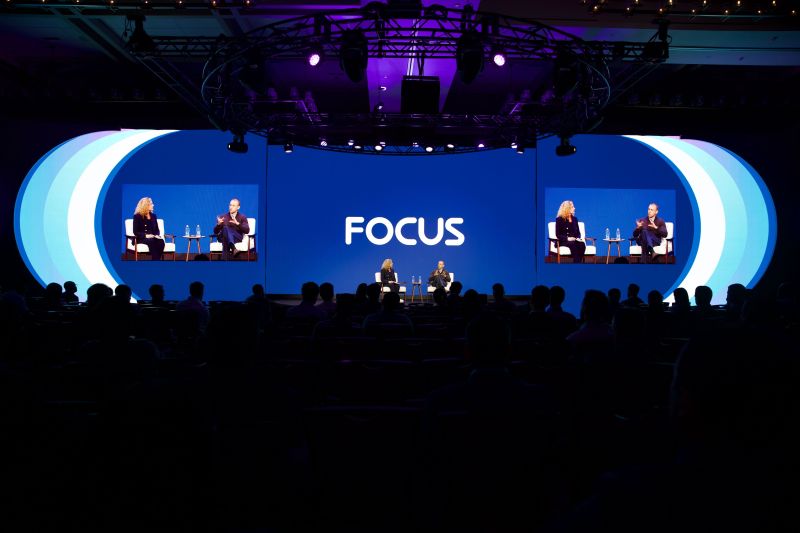
At FactSet FOCUS in Austin in May 2026, Brooks moderated a conversation with writer, analyst and Prof G Markets cohost Ed Elson. They ranged across big technology, the behavior of younger investors, private capital, software and AI. Brooks later wrote that one argument stayed with her: in a world of infinite AI-generated content, the scarce skill is curation rather than volume.
The idea neatly extends the campaign premise. More information does not automatically produce more understanding. Someone still has to choose the signal, test its reliability, place it beside the right context and deliver it at the useful moment. Generative systems can increase supply. They also increase the burden on taste.
Brooks's recent public activity has followed FactSet's work around governed financial data and AI-ready workflows. She has highlighted partnerships and conversations concerning banking, wealth management, portfolio analytics and enterprise AI. The recurring themes are trust, control, sound data foundations and technology that fits the way regulated teams already work.
There is continuity here. Bloomberg organized financial information at speed. Golub Capital operated in credit asset management. GLG connected decisions to human expertise. FactSet combines data, analytics, technology and service for investment professionals. Brooks has spent much of her career marketing businesses that turn abundant information into professional judgment.
“In a world of infinite AI-generated content, the scarce skill isn't volume - it's curation.”Jenifer Brooks, reflecting on FOCUS 2026
The person inside the enterprise
The “Not Just the Facts” work was also an argument about the people behind FactSet. Brooks said it was wonderful to let the company's personality shine through and described the campaign as an illustration of how FactSet brings technology and insight alongside the facts. Her agency collaborators characterized the employees as smart, warm and funny. The campaign allowed those qualities into public view.
This may be the quiet trick in Brooks's approach. Enterprise buyers need confidence, but confidence does not require emotional beige. A brand can respect the consequence of the purchase while remembering the buyer has spent a lifetime encountering jokes, irritations and absurdity. Seriousness and solemnity are different instruments.
Her connection to Haverford adds another dimension. Brooks served as chair of the college's Annual Fund and identified Haverford as her top philanthropic priority during a major campaign. She pointed to the school's small size and the visible impact of each graduate. The observation matches her professional instinct: scale does not erase the value of individual contribution.
Her public career offers no grand manifesto. It offers something more usable: a sequence of choices. Build on what is trusted. Broaden the audience. Thank the team by name. Give creativity an operating system. Measure what moves. When the world produces too much information, become more selective. When a category becomes humorless, find the human tension already hiding in it.
Financial data will continue to multiply. AI will make content even easier to produce. That leaves a fine opening for people who can decide what deserves attention and give it a form worth remembering. Jenifer Brooks's work suggests that judgment can wear a suit, carry a dashboard and still know when the meeting needs a punchline.