The easiest story to tell about Jennifer Chase is that she stayed. She arrived at SAS in 1999 and, twenty-seven years later, sits in the executive suite as chief marketing officer. The better story is how often she moved while remaining on the same campus. Product management. Analyst relations. Customer service. Regional marketing. Global marketing. She learned the machinery, then learned the people who buy it, explain it, question it and occasionally fear it.
That route matters because marketing has spent the past decade growing a technical nervous system. A campaign now touches data architecture, automation, privacy, models, content systems and enough dashboards to make an airport control room look restful. Chase entered the CMO job with a marketer's training in communications and journalism, plus the habits of someone who had used the product. She calls herself a marketer at heart, but says her stronger side may be the so-called left brain of data and technology.
The result is a career built on translation. Chase translates software into customer stakes, creative ambition into financial logic, and the promise of artificial intelligence into questions about trust. The work is not glamorous in every frame. Much of it is meetings, mapping influence and helping people with different incentives agree on what a good decision looks like. She has a title for that hidden labor: chief collaboration officer.
She learned the product before she inherited the promise
Chase studied communications and journalism at St. John Fisher College in New York, graduating in 1995. Four years later she joined SAS. The company was already old by software standards and unusually rooted: privately held, founder-led and based in Cary, North Carolina. Its products help organizations turn large, messy bodies of data into decisions. This is useful work and notoriously difficult to explain at dinner.
Her early product and analyst-facing roles gave her an education no slogan workshop could supply. She saw how customers actually handled the technology and where language failed them. Hands-on experience with SAS tools, she has said, shaped her belief that good customer experiences come from carefully prepared data, intelligently applied analytics and curious minds. Notice the third item. Data and software are not presented as autonomous magic. A person still has to care enough to ask a sharper question.
Her progression also complicates the familiar idea that leadership requires hopping companies every few years. Chase stayed, but the problems changed. She moved from explaining products to analysts toward modernizing a global organization. She worked to align regional teams, sales and marketing while keeping the customer in view. Longevity became a kind of accumulated context: she knew which parts of SAS were tradition, which were inertia and which still carried real value.
The year performance marketing met its opposite
In 2020, as in-person business life abruptly closed, Chase led a transformation of SAS marketing's structure, methods and skills. The company's Global Forum went digital-first. The following year brought a brand relaunch and her appointment as CMO and executive vice president. Later came a larger argument: SAS should invest in a major brand campaign after roughly a quarter-century without one.
For a data company steeped in measurement, brand can look suspiciously like an expense wearing good typography. Chase's job was not merely to propose more imagination. She had to show how memory, recognition and future demand belong in the commercial equation. Her account of the campaign emphasizes a move that says much about her style: bring finance close enough to understand and advocate for the plan.
“I think stakeholder management is one of the least understood capabilities of a CMO. I think of myself as a chief collaboration officer.”Jennifer Chase
She mapped who supported the decision, who did not, how influential each person was and what might move them. It is wonderfully unromantic. The myth of creative leadership favors the flash of inspiration; Chase describes coalition-building with boxes on a grid. Yet this is how a risky idea survives contact with an institution. A campaign needs not only an audience but internal permission to exist.
SAS's newer brand work has leaned into humor, a noticeable turn for a company associated with statistics and enterprise systems. The point is not frivolity. Humor gives a technical brand a human pulse and may earn the mental availability that a perfectly optimized product message cannot. Chase's broader move from performance-led toward brand-led thinking is an attempt to hold two time horizons at once: the lead generated now and the reputation that makes someone receptive later.
“Mad Tech” and the end of the creative-only marketer
Chase has joked that a contemporary version of Mad Men would be called “Mad Tech.” It is a neat line because the change is real. Marketing technology does not sit behind the department anymore. It shapes what audiences are selected, which message reaches them, how quickly a variation appears and what the organization thinks it has learned.
At an American Marketing Association panel in 2024, Chase described generative AI as something like a teammate for creativity. SAS had begun using its own controlled knowledge base to generate derivative material from long-form content, helping outputs remain accurate and recognizable in the company's voice. She also called SAS “Customer Zero” for its R&D teams. Marketing was not only promoting AI software. It was living with the awkward early versions.
The machine can accelerate. The human still signs.
Her position avoids both panic and intoxication. Marketers need technical literacy because they must understand what the system is doing, why it was chosen and where it could fail. The human contribution remains intuition, empathy and narrative judgment. Her most circulated line is blunt: “AI will not replace a marketer, but a marketer who knows how to use AI will.” She calls the shift a once-in-a-generation career opportunity, then follows the grand phrase with the practical requirement of data literacy.
By 2026, her advice had become more specific. Start small. Understand the problem before mastering every platform. Use workshops, mentoring and experiments. Build mixed teams of marketers, data scientists and technologists rather than letting each group toss requirements over a wall. SAS reserves time through MyFocusFridays for learning that can include prompt engineering and interpreting AI output responsibly. Curiosity, in this model, gets a calendar invitation.
“Trustworthy AI and transparent governance frameworks are non-negotiable, particularly in customer-facing contexts.”Jennifer Chase
The guardrails are equally concrete: bias audits, explainability and clear opt-out policies. For Chase, governance is not the dreary form attached after the interesting meeting. It is part of whether a customer can believe the brand. An opaque system that personalizes perfectly may still damage the relationship if nobody can explain its decision or defend the data behind it.
The customer is a person, even at stadium scale
In 2026, SAS's partnership with Liverpool Football Club offered a vivid demonstration. A football club has supporters scattered across languages, markets and degrees of devotion. The partnership made SAS the club's official AI marketing automation partner, with the goal of consolidating fan data and personalizing communication. Chase said early work included email campaigns informed by individual fan interests.
The arrangement fits her philosophy almost too neatly. Football supplies emotion; analytics supplies relevance. The marketer's duty is to prevent either from swallowing the other. Treat a supporter as a row in a table and the message loses the reason anyone cared. Ignore the data and a global club speaks as though every fan lives on the same street. Good personalization recognizes difference without making a person feel observed by machinery.
Chase has also widened the question of who gets to work on those problems. She is executive sponsor of the SAS Women's Initiatives Network and Women in Analytics Network. She founded the company's Marketing Associate Program, giving recent graduates exposure to the breadth of marketing roles. These programs express the same belief as her cross-functional AI teams: better decisions require more perspectives and clearer routes into the room.
A long tenure with the restlessness left in
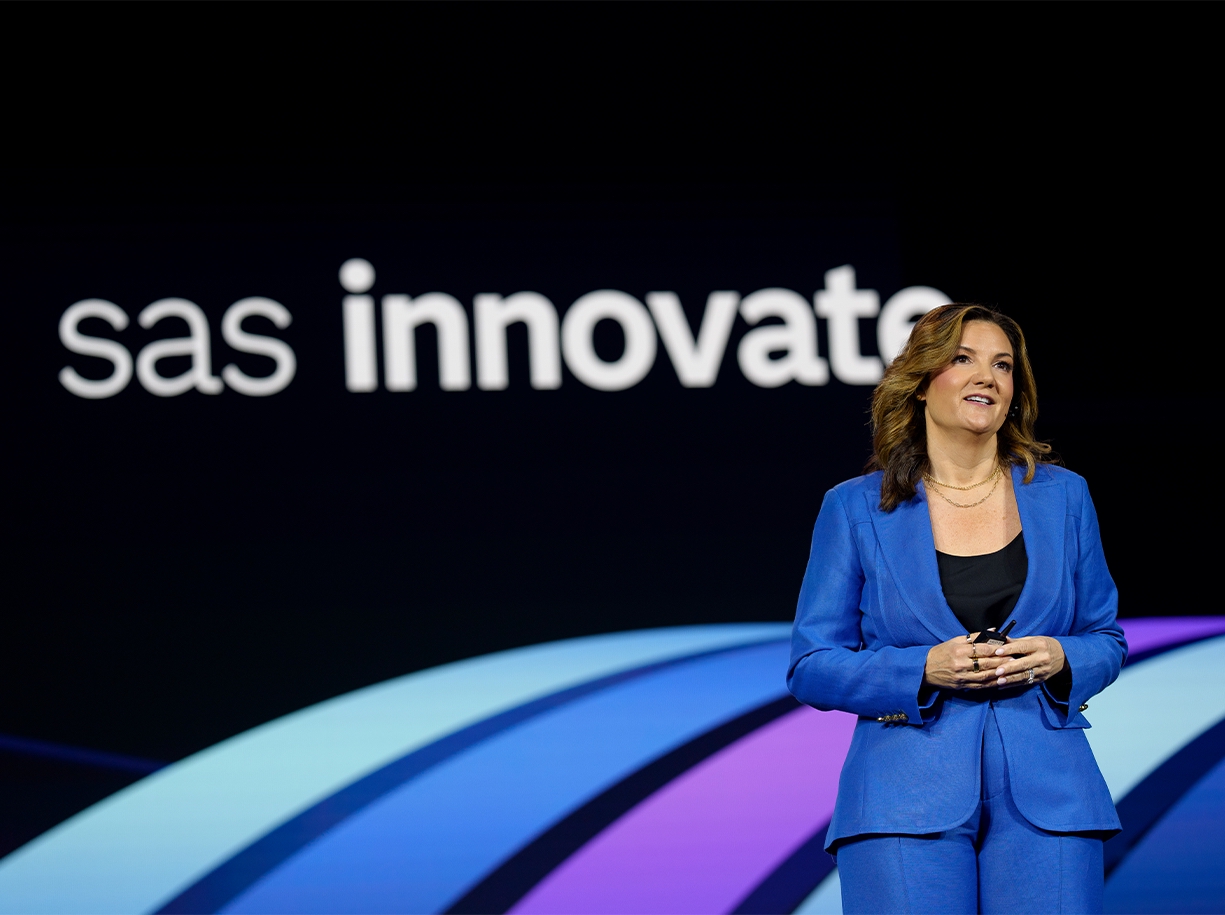
Onstage, Chase often plays interviewer as well as executive. With researcher Brené Brown at SAS Innovate in 2025, she explored empathy, courage and the discomfort of technological change. In 2026, she opened the conference during SAS's fiftieth anniversary year by connecting longevity to trust. The decisions influenced by analytics can feel invisible to the people affected by them. Her framing brought the story back to human judgment.
There is a pattern across the jobs, campaigns and conference stages. Chase is interested in the seam between disciplines: marketing and engineering, evidence and emotion, automation and accountability. Seams are less tidy than categories. They are also where the useful arguments happen.
After nearly three decades, she has not made SAS sound younger by pretending it was born yesterday. She has treated institutional memory as raw material. Product knowledge became marketing judgment. A data culture became a case for measuring brand over a longer horizon. An AI portfolio became a reason to insist on governance at home. Staying, in her career, has meant earning the right to change the place from within.
That may be the most human detail in an otherwise technical story. Chase's ambition is not to remove friction from every decision. Some friction is judgment doing its job. Her method is to gather the people who see different risks, give them evidence, make room for curiosity and then build something they can defend together. The dashboard matters. So does the conversation around it.