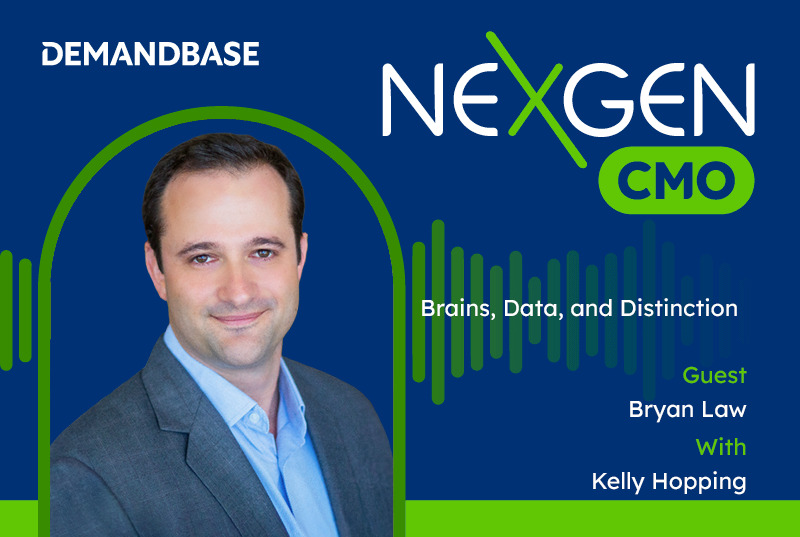
The curious thing about Bryan Law's career is not that he became a chief marketing officer. It is how long he spent learning to see everything around marketing first. Before the campaigns and brand platforms came psychology, corporate strategy, international assignments, a chief-of-staff seat, eCommerce, and a tour running data and analytics for a grocery company. By the time marketing arrived as the headline, the supporting cast already knew its lines.
In January 2026, Law joined Nerdio, the Microsoft cloud-management software company, as CMO. His remit is broad enough to qualify as an atlas: product marketing, demand generation, growth, brand, communications, analytics, and go-to-market alignment. The list says something about modern marketing. The job is no longer one department sending tasteful messages into the world. It is a switching yard where product, sales, customer evidence, finance, and memory meet.
Law's method is to make those meetings explicit. He has said he thinks of himself first as a business leader and second as a marketer. That order is not false modesty. It explains why his public language keeps returning to revenue, pipeline, customer needs, strategic priorities, and the quality of the data beneath the machine.
“I always try and think about my role is first as a business leader and then secondarily as a marketer.”
A psychologist walks into a boardroom
Law earned a bachelor's degree in psychology at Georgetown. Years later, his marketing ideas still carry traces of the discipline. He talks about buying triggers, emotional resonance, the stories people retain, and “mental availability” - the chance that a brand comes to mind when a buyer enters a category. The corporate buyer may have a procurement portal and an intimidating spreadsheet, but remains inconveniently human.
His next classroom was less tidy. After an MBA at Northwestern University's Kellogg School of Management, where he served as student body president, Law worked in strategy consulting at Monitor Deloitte. His profile records work across the United States, Brazil, South Africa, India, and Mozambique. He later recalled that taking assignments such as leading teams in Mozambique accelerated his career precisely because they were not the obvious choices.
Google followed, with work on global business strategy and major go-to-market questions. Then came a choice that looked peculiar on paper: leaving Google for Rackspace. Law has presented the move as another calculated risk. The useful turn inside Rackspace was chief of staff. Sitting near the leadership team of a roughly $2 billion revenue company, he saw how decisions crossed functions and how a company behaved when the neat boxes on an organization chart began negotiating with one another.
The useful detours
Law calls that chief-of-staff job his first real break outside strategy. It enabled a move into demand generation, then wider marketing leadership. This is a less glamorous version of career advice and therefore a more credible one: find the seat that improves your field of vision. A wide view compounds long after the title changes.
The grocer, the dashboard, and the memory
At H-E-B, Law led a company-wide data and analytics team of about 50 people. The work included data science, governance, reporting, and projects such as customer-level personalization and substitution logic for online grocery orders. A missing avocado is a wonderfully strict test of analytics. The model can be ingenious; dinner still needs an answer.
At Tableau and then Salesforce, the analytical machinery moved closer to the marketing engine. Law's public profile credits the organization with roughly 55 percent year-over-year growth in marketing-sourced pipeline and with expanding eCommerce from 3 percent to more than 45 percent of direct transactions. His remit stretched across media, websites, SEO, email, marketing technology, engineering, data science, analytics, and a large virtual conference. Marketing had become less a row of campaigns than a connected production system.
ZoomInfo made the commercial accountability plainer. From 2022 to 2024, Law led a global marketing group of about 140 people. He reports that it sourced roughly $350 million in new annual contract value in 2023 and improved the ratio of ACV to marketing spend by 45 percent year over year. The team repositioned ZoomInfo from a contact database toward a go-to-market platform and supported the launch of Copilot in 2024.
Numbers this large can acquire the unreal shine of airport currency. Their value here is structural. They show what Law asks brand to sit beside: efficiency, product adoption, customer movement, and revenue. His contention is not that everything valuable fits inside an attribution report. It is that brand should help the business move, and the business should be able to notice.
Brand makes demand cheaper
The phrase that best compresses Law's thesis is “brand makes demand cheaper.” A familiar brand carries useful associations into the buying moment. Demand generation then has less explaining to do. The buyer does not begin at zero, which is an expensive place to begin.
This is why Law favors distinctiveness and memory. Map the situations that cause buyers to enter the category. Learn which competitors already own which associations. Find white space that matters to customers. Build consistent cues around it. The method borrows from consumer marketing, where nobody is surprised that recognition and recall influence a purchase. B2B sometimes behaves as if a committee badge removes the hippocampus.
Data is the corrective, not the rival. It identifies the customer, measures movement, and disciplines the story. Law's caution about artificial intelligence follows the same logic: “AI is only as good as the data underneath it.” He has discussed synthetic audiences as a faster way to explore customer insight, but his emphasis is pragmatic. Better tools do not excuse a dirty foundation or a fuzzy question.
“Good decisions that others aren't making drive outsized growth.”
There is an appealing tension in the system. A memorable brand requires consistency. Learning requires experiments, many of which fail. Law resolves it by holding the distinctive core steady while encouraging teams to test how the company reaches and activates buyers. He has said that innovation comes from the team, not just management, and that being wrong is part of learning. The executive's job is to set a clear direction and make intelligent error survivable.
Four buckets and a listening tour
Asked how he divides his time as a CMO, Law borrowed a four-part model: people, marketing initiatives, company priorities, and customers. He tries to balance his week across them. The charm is not originality. It is resistance to the gravitational pull of the department itself. Marketing can become fascinated with marketing. The four buckets keep opening doors.
Bryan Law's working week
When he arrived as ZoomInfo's CMO, Law surveyed the marketing team. What worked? What did not? What kept people motivated? What were their pain points? He held conversations, consolidated the answers, and then returned his interpretation to small groups before taking findings to leadership. That last move is easy to overlook. Listening is not complete when the listener has notes. It is complete when the people heard can recognize the diagnosis.
His first Nerdio board meeting produced another compact framework. Law wrote that the conversation centered on what was working, where the improvement opportunities sat, and which strategic priorities should come next. He described the next meeting as the point when observations and plans would be judged as results. Boardroom prose is rarely this free of upholstery.
The cloud chapter
Nerdio sells management software for Azure Virtual Desktop, Windows 365, and Microsoft 365 environments. The category is technically dense and commercially practical: cost, security, automation, and the daily administration of cloud workspaces. Law arrives after marketing data providers and cybersecurity, carrying a familiar assignment into a different vocabulary. Make complexity understandable. Make the company retrievable when the buying trigger arrives. Make growth visible.
He is also a director at Meltwater and a member of G2's Executive Advisory Board. Those positions widen the lens again, from one operating company to the patterns shared across software, media intelligence, and buying platforms. They suit a career built less around a single specialty than around connections: psychology to memory, data to judgment, brand to pipeline, team experiments to board commitments.
The useful part of Law's story is not a recipe for becoming a CMO. Recipes are unreliable when the ingredients include Mozambique, online groceries, a 100,000-person virtual conference, and hot sauce on a marketing podcast. The useful part is an operating stance. Take the role that expands the view. Ask the team before announcing the answer. Learn the business well enough to speak in its units. Build a brand the customer can remember. Then return to the board with evidence that memory did some work.
Marketing has always lived between art and arithmetic. Law seems less interested in ending the argument than in improving the seating plan. The psychologist watches the buyer. The analyst checks the signal. The operator asks who owns the next step. Somewhere nearby, the brand earns its rent.