Shahed Ahmed arrived at a George Mason University classroom with research, slides and the sort of nerves that a job title cannot conveniently switch off. There were about 30 students. He spoke to groups regularly, but these undergraduates were an unfamiliar audience. They might ask difficult questions. They might ask the question that a roomful of clients would politely leave alone.
One asked what advice he would give his younger self. Ahmed’s answer was to take more pride in the quality of his work. He acknowledged that, straight out of college, he had not fully understood the exchange between an employer and an employee. It was a candid answer to a question that could easily have produced a rehearsed speech about ambition.
Then the conversation moved beyond the presentation. Students asked about internships and Japanese Domestic Market cars, one of his favorite interests. A talk about chief marketing officers had found its way to car culture. An audience, it turns out, brings its own agenda.
The reporter’s view of a changing business
Ahmed is now Executive Vice President and COO at Merritt Group, with oversight of its Marketing Services. His career began in technology journalism at CNET during the dot-com era, before moving through public relations and marketing. He earned a BA in Economics from the University of Maryland. Across corporate and agency roles, he has worked on communications surrounding product launches, public offerings and acquisitions.
His early bylines offer a glimpse of the business he was learning to explain. In October 2000, he reported on Dreamcast sales after the launch of SegaNet and a console price reduction. He spoke with Sega of America president Peter Moore about the relationship between software, an online service and demand for hardware.
The story involved a collection of moving parts. A customer bought a console, played a game and encountered a network offering. A reporter had to explain how those parts affected one another. The specifications mattered, but so did the reasons people might spend their money.
On January 31, 2001, another Ahmed byline covered Moore’s explanation of Sega’s decision to become a third-party software publisher. The company was changing its place in the console business. Ahmed reported the financial logic, plans for games on competing platforms and continued support for Dreamcast users.
For a technology reporter, a change like that demands more than a product description. Readers need to understand what happens to their purchase, their expectations and the company they have been following. The distance between an announcement and its meaning can be considerable. Much of Ahmed’s later work occupies that distance.
Who gets to decide what you see?
By 2014, Ahmed was examining another kind of intermediary: the algorithm. His essay on content curation considered how personalized feeds could keep readers inside familiar interests. He used the example of a person whose browsing habits favored powerful combustion-engine sports cars. An electric alternative might fail to appear, however relevant it could be.
The problem interested him as a marketer. If discovery depended increasingly on a platform’s interpretation of past behavior, an unfamiliar idea could struggle to find an audience. Data could help a business understand its readers, while the same machinery could narrow the range of ideas those readers encountered.
That leaves a peculiar assignment for anyone promoting an innovation. The person who might benefit from it has first to encounter it. The gatekeeper may be using yesterday’s preferences to decide what deserves attention today. Ahmed’s essay kept that tension open rather than tidying it into an easy promise about personalization.
In June 2015, he started a related essay with breakfast: toast, juice, Flipboard, Facebook and a couple of tweets before heading out. His own news habit supplied the opening evidence. He was reading through applications and feeds rather than regularly visiting the home pages of large publishers.
He explored a shift toward bringing content to audiences on platforms, with publishers, advertisers and distributors negotiating who controlled attention and revenue. It was a business argument with an ordinary morning at its center. The reader could recognize the behavior before considering its consequences.
A newsroom, an awards night, another deadline
That same year, Ahmed attended the Digiday Content Marketing Awards at New York’s Highline Ballroom. Merritt Group was there with Teradata, whose TeradataVoice program had been shortlisted in the best brand newsroom category. They were one of three finalists. Autodesk’s entry won.
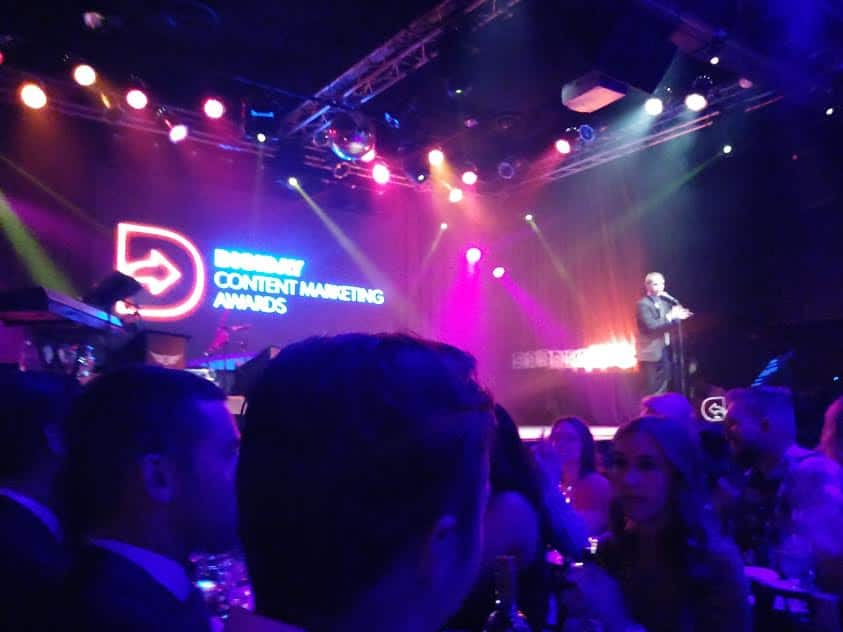
The program brought together Teradata’s executives and subject experts, Merritt’s technology writers and designers, and the Forbes BrandVoice publishing team. Ahmed described a continuing collaboration over topics, content and visual presentation. This was publishing as a repeated working practice, with another article always on the way.
His account also recorded the pleasure of sharing a table with the Forbes team. A finalist’s evening can include good company without requiring a revision of the result. The work had reached an audience; the team had something worth discussing; somebody else took the award home.
The detail that makes a message useful
In his January 2024 writing on account-based marketing, Ahmed argued for personalization that goes further than inserting a recipient’s name. A company’s particular challenges, industry and culture should shape the content. The work might involve a tailored case study, a report or a video message, informed by what the marketing team actually knows about that account.
He also emphasized coordination among channels and the operational relationship between marketing and sales. An interaction on social media could inform a later email. New information could change the next step. The sequence needed processes behind it, including regular decisions about targeting, creative work and content.
That approach asks an agency to understand the customer’s situation closely enough to make sensible choices. A personal salutation takes seconds. A useful explanation requires knowledge. The difference becomes visible when someone tries to decide whether the product belongs in their business.
Trying the tools before recommending them
Ahmed leads MG Labs, Merritt Group’s initiative for testing AI tools in marketing and PR work. His February 2024 evaluation of HubSpot AI read like an assessment of tasks rather than a declaration of allegiance. Different features received different judgments.
ChatSpot offered a convenient interface and support for research and routine platform tasks. Its usefulness depended on the underlying data, and its templated approach constrained customization. Campaign Assistant helped with advertising copy and brainstorming, while some email and landing-page output could feel generic or wordy. Content Writer could help someone get started, with further human revision still needed.
Those observations describe the small frictions that determine whether software earns a place in a working day. A starting draft can save time. A draft that sounds interchangeable with every other company’s draft creates another editing job. Poor records remain poor records when a new interface sits above them.
A family conversation meets buyer research
In June 2024, Ahmed joined Kelly Finneran and host Peter Jacobs on the Lay of the Brand podcast to discuss research into business AI buyers. He opened with a visit to his parents. His retired father had spent much of their conversation talking about generative AI, including safety and energy demands.
The anecdote gave a human scale to the wider curiosity. Questions about AI were traveling beyond specialist meetings. Merritt had commissioned We Are Talker to survey 200 professionals across industries, asking how organizations were researching, buying and using the technology.
Ahmed described two possible ways for a vendor to attract attention in a crowded market. One required enough resources and distinction to be heard widely. The other concentrated on the customers who needed that particular solution, then developed the conversation with them.
“The other way to do it is to get targeted.”
Shahed Ahmed, Lay of the Brand, June 2024
The point carries the same concern as his writing on account-based marketing: attention has a purpose. Finding an audience creates the opportunity to explain something. It does not complete the explanation.
Give the buyer something to work with
In the discussion, Ahmed emphasized practical guidance, comparisons and examples of business use. He wanted vendors to help prospective customers understand how a tool could be implemented and what value they could expect. A claim about possibility needs enough detail for someone else to examine it.
A case study gives a reader something to compare with their own circumstances. A tutorial lets them follow an action. A side-by-side explanation makes the choice more legible. These formats place demands on a vendor because they invite questions about the actual work.
They also place demands on the agency. To explain a product responsibly, the people preparing the message need to know the market and the buyer. Ahmed described practical testing as part of that responsibility. Familiarity with a tool’s capabilities gives the conversation a firmer basis.
The image that almost follows the brief
His May 2025 comparison of GPT-4o and Imagen 3 applied the same approach to business imagery. MG Labs tested stock-style images intended for technology marketing. Ahmed reported that the tools handled different demands unevenly: one could perform better on straightforward imagery while another handled complex prompts more effectively.
The evaluation also looked at inaccurate details, awkward text and a finish that could undermine photorealism. An image may be attractive at first glance and still fail the assignment. The brief, rather than the novelty of generation, supplies the test.
That was a dated comparison of particular tools. Its continuing interest lies in the method: give the systems comparable work, inspect the results and describe where further judgment is needed. A marketing team eventually has to choose an image someone will actually see.
Another change in the route to the reader
Ahmed’s predictions for 2026 returned to distribution and working practices. He forecast greater use of AI agents inside marketing teams, more early discovery through assistants, more frequent revisions to messaging and increased investment in owned communities. These were expectations for the year, with outcomes still to be tested.
The subjects connect with concerns he had raised much earlier. A platform can change who encounters a message. New software can change how the message is made. A buyer’s circumstances can change what makes the message relevant. An executive overseeing marketing services has to consider all three together.
Outside work, Ahmed watches and plays basketball, reads about physics, cars and philosophy, and spends time with his wife and daughter. His public career contains the reporter’s questions, the operator’s processes and the classroom’s moment of candor. The car conversation belongs there too. People rarely arrive with just one interest, however neatly a presentation has been arranged.
Technology gives him plenty to explain. His work keeps returning to the person who must make sense of it.