A construction company buying accounting software has quite a lot to consider before it answers a marketing email. There are budgets, existing systems, and people who will have to live with the decision. The seller, meanwhile, has a small but consequential problem: remembering to remain useful while all that consideration happens. A promising conversation can quietly expire in the interval between two perfectly reasonable meetings.
- The job: automate the next useful interaction, from first interest to customer retention.
- The distinction: work alongside an existing CRM, with pricing tied to contacts engaged.
- The catch: the team still supplies the data, content and judgment.
- The correction: the proposed Banzai acquisition never closed.
Act-On has made a business out of that interval. Its cloud software lets marketers arrange sequences of messages and actions, change them according to behavior, and pass information to sales. Think of a prospect downloading a brochure: a team can decide what follows, when to wait, and what should cause a person to intervene. The sequence is designed once, then applied across many relationships.
01 / The conversation that went missing
Jonas Construction Software provides a useful example. In Act-On’s account of the customer, the difficulty began with capturing information and maintaining contact. Its previous setup did not provide the dynamic nurturing the team wanted. After switching, Jonas connected more than 200 Salesforce lists and built more than 100 automated programs around personas, industries and buying stages.
“We weren’t properly capturing their information up front”
Sam Mendelsohn, Jonas Construction Software
Jonas reported organic leads rising 30% and organic opportunities rising 75% after implementing Act-On and rebuilding its website. That conjunction matters. The numbers describe a combined change, rather than isolate the software’s contribution. The instructive detail is the team’s method: different buyers received different follow-up, and sales could consult their activity history.
There is an appealingly ordinary lesson here. Before buying more attention, examine how the attention you already have is handled. Someone interested enough to ask a question may need a patient explanation, a technical document, or a conversation with the right salesperson. Sending the same cheerful newsletter to everyone is administratively convenient. So is alphabetizing a restaurant menu.
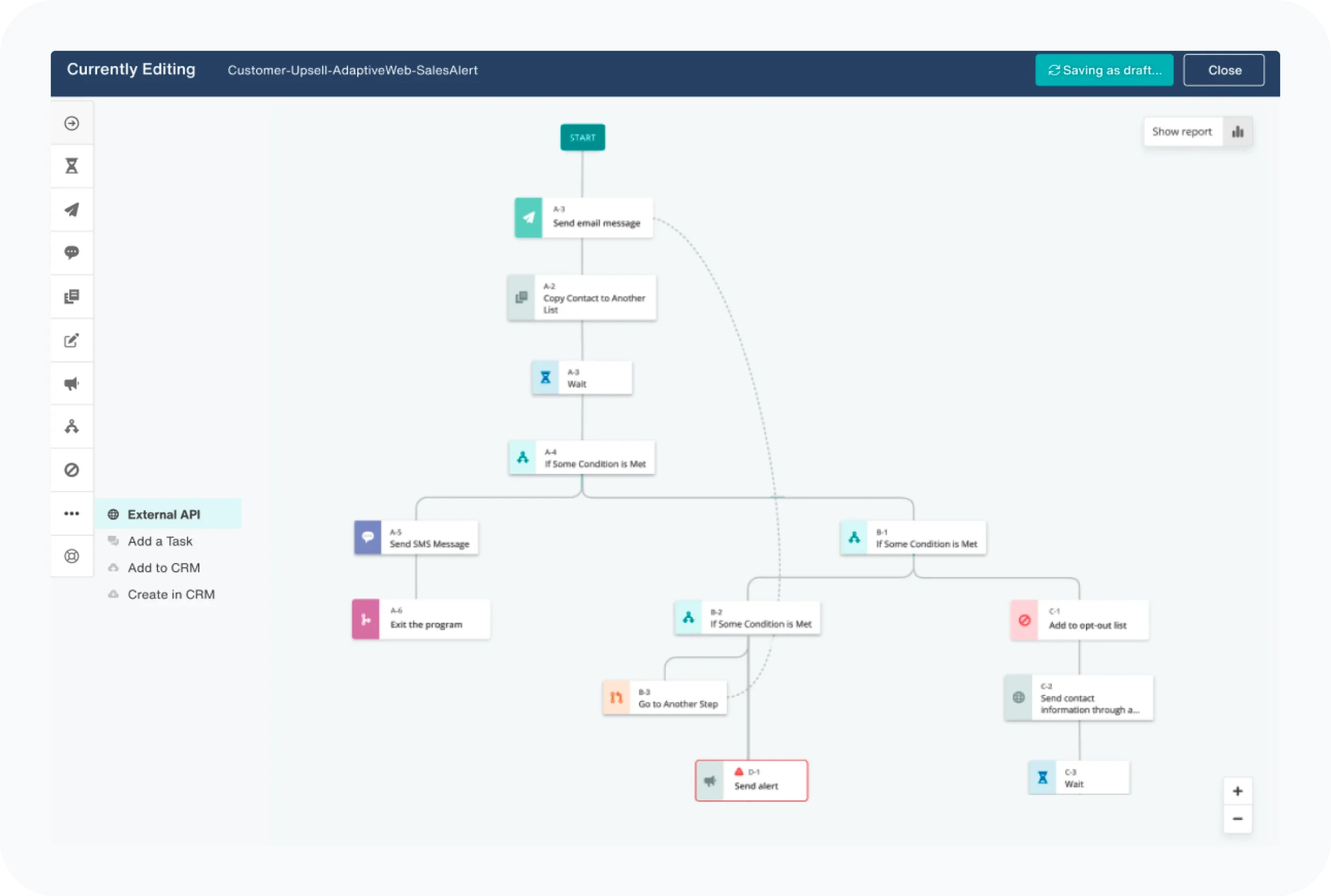
02 / Keep the CRM. Change what happens around it.
Founded in 2008 by Raghu Raghavan, a former Responsys co-founder, Act-On entered a market that already had competitors. By 2014 it had raised a $42 million round led by Technology Crossover Ventures. Raghavan’s argument was that arriving later could offer an advantage: learn what earlier products had done, then build for the direction customers were heading.
That history helps explain the current pitch. Act-On positions itself as a specialist that fits around existing systems. Its native integrations include Salesforce, Microsoft Dynamics 365, SugarCRM and NetSuite; APIs, webhooks and integration services connect further systems. A webinar attendance record or CRM update can become part of a marketing decision instead of remaining trapped in another application.
The target customer is often a marketing team serving complicated, sustained relationships: manufacturing, financial services, professional services and technology are prominent examples. Act-On’s public demo material says more than 4,000 businesses trust the platform. Treat that as the company’s stated scale, rather than a freshly audited customer census.
Reported by Hitachi High-Tech Analytical Science after its Act-On implementation. One customer’s experience, not a platform-wide benchmark.
Hitachi High-Tech Analytical Science compared Act-On with Pardot, HubSpot and Marketo. The selection involved CRM integration, analytics, administration and content creation. Its account emphasizes richer segmentation and coordination among marketing, sales and service. Those are useful buying criteria precisely because they describe work someone actually needs to do.
The alternatives remain substantial: HubSpot, Adobe Marketo Engage, Salesforce’s Account Engagement and Oracle Eloqua. Act-On’s differentiators are its CRM choice, active-contact billing and focus on the whole customer lifecycle. Competitors also offer automation and integrations. The meaningful comparison is how well each handles your particular workflow, and how much effort maintaining that workflow demands.
03 / The bill follows the conversation
Act-On’s published calculator shows Professional at $900 per month for 2,500 active contacts. It requires an annual contract, putting that displayed base rate at $10,800 for twelve months. Enterprise uses a custom quote. Implementation, configuration and add-ons can change the bill; CRM integration and Data Studio are included in Enterprise and listed as paid additions for Professional.
The unusual part is the denominator. Act-On bills around contacts engaged during the month, rather than the entire stored database. For a team with years of inactive records, the distinction can matter. For a team that emails practically everybody, that particular advantage narrows. An idle contact and an active campaign are different things; the pricing model acknowledges the difference.
Stored does not mean emailed.
A hypothetical database of 10,000 contacts. Move the slider to change how many you email this month.
Subscriptions also fund services and support. Deliverability specialists offer monitoring, list cleaning and dedicated-IP options. Those services address an inconvenient fact of email marketing: a beautiful message has little commercial value in a spam folder. The software purchase is partly a workflow purchase, partly an ongoing operating commitment.
04 / AI meets the unglamorous work
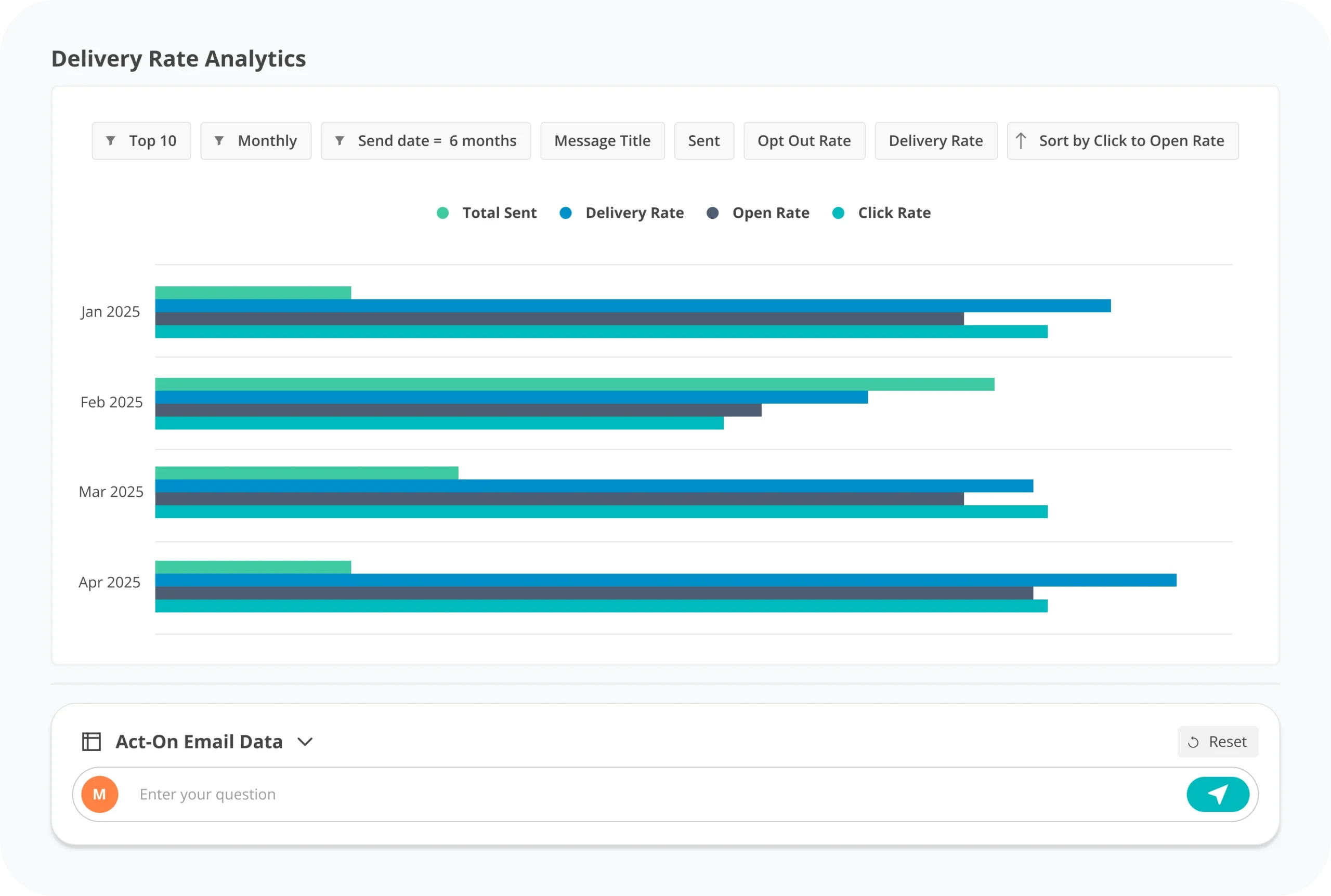
Act-On introduced AI Create for email content in June 2023, then announced an Intel collaboration on behavioral audience segmentation that September. The current AI offering extends into predictive lead scoring, send timing and distinguishing human engagement from bot activity. These are separate tasks with separate standards of usefulness. A fluent draft cannot establish that a lead is ready for sales.
InSite, announced in November 2024 with conversational AI provider MOPO, connects a website agent to lead management. It answers visitor questions using knowledge drawn from the customer’s website, while captured leads can enter scoring and follow-up. Act-On’s Data Lake adds another route for bringing customer information into campaigns, including sharing within the Snowflake ecosystem.
The practical attraction is less copying between tools. A question asked on the website can inform the next interaction. A behavioral pattern can influence a segment. A marketer can spend less time reconstructing the customer’s history. The corresponding responsibility remains human: check the information, approve the message and decide whether the recommended action makes sense.
05 / The $53.2 million sale that never happened
In January 2025, Banzai announced an agreement to acquire Act-On for an enterprise value of $53.2 million, comprising $20 million in cash and $33.2 million in equity consideration. The proposed combination would have added marketing automation to Banzai’s collection of tools. On paper, the fit was easy to describe.

The financing failed first. According to the termination account, Banzai told Act-On on June 5 that an expected funding source had fallen through. Act-On terminated the agreement on June 6. Banzai’s filing disclosed obligations of $500,000 for transaction expenses and $882,029.82 for debt-related interest and extension fees.
The reason to change course was therefore concrete: the buyer could not complete the transaction. This was an announced acquisition that did not close. The episode also illustrates a habit worth borrowing from careful software buyers: distinguish a plan from a working arrangement. A diagram showing two systems together is only the beginning of an integration.
06 / Start with one neglected handoff
The most portable lesson from Act-On is to begin with a specific gap. Pick a real moment: a brochure download that receives no follow-up, a webinar attendee who never reaches sales, or an existing customer who stops buying. Decide what information matters, what should happen next, who owns the response and when the sequence should stop.
Then bring that journey to the demo. Ask the vendor to build it using your CRM fields, your branching rules and your reporting needs. Check permissions and consent, test the handoff, and compare the outcome with the old process. Count useful conversations and qualified opportunities alongside email activity. Otherwise, the dashboard may merely document a more energetic version of the same confusion.
A team needing occasional newsletters may have little reason to pay for this machinery. A team without reliable contact data, worthwhile content or someone responsible for the program will struggle to extract value from it. Automation repeats the decisions supplied to it. Act-On’s case is strongest when a business has relationships worth sustaining and a team willing to design what sustaining them means.
Explore the product, customer accounts and company updates.