A car dealership can know a remarkable amount about someone and still struggle with a modest question: should we call them today? It may have the old sale, the service history, the financing arrangement and a telephone number. What it needs is an order of operations. A customer file remembers. A useful sales tool makes a suggestion.
That distinction explains automotiveMastermind, a software company born among people who had actually sold cars. Its proposition is easy to grasp: identify the people likely to replace a vehicle, explain why they might be ready, and help a salesperson begin a relevant conversation. The showroom is the visible part of the transaction. Mastermind works on the less photogenic business of getting someone there.
- Find the next conversation. Predictive scores organize dealer customer lists.
- Make the approach specific. Customer and vehicle signals inform offers and messages.
- Look beyond yesterday’s buyers. Acquire targets audiences outside the dealer database.
- Teach people to use it. Recurring dealer training accompanies the technology.
01 Two salesmen and a diagram
Marco Schnabl and Johannes Gnauck came from Mercedes-Benz sales. In 2012 they took their idea to software engineer Mohammed Jaleel, known as MJ. In the company’s anniversary account, he remembered the starting point as “a PDF with a diagram drawn on it.” It is an agreeable corrective to the polished origin story: before there was a platform, there was something you could attach to an email.
MJ worked from India while the founders were in New York, collaborating over Skype and incorporating dealer feedback. The platform launched in 2013 with six dealer partners. By 2016, the company says, it had brought on more than 800. The early expertise was unusually concrete. These were people who knew the difference between a promising customer record and a conversation that might go somewhere.
JMI Equity announced a growth investment in November 2016, describing it as the company’s first institutional capital. In September 2017, IHS Markit acquired roughly 78% of the business. Its initial disclosure put the price at about $392 million, potentially rising with performance. Later reporting recorded approximately $432 million, including contingent consideration. Those were acquisition payments, rather than a dealer’s software bill, but they reveal what the buyer thought this narrow problem was worth.
“a PDF with a diagram drawn on it.”Mohammed Jaleel, recalling the original concept
02 The customer who has not raised a hand
Mastermind’s Behavior Prediction Score ranks prospects from 0 to 100 according to their propensity to buy. Its Behavior Drivers supply context for the ranking. In a 2025 technical account, the company described an engine assessing whether dealership customers were likely to replace their vehicles within the next 90 days, using more than 150 features. The distinction matters: the score is a priority signal. It should not be read as a promise that a particular person will purchase.
The surrounding platform connects prediction to action. A customer deal sheet collects information that can guide an offer; personalized campaigns carry the approach into print and digital channels. The salesperson gets a suggested direction rather than another undifferentiated list. In ordinary business terms, Mastermind is selling attention management: a way to spend a finite working day on more plausible opportunities.
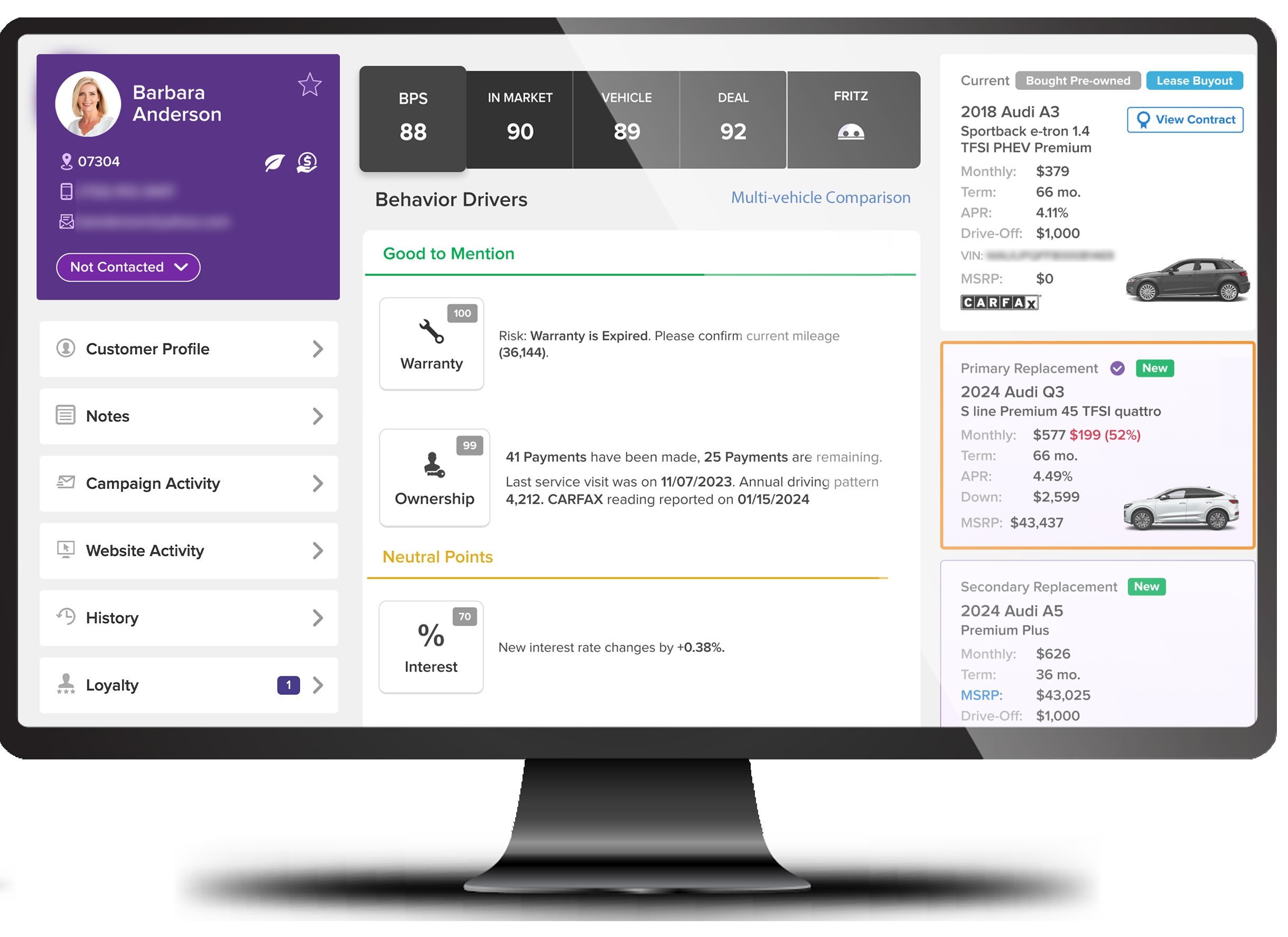
One especially useful setting is the service drive. The company introduced its Service-to-Sales Activator in 2019. Someone arriving for maintenance has already made a connection with the dealership. The task is to assess whether a replacement conversation is relevant, using information such as equity or warranty status, rather than assuming that every person waiting for an oil change wants a new car. A well-timed offer needs a reason.
Conceptual workflow, not a representation of the proprietary algorithm.
03 Fritz learns to talk
Prediction and composition are different jobs. Mastermind CoPilot, launched in January 2025, addressed the second: generating call scripts, emails and text messages from customer, vehicle, behavior and replacement-deal information. A ranked list can tell someone where to begin. A draft message can help them begin without staring at an empty text box.
The company calls its assistant Fritz. In January 2026 it announced conversational capabilities, including natural-language requests, help with objections, service follow-ups and translation into more than 100 languages. This is a specific use of generative AI, attached to a specific working record. The intended benefit is consistency and preparation in customer outreach.
There is a practical boundary here. The company’s terms require subscribers to verify generated content and acknowledge that predictions do not guarantee outcomes. The salesperson still has to check the offer, understand the customer and decide whether the draft sounds like a person they would trust. Fluent language is inexpensive. A reason to reply is harder to manufacture.
04 A map beyond the customer list
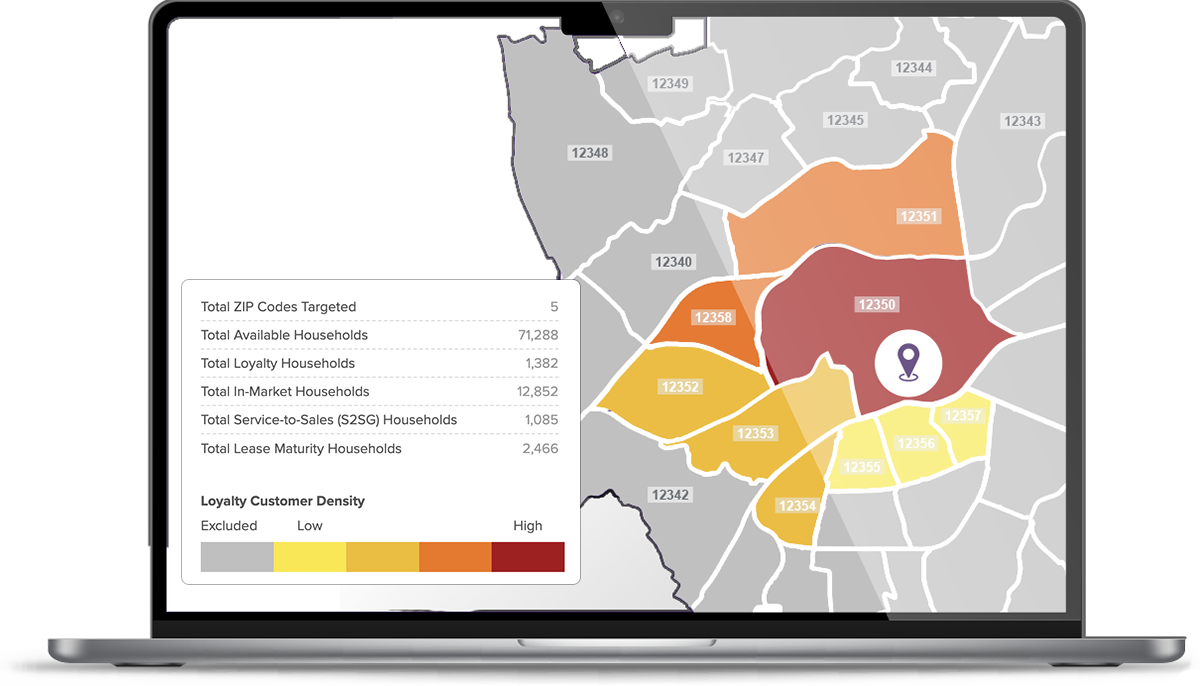
Retention has an obvious limit: it starts with people a dealer already knows. Acquire, introduced in January 2025, broadens the search. Using sources including Polk Audiences, it identifies likely buyers outside the dealership database and displays opportunities by ZIP code. Dealers can choose neighborhoods, exclude areas and move selected audiences into automated, multi-month outreach.
At the manufacturer level, Enterprise EyeQ plans and activates customer-specific private incentives. Its advertised workflow includes measurement against control groups. The shared idea is precision: choose who receives an offer, then examine what the offer accomplished. Dealers and manufacturers face different budgets, but both have reasons to question indiscriminate spending.
Mastermind also sits within a substantial automotive data family. The IHS Markit business joined S&P Global in 2022; in July 2026, Mobility Global completed its separation into an independent public company. automotiveMastermind now belongs alongside brands including CARFAX, Polk and Market Scan. The connection helps explain its position at the intersection of customer records, automotive data and marketing execution.
It has company in that intersection. AutoAlert markets data mining, retention, service-to-sales and AI engagement products. Fullpath’s Equity product uses dealership data and its customer data platform to identify equity and automate offers. Prediction, personalization and AI are therefore poor distinctions on their own. Mastermind’s case rests on the particular combination of automotive data, sales workflows, campaign execution and field support.
05 The humans in the subscription
The field support deserves attention. Mastermind says its Dealer Relations Managers conduct on-site or virtual training on a 30-45-day cycle. They work with sales and marketing performance as well as platform use. Its Academy supplies complimentary role-based learning. Software adoption, in this model, is something people keep working on after the invoice arrives.
The commercial arrangement is a business subscription. Published May 2026 terms tie monthly package and service-level pricing to a location’s vehicle sales over a rolling 12-month period; the actual fees sit in the customer agreement. Evaluating the expense means looking at the selected services and marketing commitments alongside the software. A dealer also spends staff time learning, contacting prospects and reviewing results.
Integration is another response to that time cost. In February 2026, Mastermind and DriveCentric expanded their two-way exchange of customer, deal and activity data. Scores and buying drivers become visible inside the CRM, while engagement information flows back. Our reading of this change is straightforward: an insight has more chance of being used when it appears where someone is already working.
06 Moran’s million, with the small print
Moran Chevrolet offers a concrete example of the problem. In a February 2026 Mastermind case study, the dealership wanted help organizing a large database, prioritizing opportunities and reducing the systems involved in daily work. The account describes outreach informed by vehicle equity, replacement options, warranty status and household information.
Reported return on investment
The published results include 19x ROI, more than $1 million in profit during the first half of 2025 and over 32% of sales attributed to Mastermind. These are the vendor’s case-study figures. Attribution means the system receives credit under the reporting method; it does not establish that every credited sale would otherwise have vanished. A dealer considering the product should ask how that credit is assigned.
The transferable lesson is less theatrical than the number. Organize the opportunities, attach reasons to them, give the team a way to follow up, and keep reviewing what happens. The case describes a dealership buying help with prioritization and execution. The number is interesting because of that process, not a substitute for examining it.
07 Copy the routine before the software
A reader can borrow the operating logic without borrowing the brand: build a daily shortlist, record why each customer belongs on it, prepare a relevant offer, assign the follow-up and measure the result. Start with a question the team can answer tomorrow morning. An enormous dashboard is a rather expensive place to hide an unanswered question.
That routine depends on usable customer records, workable integrations, relevant inventory and staff who actually act on the shortlist. Poor inputs make rankings less useful; an offer the store cannot honor makes personalization beside the point. Even an accurate forecast has limited value in a dealership that leaves the conversation unattended. These are operating conditions, rather than predictions of failure at any particular customer.
automotiveMastermind’s distinctive choice is to join those pieces: prediction, an explanation, a message, and people who help the dealer put them to work. The founders understood the sales floor well enough to begin with the next call. Fourteen years later, that remains a sensible place to judge the product.
Website ↗Announcements ↗Dealer blog ↗LinkedIn ↗X ↗Instagram ↗Facebook ↗