A laptop is an awkward thing to sell twice. The first sale is easy to understand: somebody needs a computer. The second requires a little more tact. The machine probably still works. The buyer may be perfectly happy. An email announcing another laptop can arrive with all the social grace of a waiter offering dinner immediately after dessert.
That was the retention puzzle facing Lenovo. In Bluecore’s account, the company had tried increasing email volume to increase revenue and retention. But laptops and tablets have long replacement cycles. A fuller inbox could hardly make the computer on the desk age faster. The interesting question was which other purchase might actually make sense for that customer.
- Bluecore connects shopper identity, behavior, and product data.
- Its retail tools act across email, SMS, websites, and paid media.
- Lenovo and DXL show two uses: repeat purchases and fewer disconnected systems.
- Insider One acquired the company in May 2026.
Bluecore’s bet is that retail marketing becomes more useful when it understands the merchandise as well as the mailing list. The distinction sounds small. It changes what a campaign is for. Instead of finding something to send on Tuesday, a retailer can look for a change that gives a particular shopper a reason to return.
The merchandise has a memory
Consider an illustrative shopper looking at a jacket. A customer record might contain her previous purchases. Behavioral data might show that she viewed the jacket twice. The product catalog adds a third piece: her size has returned to stock, or the price has fallen. Bluecore combines those signals so the retailer can respond with a relevant message. The example is hypothetical; the back-in-stock and price-decrease triggers are actual capabilities.
That catalog connection is central to the company’s identity. Bluecore says its original insight was that behavioral data alone could not produce a compelling shopping experience. You also had to know what was happening to the products. Its technology matches people with merchandise while predictive models estimate things such as category preference, discount affinity, and the next likely purchase.
Recognize the shopper.
Follow interest and intent.
Watch price, stock, and products.
Identification makes that logic usable. A retailer cannot personalize a follow-up for somebody it cannot recognize. Bluecore’s Transparent ID Network, launched in December 2023, addresses reidentification. Its February 2026 dentsu integration expanded that network with an additional identity graph. Bluecore reported identification-rate lifts of 20-50%, while saying retailers’ proprietary customer information remains separated from competing brands.
An email tool with an engineering problem
The company began in 2013 as TriggerMail, founded by Fayez Mohamood, Mahmoud Arram, and Max Bennett. The ambition began with a thoroughly unglamorous obstacle: integration. Marketers had data in ecommerce systems, analytics tools, recommendation engines, and email software. Turning it into an automated message could become a project before it became a campaign.
When TriggerMail became Bluecore in January 2015, it announced a $6 million Series A led by FirstMark Capital. Its early pitch emphasized a JavaScript integration that reduced the work of assembling retail triggers. Mohamood’s slogan, quoted at the time, was admirably impatient: “Stop integrating. Start Marketing.”

Fayez Mohamood / Co-founderThe original problem was getting retail data into action. The channels multiplied; the problem remained recognizable.
The larger platform took time. Norwest’s account says Bluecore lacked adequate AI technology when the investor joined its Series C in 2017. Product-planning work with partner Scott Beechuk helped develop the engine over subsequent years. That is a useful corrective to the idea that an AI business arrives fully formed: the capacity had to be built.
Expansion also came through acquisitions. Buying Betaout in 2018 established Bluecore India and added engineering depth for channels beyond email. Today the careers page describes a hybrid workforce across the US, India, and Canada. It lists a weekly meeting-free day and hackathons open beyond engineering. Even its culture puts a little emphasis on protecting the time needed to make things.

Fourteen percent does the heavy lifting
Lenovo partnered with Bluecore in April 2022. The work began with an assessment of its customer base, then moved toward automated messages linked to shopper and merchandise signals. Recommendations widened beyond the biggest-ticket products. The reported results included a 21% increase in email revenue and a 6.5% increase in repeat purchases from active buyers.
Those shares suggest that useful timing can matter more than raw volume. They do not establish how many purchases would have happened anyway. An automated message may reach somebody already close to buying. Revenue attributed to that message is consequently a different measure from revenue caused by it. The distinction should survive any sales presentation.
The second purchase needs a reason. A campaign calendar supplies a date.Editorial observation
Fewer systems, more useful signals
DXL offers a different demonstration. In February 2025, the big-and-tall clothing retailer expanded its Bluecore relationship to consolidate identification, segmentation, campaign management, and media integration. The fit was literal as well as technical: activations could use clothing size and SKU-level attributes. For this retailer, a broad category preference is less useful if the recommended item cannot fit.
The product range follows that practical logic. Email and Mobile handles personalized communications and dynamic audiences. Site addresses onsite identification and conversion. Paid Media and Social synchronizes audiences with advertising platforms, including decisions about whom to target or suppress. Bluecore also offers training, strategy, creative production, and fully managed programs. Buying the platform can mean buying help operating it.
This places Bluecore across customer data, personalization, and campaign execution. Klaviyo and Braze sell overlapping retail engagement capabilities; behavioral triggers and cross-channel messaging are not exclusive to Bluecore. Its particular pitch emphasizes retail catalog intelligence joined to identification and execution. Whether that combination earns a place in an existing stack depends on the retailer’s actual workflow.
Consolidation is one option, as DXL shows. Integration is another. Bluecore’s partner ecosystem includes Amperity for customer-data synchronization and Criteo for predictive audiences. An enterprise can use Bluecore to activate intelligence alongside other systems rather than assume every existing tool must disappear.
The question before the purchase
In November 2024, Bluecore acquired alby, an AI shopping assistant. The transaction brought back Bennett, an original Bluecore co-founder, to lead alby’s evolution. There is an appealing continuity here: a company organized around understanding products bought a business organized around answering questions about them.
A shopper asking whether a tent is easy to assemble reveals something a page view cannot. Alby’s current offering covers discovery, comparisons, product advice, and support. Those conversations can generate another kind of customer signal. Its tools also let merchants set rules and inspect responses. Accuracy matters because a confident answer about the wrong product is an expensive sort of charm.
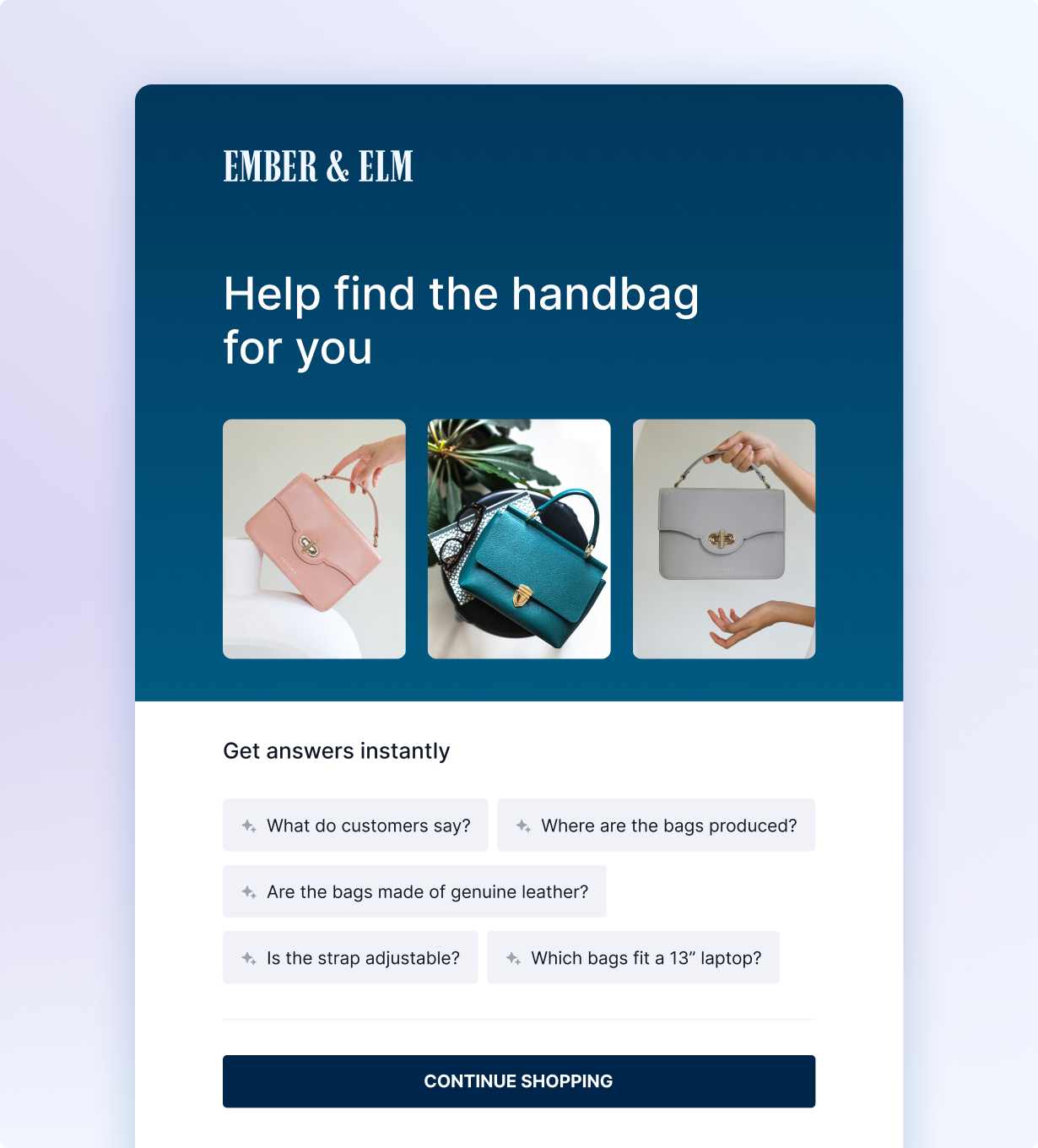
The company also markets a Marketing Agent for the people behind the campaigns. Its published workflow includes conversational revenue diagnostics, identification monitoring, and movement from analysis into email and mobile execution. It addresses another delay: the distance between discovering what happened and deciding what to do next.
What success costs
Bluecore introduced shared-success pricing in 2019. Its 2021 announcement described payment tied to traffic and conversions generated by AI. That historical model makes measurement part of the commercial relationship. A buyer evaluating a current proposal should understand the attribution rules, service scope, and definition of a billable outcome before treating the incentives as settled.
The capital story is more explicit. A $125 million Series E in August 2021 valued Bluecore at $1 billion, with Georgian leading alongside FirstMark, Norwest, and Silver Lake Waterman. On May 13, 2026, Bluecore announced its acquisition by Insider One. Bloomberg reported cash and equity consideration and said the deal retained a valuation above $1 billion; the precise price was undisclosed.
The acquisition connects Bluecore’s retail data and identification with Insider One’s broader engagement platform. It is a change of ownership, with a clear strategic rationale. It should not be mistaken for evidence that every retailer will obtain Lenovo’s results or that autonomous marketing has already solved the retailer’s business problem.
Copy the questions before the software
The practical lesson is an editorial inference from these cases: start with a customer decision you want to improve. Identify the people you can appropriately reach, connect their interests to reliable product information, and choose a signal that deserves a response. A return to stock is a promising candidate precisely because it changes something for the buyer.
Then judge additional purchases and margin, alongside campaign activity. A controlled holdout can help separate influence from coincidence. Catalog errors, weak identification, or products with few plausible follow-on purchases make this approach harder. More accurate targeting cannot conjure demand for something nobody needs. Consent and eligibility also determine whether a useful signal can become a message.
Bluecore’s most portable idea is the simplest part of its architecture: merchandise changes, customers change, and a good retailer notices when those changes meet. The software automates the noticing. The reason to come back still has to be good.