Two emails arrive from the same shop. One announces a sale to everyone. The other remembers the shoes you left in a cart. They may use the same typeface, the same discount, even the same photograph. Yet the second has something the first cannot manufacture: a reason to arrive just now.
That difference is the most useful way into Omnisend. In the company’s analysis of 2025 activity, behavior-triggered emails generated 30% of email revenue while accounting for 2% of sends. These are attributed sales inside its merchant data, rather than proof that every order would have disappeared without a message. Still, the imbalance deserves a merchant’s attention.
- Omnisend puts email, SMS, and browser push into ecommerce workflows.
- Its customers are chiefly small and midsize online stores.
- Shopping behavior supplies the cue; automation supplies the response.
- The useful test is profit after costs, not a handsome open rate.
Small share of sends.
Large share of sales.
A business idea with dinner attached
Rytis Lauris’s account of the company’s beginnings places the decisive conversation in a Persian restaurant across from London’s Ecommerce Expo in 2013. He and his future co-founder, Justas Kriukas, had seen a crowded market. At one end were basic bulk-email services. At the other were complicated enterprise systems with prices and operating demands a small shop could scarcely entertain.
The opportunity was a specific customer between those ends: an ecommerce merchant who wanted useful shopping data without hiring a department to interpret it. Soundest launched in 2014. Lauris says its first version took four months to build and was initially free, a way to test whether merchants wanted the proposition.
By 2017, the company was thinking beyond email. More customer touchpoints required a more coordinated experience, and Soundest became Omnisend. SMS followed in 2018. The company now describes itself as bootstrapped and profitable, with more than 150,000 stores using its software. The original customer remains easy to recognize: a person with products to sell and too many jobs already.

The shopping cart becomes an instruction
Omnisend sits between the store and the customer’s inbox or phone. Its ecommerce connections bring customer, product, and order information into the marketing system. A merchant can then build a campaign, collect subscribers with forms, or create a sequence that starts when a shopper does something.
That sequence might welcome a subscriber, follow up on an abandoned checkout, or reconnect with a customer after a purchase. Email, SMS, and push can participate in the same workflow. Delays and conditions let the merchant decide which message comes next. A visual builder makes those decisions inspectable rather than burying them in a programmer’s queue.
Segmentation adds a second kind of judgment. Buying history and engagement help distinguish a frequent customer from someone drifting away. A blanket promotion treats them alike. A segment gives the merchant a chance to behave as if the distinction matters.
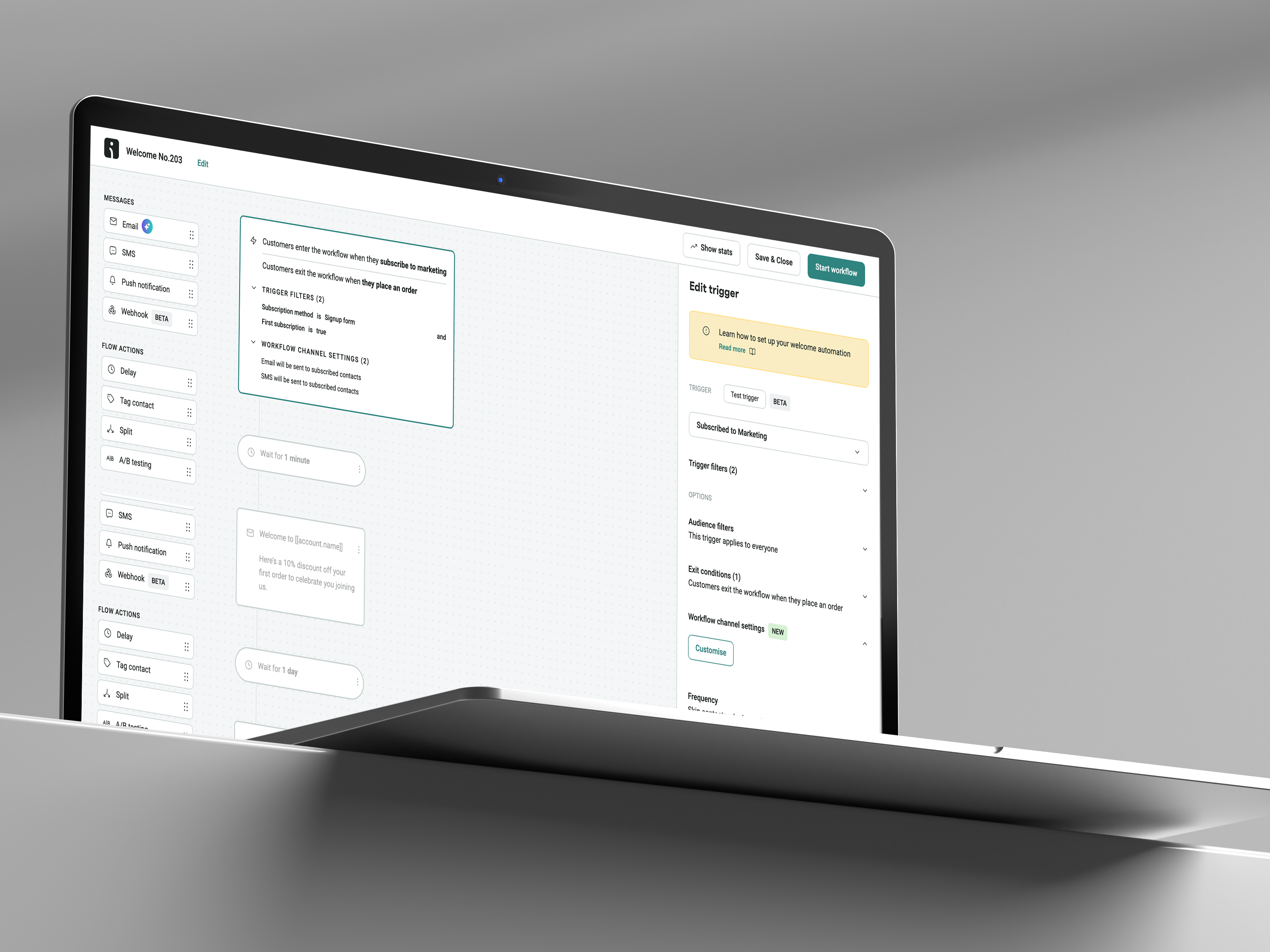
- 01 / NoticeA shopper leaves checkout.
- 02 / WaitAllow time to return unaided.
- 03 / RespondSend a relevant reminder to an eligible contact.
- 04 / StopExit when the order is placed.
A design example, not a promised result or a preset sending schedule.
The competitive claim is practical. Klaviyo, Mailchimp, and Attentive give merchants other routes into customer messaging. Omnisend emphasizes a store-focused setup, coordinated channels, and accessible operation. A useful buying decision compares the workflows your store needs, the data each integration supplies, and the bill at your actual audience size. A feature list cannot make that decision alone.
At B-Wear, the first thing missing was the answer
B-Wear Sportswear, an Ohio apparel retailer on BigCommerce, switched from Constant Contact to Omnisend in January 2021. In its published customer story, the immediate problem was visibility: the team could see email engagement but struggled to connect campaigns with sales. The integration gave it a clearer view of customer activity and attributed revenue.
The interesting part is what followed. B-Wear tested its welcome offer, moving from a 10% discount to 15%. It reported a 390% increase in sales per email and a 121% increase in orders. That encouraged a further move to 20%. Its cart workflows also used different paths according to cart value, with SMS added to the mix.
This is a vendor-published case, not a controlled experiment. A larger discount costs margin, and the revenue result does not settle whether the extra orders were profitable. The transferable habit is the test: change an offer, inspect the response, then decide whether to keep paying for it.
“Personalization goes a long way.”Shane Biles, B-Wear’s director of marketing
The bill has more than one moving part
Omnisend’s free tier currently reaches up to 250 contacts with 500 emails a month. Its familiar Standard entry price is $16 monthly before promotions; larger lists cost more. The pricing page may display an introductory discount, so the ongoing rate deserves a separate look. Pro serves higher-volume use with additional capabilities.
SMS introduces another variable. In May 2026, Lauris announced US rates starting at $0.007 per message. That starting rate applies to high-volume US sends; destination and volume affect the price. He described message cost as a reason smaller brands had hesitated to adopt the channel. Lowering it was a response to that hesitation.
For a merchant, the sensible arithmetic includes subscription charges, texts, discounts, and staff time. A campaign that brings in revenue can still leave less money in the till. Begin with a small, relevant audience and measure contribution after those costs. Expand when the economics survive the calculation.
It takes confidence to advertise boredom
In 2025, Omnisend adopted the slogan “Email & SMS marketing so good, it’s boring.” Its earlier promise about marketing that sells sounded much like the rest of the category. The company’s rebrand account says it chose a more distinctive personality built around dependable operation.
There is a neat understanding of the buyer in that joke. A shop owner might enjoy designing a product, meeting a customer, or seeing an order come in. Maintaining an email workflow is unlikely to win the same affection. Software that earns less attention during an ordinary working day can be easier to value.
Teaching the dashboard to answer back
The 2026 updates extend that effort to reduce operating work. August brought Reports AI, which lets merchants ask questions about performance, and send-time optimization, which uses engagement history to schedule delivery. Connected AI tools can work with account data through Omnisend’s MCP connection, with permissions controlling access.
September’s release notes describe expanded form management through that connection, improvements to AI segment building, and recommendations for forms, audiences, and workflows. The direction is clear: less time assembling a question out of menus, more time deciding whether the answer merits action. Important conclusions still deserve comparison with the underlying reports.
The same preference appears inside the company. In June 2026, Omnisend described cash bonuses for effective employee AI adoption. Its stated criteria are efficiency, business impact, and implementation: does the work save time, help the business, and become useful to other people? That last condition makes a clever private shortcut answerable to a team.
What a small store can borrow tomorrow
The method starts before choosing software. Pick a customer event you can observe reliably. Decide what help or reminder would make sense at that moment. Set a limit on how often the customer hears from you. Then test the response against a sensible comparison, including a holdout group where practical.
It depends on permission, accurate store data, and an offer with enough margin. A business without a meaningful subscriber audience has fewer opportunities to automate. Broken checkout events produce badly timed messages. Discounts that train customers to wait can undermine the sale they appear to rescue. These are operating questions the merchant must answer.
Omnisend gives that merchant a place to connect the evidence with the next message. The detail worth remembering is the quiet one: a customer’s action can be more useful than another date on the marketing calendar. Before writing a louder email, find out whether it has arrived for a reason.
Follow the next message
Explore the platform, its working notes, and the people building it.