A small red badge appears on your phone. It asks for almost nothing - one tap, perhaps three seconds. Yet that tap may be the most contested piece of real estate in software. A company has already paid to acquire you; now it must earn the right to interrupt you. OneSignal exists in the space between those two events. Its founders first noticed the problem while running a mobile game studio: their games attracted players, but the messages meant to bring them back were generic, poorly targeted and hard to judge.
The short version
- What it does: coordinates push, in-app, email, SMS and RCS messages with targeting, automation and measurement.
- Who uses it: app teams, publishers, shops, games and larger businesses that need to bring users back.
- The bet: one customer profile and one workflow can make each interruption more useful.
- The bill: free to begin; Growth starts at $19 monthly plus channel usage, with custom annual plans above it.
The trouble with a successful game
George Deglin and Long Vo had a plausible business in games. Their studio was backed by Y Combinator, and Deglin later wrote that its titles were well reviewed and featured in app stores. The problem was less glamorous than making a game: keeping its audience. A push notification went to everyone, regardless of what they had played. Email required moving lists between systems. The team could see a player leave, but had few elegant ways to ask that player back.
In 2015, according to Deglin's account, they turned the studio's internal headache into the business. Their product would make messaging easy enough for a small team, scalable enough for an app with a huge audience, and measurable enough to distinguish a welcome reminder from an annoyance. OneSignal's founding mission - democratizing customer engagement - sounds grand. Its origin was satisfyingly ordinary: the founders disliked the tools on their own desks.


“I would have never imagined we'd pivot away from a successful business, but that's why OneSignal exists today.”George Deglin, co-founder and CEO
A conversation in five channels
The first use case was push. Today, OneSignal sells a broader customer engagement platform: mobile and web push notifications, in-app messages and Live Activities, email, SMS and RCS. Developers install SDKs or use APIs to connect an app or website. Marketers can then build segments, write messages, set triggers, test variants and inspect results. Journeys, its visual workflow builder, links those steps across channels.
Imagine a customer who browses a pair of shoes and leaves. A team could send an in-app sizing tip on the next visit, a push alert when that size returns, and an email if the alert goes unopened. The point is not to use every channel; it is to stop each channel acting as if it has never met the customer. For a publisher, the trigger could be a new story in a reader's chosen topic. For a finance app, it might be a timely account update. For a game, it may be the completion of a quest.
A useful message has a sequence
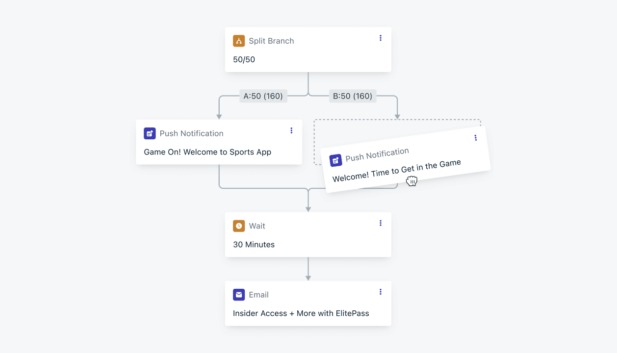
This combination is its place in the market. Apple Push Notification service and Firebase Cloud Messaging can deliver app pushes, but a business still needs to manage users, preferences, timing, templates and reporting. At the other end sit broad engagement suites such as Braze, Iterable, Airship and CleverTap. OneSignal's pitch is a short path from SDK installation to a marketer-run campaign, with a free door at the entrance. That positioning matters most when engineering time is scarce and the person writing the message is not the person shipping app code.
The number that needs a denominator
OneSignal says more than one million businesses use its platform and that it sends about 12 billion messages each day. Those are company reported scale figures, impressive as infrastructure, but they do not tell us whether a message helped. The more instructive numbers come from customers who describe an actual change in behavior.
Joe, an ordering and rewards app for independent coffee shops, used push and in-app messages for order updates and promotions. Its team segmented users by what they did and what would matter to them. In OneSignal's case study, Joe reported 25% higher retention and 30% revenue growth in the first 30 days. That is a customer account, not a controlled trial proving OneSignal caused every dollar. The copyable move is more modest and more useful: separate transactional messages from offers, then target each with evidence of relevance.
Ogun, a Spanish construction management app, had a different problem. Users needed to discover features and follow tasks without a new screen being built for every explanation. It used in-app message carousels for onboarding and push alerts that led back to specific conversations. Its case study reports an 80% rise in click-through on onboarding messages and a 35% reduction in churn. The lesson is less about a clever notification than where it lands: a reminder that opens the exact unfinished task beats one that drops a busy contractor on the home screen.
“We have been able to reproduce WhatsApp's push notification experience using OneSignal.”Ignasi Salvador, CEO of Ogun
What the easy start costs
The free plan has been central to OneSignal's spread. It lets a developer try the SDK before involving procurement. But the free plan is a real pricing choice, not a promise that every growing app can stay free. As of September 2026, new free accounts have a 1,000 monthly active user cap for mobile push and in-app messaging; existing accounts move to that limit on October 1. The same plan includes 10,000 monthly email sends and web push with a 10,000 subscriber limit per send. OneSignal also added more Journeys steps, data tags and AI access to the free tier.
Growth starts at $19 a month, then charges by use: $0.012 per monthly active mobile user, $0.004 per web push subscriber, and $1.50 per thousand email sends after the included allowance, according to the published pricing page. SMS and RCS have separate sending costs; Professional and Enterprise are custom annual contracts. A team evaluating OneSignal should price the audience it hopes to have, not merely the one it has today. The first thing to fail in a campaign is often the economics of sending indiscriminately: a bigger list can mean a bigger bill and a more irritated audience.
The company itself took the long route to financing that system. It raised $50 million in a 2022 Series C led by BAM Elevate, with SignalFire among participating investors. Deglin said the money would develop omnichannel orchestration, particularly Journeys. OneSignal opened a London office in 2023, saying nearly 70% of its customers were then outside the United States. The business is global because a notification can travel anywhere; the difficult work is making its timing and language local.
Now the dashboard wants to act
OneSignal's 2026 releases show a shift from reporting on sends toward reporting on outcomes. Conversion Metrics became available across plans; new retention views compare users who return after 7, 14 or 30 days. The company also introduced an MCP Server in open beta so external AI assistants can read and operate parts of the platform, and offered its own embedded AI assistant in early access. Deglin describes a future in which software plans, tests and improves lifecycle campaigns under goals and guardrails set by people. That is a direction, not proof that the marketer has left the room.
The best way to copy OneSignal's thinking does not require an AI agent. Pick one moment at which a customer would genuinely benefit from hearing from you. Define that event, the permission required, the channel, the landing destination and the outcome to measure. Run a small test against a group that receives nothing. If people return and stay, expand carefully. If clicks rise while opt-outs rise faster, you have learned something just as valuable.
There are conditions under which this playbook is weak. A product with little repeat use has few welcome reasons to reappear. Thin customer data makes segmentation a polite name for guessing. A user who has declined permission cannot be reached by wishful thinking. And a company that treats every new channel as another megaphone will simply become louder. OneSignal can make a message easy to send. Whether it deserved to be sent remains a decision the software cannot make on a company's behalf.