Company Profile · Martech · Sydney
Vero
The customer engagement platform that decided the best feature was the data it chose not to store.
The customer engagement platform that decided the best feature was the data it chose not to store.
In 2012, two Australians - Chris Hexton and James Lamont - noticed something odd about the marketing tools of the day. The fastest-growing online businesses were paying the most for the least flexibility. List-based email platforms treated every customer as a row in a spreadsheet, when what these companies actually needed was to react to behaviour: a click, a signup, a feature tried for the first time. So they built Vero, went through the Startmate accelerator, and shipped a real-time automation product for software teams. Twelve years and billions of messages later, the founding bet still holds - message people based on what they do, not what list they land on.
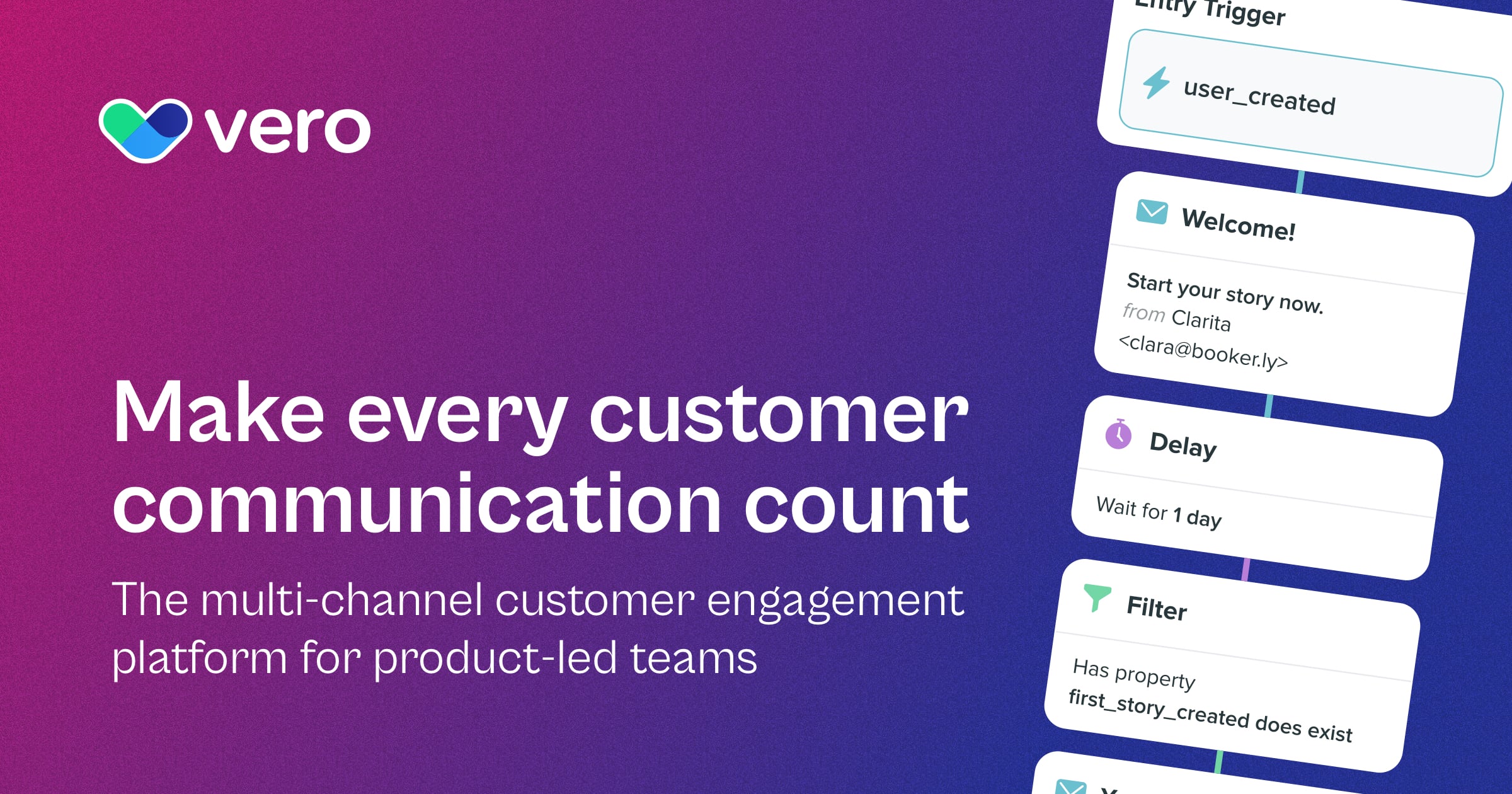
Vero lets teams send personalized email, mobile push and SMS messages triggered by what users actually do inside a product. Its workflow engine reacts in real time - to every button click, every pageview, every feature engaged with - and coordinates email, push, SMS and in-app messaging inside a single customer journey.
Marketers get intuitive editors and a visual journey builder. Engineers get a flexible API and event ingestion. Both work from the same source of truth, which is the point.
Product-led companies, from startups to enterprises: SaaS platforms, marketplaces, edtech and tech-enabled services. Named customers include Unsplash, Dribbble, Pipedrive, Helloprint, CodeSandbox, Stockpile, Snappr, Sticker Mule, Flock Freight and Ausmed.
These are teams that grow through the product itself - where the right message at the right moment is part of the experience, not an afterthought bolted on by a separate marketing department.
"Make every message count."
VERO — company taglineTraditional marketing platforms want to store a copy of your customer data. That means duplication, extra cost, and one more place for sensitive data to sit - and leak. It also creates two versions of the truth: the one your analysts query, and the one your marketers message from.
With Vero Connect, the platform reads directly from a company's data warehouse. Teams query their user data with SQL and send from it - no copying required. Because Vero stores less, it ends up both cheaper and more privacy-compliant. And it charges to send messages, not to store contacts.
A real-time behavioural automation engine. It reacts to in-product actions and triggers coordinated email, iOS/Android push and SMS - the kind of onboarding and lifecycle sequences that quietly drive activation and retention.
Email marketing built for the modern data stack. Reads directly from your data warehouse so you can query users with SQL and message them without duplicating data. Now carries nearly a third of Vero's total message volume.
Intuitive email, push and SMS editors plus a visual journey builder, with A/B testing and segmentation - so ideas can be launched quickly without waiting on engineering for every change.
A developer-friendly API and integrations to push events and orchestrate messaging programmatically. Built so engineering and marketing can share ownership of the messaging layer.
Martech is a loud, well-funded neighbourhood - Customer.io, Braze, Iterable, Klaviyo, Intercom and Mailchimp all compete for the same product-led buyer, and warehouse-native tools like Hightouch and Census are moving in from the data side.
Vero's differences are unglamorous on paper and rare in practice. It stores less of your data by design. It charges by messages sent rather than contacts held, which inverts the usual incentive. And it has grown for over a decade on essentially a single equity round - reaching around 300 customers and roughly $1.8M in revenue by 2020 - rather than raising again and again.
"By not storing customer data, Vero is not only cheaper but more compliant - customers keep their data in fewer places."
On Vero's data-light architectureB2B SaaS. Subscription plans scale with sending volume rather than contacts stored, with an enterprise tier for higher-volume product-led teams. The usage-based model favours companies with large audiences but selective, well-timed sends.
Vero sits between the marketer-first suites and the engineer-first data tools - a messaging layer that both sides can own, tuned for teams that grow through the product itself.
More than twelve years of running behavioural messaging at scale - billions of messages a year at 99.99% uptime, backed by a 24/5 support team. That reliability is the quiet product: the emails that always arrive, the workflows that fire on time.
Seeded through Startmate (2012), a roughly $4M round led by Square Peg Capital (2014), and venture debt from Partners for Growth (2020). Total raised is around $3M in equity - modest by category standards, and deliberately so.
Chris Hexton and James Lamont launch Vero through the Australian Startmate accelerator.
The behaviour-triggered automation product for software teams goes live.
A roughly $4M round led by Square Peg Capital helps scale the automation product.
Venture debt from Partners for Growth; ~300 customers and ~$1.8M revenue reported.
Launches an email platform built for the modern data stack, reading directly from warehouses.
Outlines WhatsApp, custom webhooks and in-app messaging as it deepens the journey builder.
Developer-first and product-led brands that treat the right message as part of the product experience.