The trouble with a successful email program is that it can teach you an expensive habit. Need more sales? Send more email. It is an attractively simple lever. Then the money earned by each message starts to fall, and pulling harder becomes the job.
That was the problem at fashion retailer Revolve. Its team found that targeted emails performed better than broadcasts, but customer data was difficult to move through its old provider. New automations required engineers and could take months. In early 2017, Revolve chose Cordial. The first six months produced 19 triggered campaigns; those messages accounted for 20% of email revenue, according to Cordial’s customer account. The useful discovery had already happened. The team needed software that would let it act.
A database with somewhere to go
Cordial sells enterprise software for email, text, and mobile app messaging. Its customers include retailers, publishers, and other consumer businesses. On its website, L.L.Bean shares space with Forbes and Realtor.com. These are businesses with different things to sell, but a common operational challenge: connecting what they know about people to what they send them.
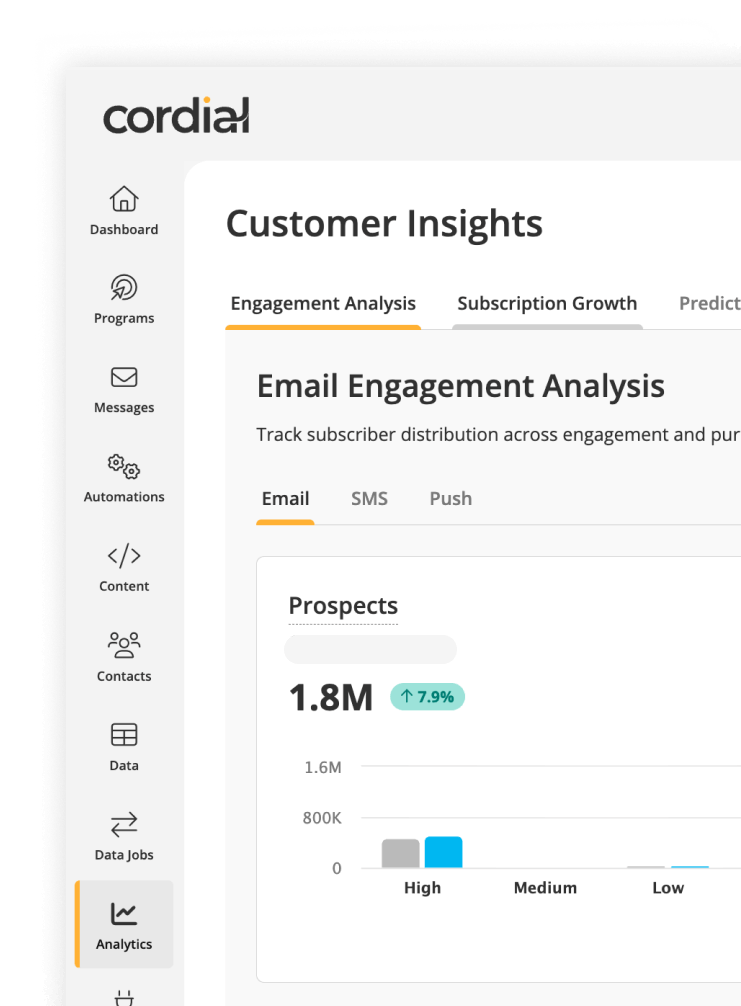
The machinery begins with a customer data platform. It brings together contact records, purchases, product information, and behavioral events. Marketers can build audiences from that material, update them as information arrives, and use them in automated journeys. Cordial also supports data transformations and connections to systems such as Snowflake. A warehouse full of records becomes more useful when the person planning a campaign can actually work with them.
Consider a hypothetical shopper who has saved a jacket. A useful message could depend on the jacket returning to stock, the shopper’s size being available, and whether they have already bought it. Getting the name right in the greeting is the easy part. The hard part is knowing whether there is still a reason to write.
Illustrative workflow, not a measured customer result.
Cordial competes in a busy neighborhood. Iterable, Braze, and Klaviyo all appear among its alternatives. Personalization alone cannot settle a buying decision. Cordial’s more concrete pitch is the combination of flexible data handling, messaging, and practical help putting both to work. Buyers should test that combination with their own awkward data and actual campaign requirements.
The discount you might not need
In January 2025, Cordial introduced Cordial Edge, AI models tailored to individual brands. The company describes models that consider both structured records and unstructured material, including text and imagery. Its stated objective is purchases. That choice matters: a person can be very willing to open an email and entirely unwilling to buy anything.
Two months later came Message Insights and Message Assistant. The first analyzes characteristics such as subject lines, imagery, and tone against message performance. The second brings recommendations into the editor. The intended working loop is straightforward: learn from previous messages while building the next one. Whether those recommendations help a particular brand is something to establish in its own program.
The most revealing addition may be Price Sensitivity, announced in June 2025. It uses past behavior to predict responsiveness to price. Cordial’s example separates a shopper who might need a coupon from one who might prefer a premium item at full price. Its wider prediction suite also includes customer value and per-contact frequency controls.
Here is the commercial tension in miniature. A coupon can help close an order. It can also surrender money the shopper was prepared to pay. Evaluating this kind of system means looking beyond the number of orders to the margin left afterward. A larger sales total is a useful observation; it is not the whole experiment.
The bill belongs in the story
Cordial operates as an enterprise subscription business. A useful historical cost example appears in the 2023 Forrester study commissioned by Cordial. For a composite business with $1 billion in annual revenue and one billion annual messages, it modeled first-year platform fees of $230,000 and volume fees of $398,000, before risk adjustments. That is $628,000. It is a modeled example, not a current price quote or Revolve’s bill.
The study also allowed for internal work, including 120 hours of training for each of eight primary users in the first year. Software that reduces campaign labor still takes effort to adopt. Forrester’s three-year model produced a 369% ROI; that result rests on the composite’s costs, benefits, and assumptions. It is a scenario to inspect, not an outcome to paste into next year’s budget.
A practical buying exercise follows: choose one valuable customer event and map every dependency between noticing it and sending a useful response. Then run a limited program with a suitable comparison group. Measure the commercial result and the operating effort. If the data is unreliable, the audience cannot be contacted, or a simple newsletter already does the job, this much machinery may have little to earn its keep.
A company called Cordial has obligations
Cordial began in 2014. Co-founders Jeremy Swift and Adam Gillespie had worked at BlueHornet, an earlier email software business. Gillespie’s biography also includes BandFarm, a service for helping musicians promote their work. There is a pleasing continuity there: the tools change, but finding an audience remains a problem.
Swift addressed the naming challenge in a sponsored 2021 theCUBE interview. The name creates an obligation customers can remember when something goes wrong.
“You can’t name your company Cordial and be a jerk.”
Jeremy Swift / theCUBE, 2021
The published working culture emphasizes clear communication, accountability, and direct feedback. Most employees work remotely; the company brings everyone together twice a year. Those are descriptions of its intended culture, rather than proof of every employee’s experience. They do, however, suggest that being cordial is supposed to allow disagreement.

The human side is also part of the product offering. Cordial’s services team handles onboarding, strategy, production work, deliverability, and custom solutions. That matters when the purchase replaces an established routine. Somebody must rebuild connections, teach the team, and deal with the campaign that refuses to behave.
The inbox is becoming an interface
Cordial raised a $50 million Series C in July 2022, led by NewSpring with ABS Capital participating. The company reported $85 million in total investment at that point. It said the money would support product development and international expansion. Funding bought capacity to pursue the plan; it was not evidence that every customer would succeed.
The international ambition became more tangible in April 2026, when Tapestry selected Cordial for enterprise email and SMS across North America, Europe, Japan, Australia, and New Zealand. That announcement concerned consolidating messaging across markets. It did not report a completed rollout or a revenue lift.
In June, Cordial opened its capabilities through MCP, CLI, and API interfaces, allowing outside AI agents and developer tools to use services such as audience logic, message generation, and send execution. The company also described Email Production and Data Intelligence agents operating within its controls. The direction is significant: marketers may increasingly reach the platform’s capabilities from somewhere other than its own screens.
August brought a Wunderkind integration that connects identity and shopping-intent signals to Cordial’s messaging. Cordial remains the record for subscription status, while Wunderkind applies suppression before triggering. Recognizing a visitor and deciding whether to contact them are separate steps in the announced design.
Across those changes, the old question survives. What happened that makes the next message worth receiving? A team evaluating Cordial can start there. Ask the software to follow a real customer event all the way to a useful response. The demonstration gets much more interesting once it has somewhere specific to go.
Keep the conversation going
Cordial · Request a demo · Developer tools · Company news