The most revealing thing about Mapp is that it was not dreamed up on a whiteboard by two founders with a fresh domain name. The modern company was assembled. In 2016, private-equity firm Marlin combined BlueHornet, an American email-marketing provider, with the marketing execution business it had bought from Teradata. The result inherited customers, software and two decades of institutional muscle. It also inherited the classic martech problem: plenty of capable parts do not automatically make a coherent machine.
Mapp has spent the years since trying to make those parts behave like one product. Its Marketing Cloud collects customer data, resolves profiles, studies journeys and launches messages across email, SMS, websites, apps and push notifications. In plain English, it is for the retailer that knows someone browsed raincoats on Tuesday, joined the loyalty program on Friday and ignored Saturday’s generic newsletter - but whose systems still treat those events as three unrelated people.
The Mapp loop
A company built in the order marketers complain
First came execution: lists, segments, messages and campaigns. Then came the harder question - did any of it work? Mapp answered in 2019 by acquiring Berlin-based Webtrekk, whose digital-analytics and customer-intelligence technology became Mapp Intelligence. The deal pulled campaign dashboards, journey analysis, product recommendations, scoring and real-time behavioral data closer to the send button.
That proximity is Mapp’s best argument against the crowded field of Salesforce, Adobe, Braze, Iterable, Bloomreach, Optimove and SAP Emarsys. Plenty of rivals can send an email or draw a dashboard. Mapp’s proposition is that the observation and the response should share the same plumbing. A marketer should be able to spot churn risk, form an audience and trigger the next journey without exporting a CSV, filing a ticket and hoping the customer has not moved on.
It is a pragmatic position. Mapp is not asking an enterprise to throw away Shopify, Magento, Salesforce, Segment or its loyalty platform. It publishes connectors and APIs, and its MACH Alliance membership advertises microservices, API-first design, cloud delivery and headless operation. The promise is not a pristine, single-vendor universe. It is a tolerable mixed household where customer data can still find the kitchen.
The dress knew more than the customer record
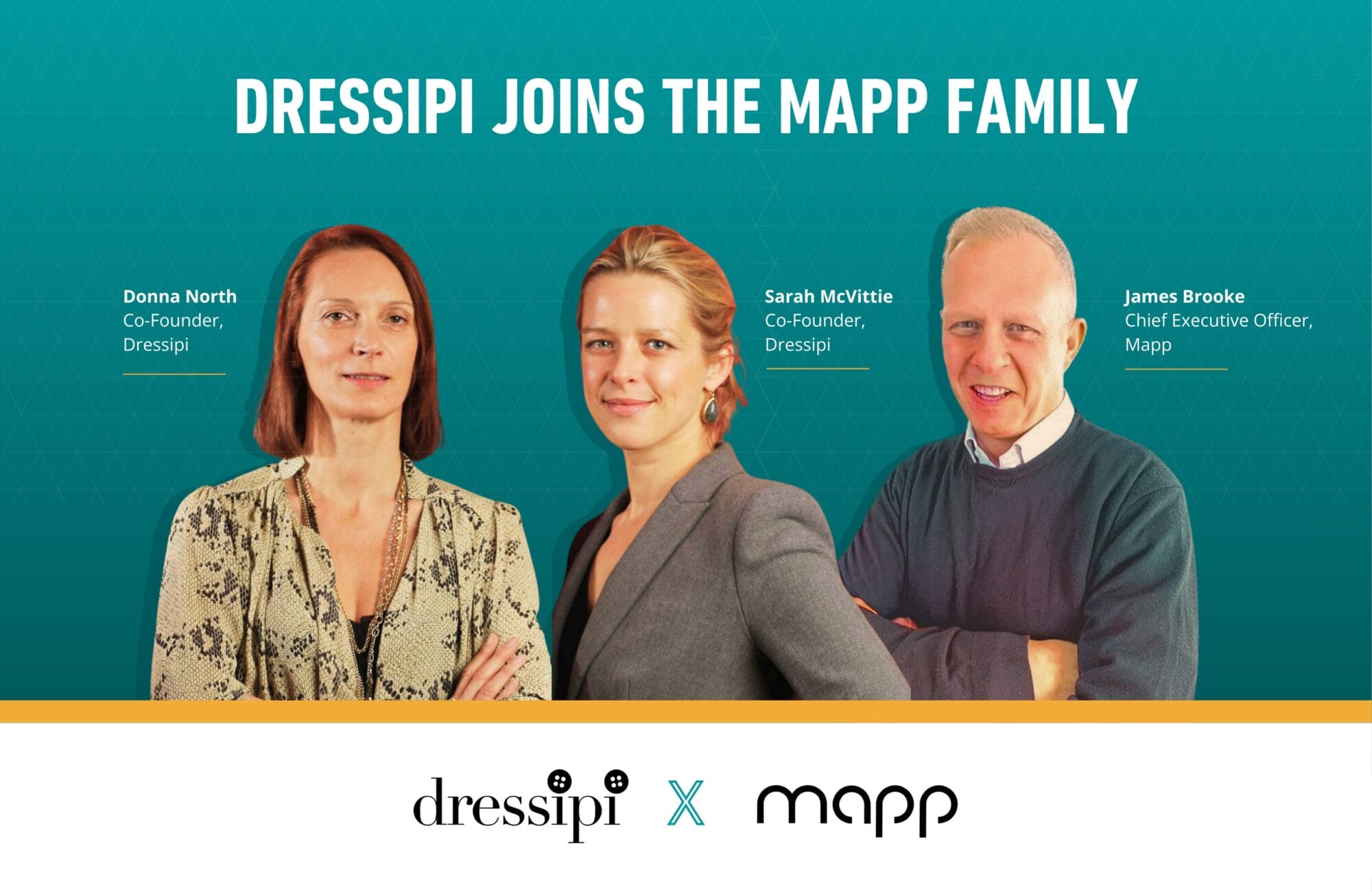
The next missing piece was unusually specific. In January 2025, days after James Brooke took over as chief executive, Mapp acquired Dressipi, a London fashion-intelligence company founded by Donna North and Sarah McVittie. Dressipi’s wager was that ordinary product recommendations are poor at fashion because the catalog data is poor. “Black midi dress” does not explain silhouette, occasion, fabric, compatibility or why a shopper rejected six similar-looking alternatives.
Now branded Mapp Fashion, the technology enriches merchandise with a taxonomy of roughly 26,000 attributes and uses fashion-trained models for similar items, outfits, personalization, demand forecasting and sizing. That specificity matters in a category where about one-third of inventory can be new each month and many shoppers purchase only once a year. There may be little history to learn from, so the model needs to understand the product itself.
“The team at Mapp Fashion really understands the nuances around the fashion domain.”John Hodge, Head of eCommerce, House of Bruar
House of Bruar offers the cleanest public test. The retailer A/B tested Mapp Fashion’s similar-item and personalized-outfit models against a generic algorithm and outfits assembled manually in-house. Mapp’s case study reports a 5 percent increase in revenue per visitor and a 2 percent reduction in returns. Country Road Group tested the technology at Witchery, reported 4 percent higher revenue per visitor against its incumbent provider and began rolling it out to sister brands. Those are vendor case studies, not universal laws, but the experimental design is copyable: isolate a placement, keep a control and measure margin-sensitive outcomes instead of applause for “personalization.”
The first failure is usually not the campaign
Mapp’s case studies repeat a less glamorous diagnosis: the data fails before the creative does. Professional Building Supplies had customer information split across brands and sources, making personalization and behavioral tracking difficult. Creed wanted to join signals from its website, stores, franchises and department-store concessions. The platform’s job in both cases began with integration and identity, not a clever subject line.
What changed minds was measurable movement after the pipes were connected. PBSL says personalized cross-sell, upsell and lifecycle work helped lift online eCRM revenue by 80 percent and email engagement by 225 percent. Creed reports a 32 percent year-over-year rise in email revenue, alongside stronger automated journeys and paid-audience performance. Again, these are selected customer results. The transferable lesson is narrower and more useful: agree on a baseline, unify only the sources required for a defined journey, and let one controlled use case earn the next integration.
Enterprise software with the price tag left on
Mapp is refreshingly direct about who should buy it. Its published U.S. price starts at $3,050 a month for Essential, which includes email and SMS automation, a customer-data platform, web personalization, segmentation and recommendations. Professional starts at $3,600 a month and adds web and mobile analytics, the fuller AI assistant, journey analysis, RFM modeling, forecasting and anomaly detection. Custom adds channels and data flexibility. Contracts run for at least 12 months.
The final price depends mainly on the size of the contactable database and average unique monthly visitors, with implementation scope settled before signature. This is not Mailchimp with a smarter hat. It is an enterprise operating system for teams that have several data sources, several channels, enough traffic to make segmentation meaningful and people capable of running the machinery.
The likely buyer is a CRM director who has already felt the ceiling of a simpler email service, or an ecommerce leader tired of reconciling campaign reports with a separate analytics truth. For that team, the economic case is partly subtraction: fewer handoffs, fewer duplicated audiences and less time translating a useful observation into an executable segment. Mapp’s commissioned Forrester Consulting study modeled a 540 percent three-year return for a composite customer, with $4.2 million in benefits, better engagement and higher marketer productivity. It is a modeled case sponsored by Mapp, so it belongs in a business case as a hypothesis, not a promise. The number worth copying is the one a buyer establishes before implementation: hours spent moving data, campaigns delayed, customers reachable and conversions lost in the gap.
That also defines the boundary. A small business sending a weekly newsletter would be buying an aircraft carrier to cross a pond. A larger company with rotten identifiers, uncertain consent or no owner for customer journeys will merely centralize its confusion. AI cannot rescue missing product attributes, and automation scales bad decisions as efficiently as good ones. Mapp works when a company has useful first-party signals, a testable commercial problem and the operational patience to integrate them.
What a marketer can steal without buying Mapp
Mapp’s own corporate history supplies the most practical playbook. It did not attempt to invent every capability at once. It added analytics when execution lacked feedback, then vertical expertise when generic intelligence hit a ceiling. In 2025, it raised $13 million from O’Connor Capital Solutions within UBS Asset Management to deepen AI and automation and expand in key markets. The capital followed a specific product thesis, not a vague desire to sprinkle AI over the homepage.
The copyable version
- Choose one journey where disconnected data causes a visible leak - churn, returns, abandoned carts or irrelevant recommendations.
- Connect only the signals needed to understand and act on that journey.
- Run the new model against the incumbent process, not against wishful thinking.
- Measure revenue, conversion, returns or labor saved. Open rates are evidence only when they lead somewhere.
- Expand after the control group loses, and keep consent and identity quality as product requirements.
Mapp says more than 700 companies use its products, among them PizzaExpress, Ella’s Kitchen, Farrow & Ball, Furla and Diageo. Its careers site describes a hybrid, internationally distributed workforce with flexible vacation, development programs and four paid volunteering days. LinkedIn lists roughly 415 employees, while company pages use lower figures, a reminder that headcounts move faster than corporate copy.
The larger market question is whether an independent vendor can stay broad enough to replace point solutions while remaining focused enough to beat them. Mapp’s answer is to make the connective tissue the product and then go deep where generic tools stumble. Fashion is its most visible proof. The software does not merely ask who the customer is. Increasingly, it asks what is hanging on the rail, why it might appeal and whether sending that recommendation now will help the retailer sell it without a markdown or a return.
Keep mapping
Explore Mapp’s product, documentation, company updates and public developer work.