Acoustic has the sort of origin story that makes a software buyer reach for the architecture diagram. In 2019, private-equity firm Centerbridge Partners bought a collection of IBM marketing and commerce products and turned them into a standalone company. The pieces included campaign automation, behavioral analytics, content, personalization, data exchange and retail pricing. Acoustic arrived with more than 3,500 brand customers, seasoned code and a name chosen to suggest listening. It also arrived with the reason corporate carve-outs are difficult: a portfolio is not automatically a product.
Seven years later, the company’s pitch has narrowed. Acoustic Connect, its flagship platform, puts audience data, real-time behavior, product intelligence, campaign analytics and messaging in one place. Email, SMS, WhatsApp and mobile push share the same journey. In August 2026, Acoustic AI added a more ambitious layer: software that continuously watches first-party behavior, notices a commercial opportunity, explains the evidence and helps build a response before the customer’s interest cools.
That makes Acoustic a useful case study in subtraction. The company is not trying to invent another marketing channel. It is trying to remove the handoffs between systems that observe, systems that decide and systems that send. For a lifecycle marketer exporting lists before lunch and begging IT for a segment after lunch, that can sound less like innovation than basic workplace hygiene.
The first thing that failed was priority
IBM had spent years assembling a marketing cloud, including Silverpop for campaign automation and Tealeaf for digital-experience analytics. But the audience inside IBM was the problem. The company’s center of gravity sat with chief information and technology officers, while a marketing suite needs obsessive attention to the chief marketing officer. Mark Simpson, Acoustic’s first CEO, said the quiet part plainly at launch: serving the marketing department would now be the whole job.
The transaction was not free. IBM reported receiving a net cash payment of $240 million when the U.S. deal closed in June 2019 and expected another $150 million within 36 months. Those figures describe cash flows around a global divestiture, not a tidy sticker price. The new company then had to separate systems, support customers and make products acquired across different eras behave as a coherent platform. In 2022, Francisco Partners supplied an undisclosed strategic growth investment while Centerbridge remained the primary owner.
What changed Acoustic’s mind about the product was the same complaint its customers kept making about their own stacks: too many seams. The original 2019 catalog listed nine named offerings. Today’s public site leads with one flagship, Acoustic Connect, while established products such as Acoustic Campaign and Tealeaf remain available. The company went from presenting a shelf to presenting a loop.
“Only by listening carefully to consumers can marketers make themselves heard.”Mark Simpson, Acoustic’s founding CEO02 / The new loop
One product tries to eat the relay race
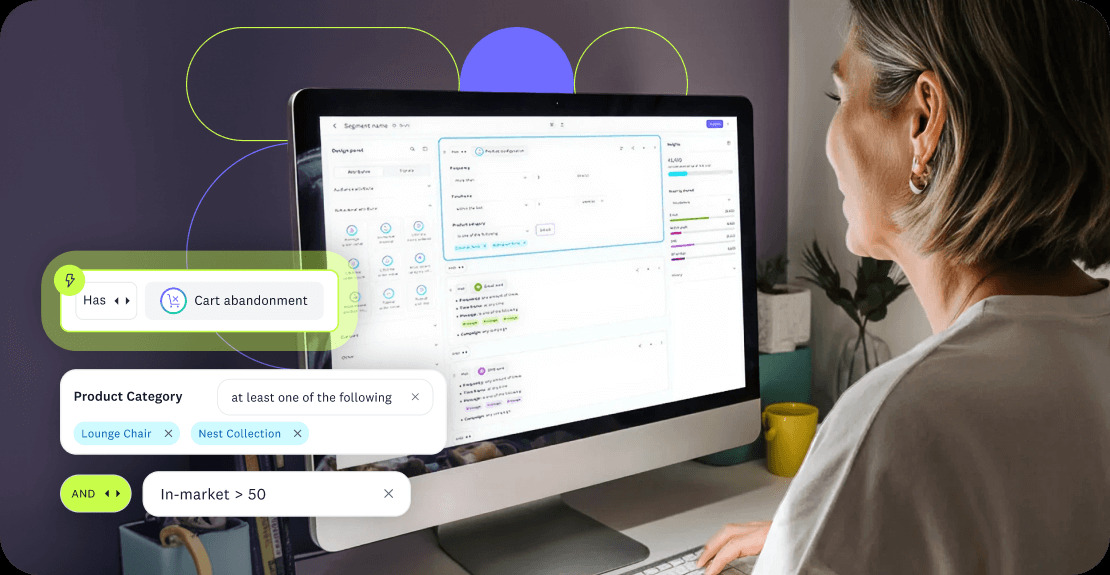
The loop begins with owned behavior: a product view, search, cart addition, order, message response, preference or sign of fatigue. Acoustic Connect attaches those signals to a customer profile and product catalog. A marketer can build a segment without SQL, place it into a journey and deliver a message across several channels. The analytics come back into the same environment. The notable claim is not that Acoustic can send an email. It is that the observation that triggered the email does not need to travel through a spreadsheet, a separate CDP and an external reporting tool first.
Acoustic’s native Shopify, WooCommerce and BigCommerce integrations, released in January 2026, make that argument tangible for retailers. Catalogs, variants, inventory, orders and storefront behavior synchronize in both directions. The platform’s core data layer runs on Snowflake, and its professional-services team handles migrations, deliverability, advanced configuration and campaign work. This is enterprise SaaS with service attached, not a credit-card signup and an afternoon tutorial.
Nor is the price sitting on a menu. Acoustic offers Professional, Premium and Ultimate plans, but publishes no dollar amounts. The unusual part is what it says it meters: messaging volume, data depth and personalization ambition, not the number of people in the audience. That removes the familiar tax on a growing database, though buyers still need a sales conversation to learn the actual bill.
03 / The receiptsThe best proof is operational, not magical
Vacation Innovations offers the cleanest account of what broke first at a customer. Its lean team managed more than 12 travel brands on Salesforce Marketing Cloud. Basic segmentation and list changes required a full-time administrator or IT help. Renewal fees climbed, and one business line needed an extra CRM license merely to expose its data. The company concluded that the cost outweighed the value, then spent six months moving to Acoustic without stopping normal operations.
The reported results are unusually specific: a 75 percent reduction in customer-engagement platform total cost of ownership, a 98 percent reduction in time spent creating or updating contact lists, and more than 20 journeys launched. The migration worked because it treated independence as the product. Marketers could change segments and dashboards themselves. Acoustic’s team also solved custom integrations rather than routing every awkward request to another consultancy.
Other customer examples show where the machine earns its keep. The Australian Ballet reported a 4.5 percent lift in email revenue, a 10.4 percent lift in opens and 25 percent fewer unsubscribes. Secure Medical reported 16.4 percent annual growth in open rates and more than 200 percent growth in email opt-ins over three years. IDP Connect, working with services partner Purple Square, said web sessions rose 23 percent after improving templates and campaign operations. These are company case studies, not controlled experiments. Still, they point to a prosaic advantage: fewer queues, faster iteration and more relevant messages.
04 / The AI turnAcoustic AI does not wait for the clever prompt
Most marketing copilots begin with a blank box and an implicit test: ask a good question. Acoustic AI is designed to look first. Its In-Market Index evaluates 27 behavioral attributes for signs that customer interest is building, changing or fading. If attention around a product rises while conversion stalls, the system can quantify the opportunity, recommend a campaign and explain its reasoning. A marketer can then ask questions in plain language or have the software assemble a segment, message or journey, including checks for opt-out and compliance language.
This is a sensible extension of Acoustic’s architecture. An agent that only drafts copy is decoration. An agent that can see live behavior, understand the catalog and work inside the campaign builder may remove actual work. The control boundary matters: Acoustic says the marketer remains responsible for what launches. That is reassuring, but it also means the customer needs clean data, permissions, consent records and a team capable of judging the recommendation. Agentic software cannot rescue a rotten identity model.
| Choice | What it optimizes | What can go wrong |
|---|---|---|
| Point-tool stack | Best-of-breed depth and local team preference | Data lag, duplicate profiles, repeated logic and vendor handoffs |
| Acoustic Connect | One loop from behavior to approved multichannel action | Migration weight, enterprise buying process and dependence on platform breadth |
| Simple ESP | Fast, inexpensive scheduled email | Limited behavioral context and weak cross-channel coordination |
Where Acoustic fits - and where it is too much
Acoustic sits in the crowded customer-engagement market beside Salesforce Marketing Cloud, Adobe Campaign and Journey Optimizer, Oracle Responsys, Braze, Iterable, Insider, MoEngage, Netcore and SAP Emarsys. Its differentiator is the tight coupling of behavior analytics, product intelligence and execution, supported by technology with Silverpop and Tealeaf ancestry. Its commercial target is a B2C lifecycle team in retail, travel, entertainment or financial services that sends at scale and can put first-party behavior to work.
It will not be the right answer for everyone. A small business sending one newsletter a week does not need an intent engine. A B2B sales operation centered on account scoring may prefer a platform designed for long, salesperson-led funnels. A company with thin behavioral data will have little for the system to interpret. And an organization deeply standardized on Adobe or Salesforce may find that the cost and politics of migration exceed the savings from consolidation. Acoustic works when tool sprawl is already expensive, signals decay quickly and the marketing team is trusted to act.
The customer count deserves context too. Acoustic launched with more than 3,500 brands and now reports more than 1,800 customers. That decline cannot be diagnosed from public data alone, but it undercuts any lazy growth narrative. The more defensible story is concentration: a broad inherited portfolio has been reorganized around a smaller customer base and one flagship platform. For a private company, execution will show up in retention and migrations long before it shows up in public financial statements.
06 / The useful copySteal the operating idea, not the software diagram
- Measure the handoff. Pick one valuable customer signal and time how long it takes to become a live response. The delay is a better buying brief than a feature wishlist.
- Launch before the migration is over. Acoustic says customers can run first campaigns while the broader transition continues. Early proof lowers organizational fear and exposes bad assumptions.
- Give the operator the controls. If every segment change requires SQL, an IT ticket or a vendor, automation has merely moved the bottleneck.
- Price the whole workflow. Count administrators, consultants, duplicate licenses and hours spent reconciling reports, not just the platform subscription.
- Keep approval human. Let AI notice and assemble, but make a named marketer accountable for the audience, claim, consent and send.
Acoustic’s wager is refreshingly concrete: customer intent has a half-life. Every export, dashboard switch and queue burns some of it. The company may have inherited the very complexity it now argues against, but that is also why it understands the problem. Its future depends on whether it can finish the unification work faster than bigger suites improve and newer platforms move upmarket. The lesson for a buyer is simpler. Do not purchase “real time” as an adjective. Find the moment your current stack misses, calculate what the miss costs and ask the new system to catch it in front of you.