In 2021, Dataships launched a Privacy Centre. Its founders expected a crowd. The crowd declined to appear. This was awkward for a young company built on the conviction that privacy compliance mattered. It was also useful. Michael Storan and Ryan McErlane began interviewing early users, and the answers pointed away from the privacy dashboard they had made. Merchants kept asking about the same thing: could they use the customer data they already had to send marketing? The answer, McErlane recalled, was maddeningly conditional: “It depends on how the data was collected.”
That sentence became the business. If the right to contact someone depends on the moment their data was collected, then the moment deserves rather more attention than a default checkbox usually receives. Dataships moved toward marketing consent at ecommerce checkout. Its current product asks for permission, decides which rules apply, keeps a record of the answer and sends marketable contacts into the merchant's existing marketing system.
The short version
- The jobTurn paying shoppers into contacts a merchant can legitimately market to.
- The methodAdapt the checkout request by location, channel and prior consent; log the result.
- The wagerMore usable buyers in the list can mean more repeat purchases, without buying more traffic.
A permission slip with a P&L
Retailers have spent years making checkout frictionless. They may spend far less time on the sentence beside the marketing checkbox. Yet a sale and permission to market are different assets. The first brings in revenue today. The second can make another sale possible next month. A customer may buy a chair, a protein bar or a tin of tea, then leave a brand with an email address it cannot freely use for a campaign.
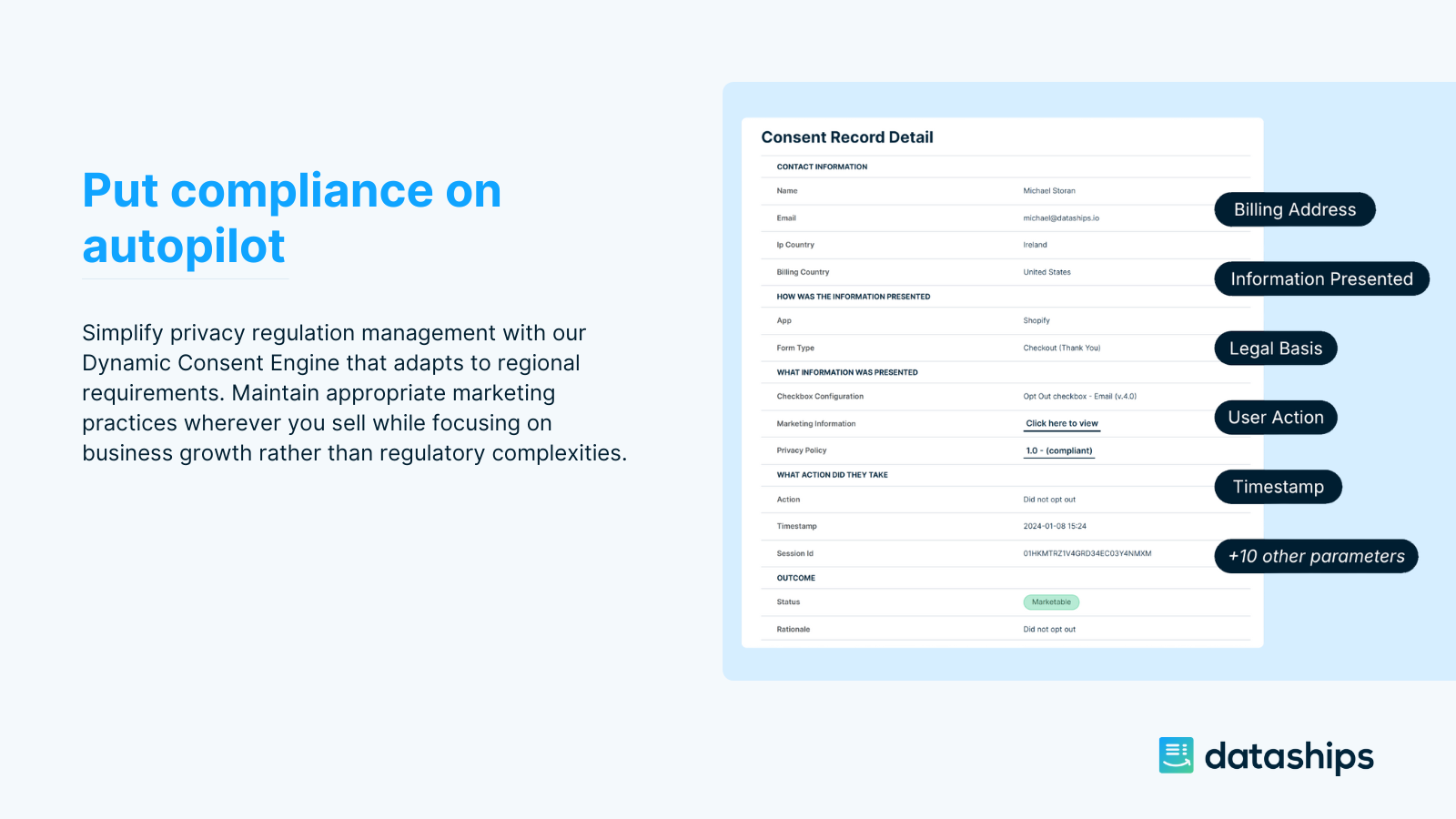
Dataships sits in that narrow gap. Its widget replaces a static Shopify consent request with one adjusted to the shopper's jurisdiction, the communication channel and any consent already on file. It records what wording appeared, what the shopper did, when and where it happened, and the resulting status. It then syncs eligible contacts into platforms such as Klaviyo. The company is not the email sender or the campaign designer. It sells the permission layer that comes before either.
Four moves at checkout
The line between a customer record and a marketing list is an actual decision, not a decorative checkbox.
The distinction is most visible across borders. A single retailer can sell in places with different rules for email, SMS and now WhatsApp. Dataships' own explanation describes several collection methods, from explicit opt-in and double opt-in to legally available opt-out approaches in particular sale contexts. Its software chooses a configuration and preserves evidence of the choice. That is why the company can pitch both list growth and compliance in the same breath, even though those words often sound like enemies at a marketing meeting.
The customer interviews that changed the product
The founders' first assumption was reasonable: businesses faced a growing thicket of privacy rules and needed help. Their Privacy Centre offered that help. But an important customer problem is not automatically a product customers rush to buy. McErlane's account of the disappointing launch is unusually specific. Users asked whether an old Mailchimp list could be emailed, whether addresses could be uploaded to Facebook, and whether a shipping phone number could be used for SMS. Each question came back to collection context.
The pivot was to move upstream. Rather than make merchants reconstruct permission from an old database, Dataships could help them collect it properly as purchases happened. The company still offers privacy tools, including policy configuration and data subject request handling. Its center of gravity, however, is the checkout moment and the revenue that may follow. Storan and McErlane, whose earlier work included fantasy rugby, had found that the dullest square on a store page could be the most consequential one.
“It depends on how the data was collected.”Ryan McErlane, recalling the question behind the pivot
What the numbers can, and cannot, say
Dataships' published customer studies offer concrete examples. IQBAR, a nutrition brand, reports that email opt-ins rose from 60% to 96% and SMS opt-ins from 0.36% to 6%. Its SMS change involved moving verification into checkout instead of waiting for a later “Reply Y” message. Over 12 months, the case study counts 19,128 new subscribers and 6,286 repeat purchases from them. Denver Modern, a furniture retailer, reports email consent moving from 72% to 93% and SMS from 0.36% to 12%.
Numi Tea offers the sharper experiment: its case study says a control checkout produced a 2.4% email consent rate, versus 88.8% with Dataships. That is a comparison of two checkout treatments, and the size of the gap also tells us something about how little the earlier setup captured. These are vendor-published customer results, not a universal forecast. A merchant's starting configuration, geography, order volume and ability to run useful retention campaigns will decide how much an extra contact is worth.
This is where Dataships has a persuasive sales device: it offers an A/B test against the merchant's existing checkout, then shows the lift in marketable contacts and models downstream revenue. A prospective buyer can copy that discipline without buying the software: measure the current opt-in rate, test a changed consent experience within the law, and track whether newly reachable customers actually return. Count subscribers, certainly. Count purchases too.
A narrow product in a crowded stack
Shopify offers native consent controls. A capable team can write its own checkout logic. Broader privacy platforms handle consent in other contexts. Dataships charges for a focused combination: regional decision rules at the point of purchase, records that explain each outcome, links into the marketing stack and experiments that expose the commercial effect. That focus is its strength and its limitation. A store with one market, one channel and few orders has a smaller problem to solve. A brand selling across regions with email, SMS and WhatsApp has considerably more moving parts.
The Shopify App Store listed plans beginning at $440 a month in September 2026, rising through $880, $1,500 and $1,750 tiers with differing record, market and channel limits. There is a five-day trial. The company also lists a Salesforce B2C Commerce integration with a separate starting platform fee. Those are meaningful costs for a small merchant. They make the A/B test a necessity, not theater: incremental repeat margin has to exceed the subscription and the work of using the larger list well.
The purchase decision, in one line
Extra consent has value only when a merchant can legally use it, can send something customers want, and earns enough incremental margin to cover the tool.
The company says more than 600 ecommerce brands use its platform. It raised a $7 million Series A in January 2025 led by Osage Venture Partners, with Lavrock Ventures and Urban Innovation Fund taking part. Since then it has added integrations and expanded beyond email and SMS. In July 2026 it introduced separate WhatsApp consent collection for Shopify Plus merchants using Klaviyo. The separate request matters: permission for one channel is not a free pass to another.
Dataships' story is appealing because the pivot did not require the founders to abandon privacy. It required them to notice when privacy became urgent to the buyer. The rulebook had been there all along. The merchant's question was more immediate: after this customer pays, may we speak again? A small square at checkout now carries the answer, and Dataships has built a company around taking that square seriously.